
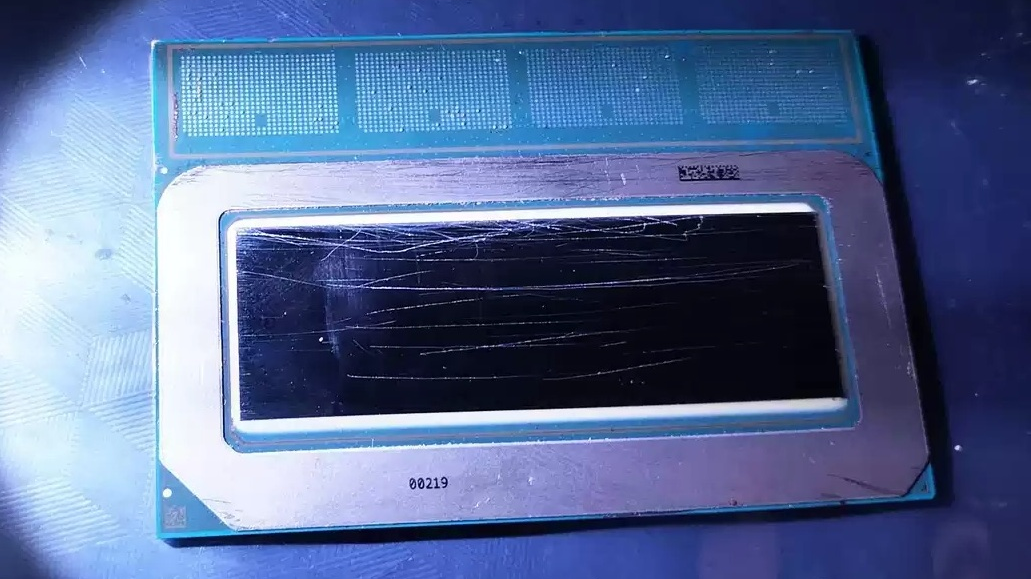
Intel's upcoming Razor Lake AX processor has surfaced online, revealing a massive BGA package with 4 dedicated memory sites alongside its main silicon area. The next generation SoC is expected to compete directly with AMD's Halo processors and NVIDIA's RTX Spark platform, targeting premium laptops, compact gaming PCs, professional workstations, and local AI applications.
The prototype images, shared by hardware leaker HXL on X, originated from a listing on the Chinese secondhand marketplace Xianyu. The sample reportedly measures 37.5 x 56.5 mm and utilizes a BGA 4326 package originally associated with Nova Lake AX before Intel reportedly transferred its development to the Razor Lake family.
RZL-AX Die https://t.co/h7rKjW1jxS https://t.co/1zc7GdxClq
— HXL (@9550pro) November 26, 2026
Although the central silicon area appears to feature a single large die, the final processor is expected to utilize a modular architecture incorporating separate compute, graphics, I/O, and SoC tiles. The photographed component could be a thermal or mechanical testing sample rather than functional silicon, particularly given its physical condition and unusually large dimensions.
The most significant discovery is the presence of 4 memory sites, reinforcing earlier reports that Intel intends to reintroduce memory integration directly on the processor package. Current industry reports indicate memory configurations ranging from 32 GB to 128 GB, while capacities of up to 192 GB could theoretically be achieved using higher density memory modules.
Intel reportedly intends to allow OEM and ODM partners to install the memory during manufacturing rather than supplying processors with predetermined memory capacities, providing manufacturers with greater configuration flexibility.
| Specifications | Intel Razor Lake AX |
|---|---|
| Product Segment | Premium mobile and Halo class SoC |
| Package | BGA 4326 |
| Package Dimensions | 37.5 x 56.5 mm, estimated |
| CPU Architecture | Griffin Cove and Golden Eagle reportedly associated with Razor Lake |
| Graphics Architecture | Intel Xe3P, reported |
| Integrated Graphics | Up to 32 Xe Cores, rumored |
| Memory Technology | LPDDR5X expected, LPDDR6 unconfirmed |
| Memory Sites | 4 |
| Memory Interface | 256 bit, rumored |
| Reported Memory Capacity | 32 GB to 128 GB |
| Potential Maximum Capacity | 192 GB, theoretical |
| AI Performance Target | 700 TOPS |
| Target Launch | 2028 |
Intel executive Cho Min Sung previously outlined the company's Razor Lake AX roadmap during a semiconductor robotics conference in Seoul, targeting approximately 700 TOPS of AI processing performance in 2028. This represents approximately 3.89x the 180 TOPS platform performance associated with Panther Lake.
Combined with earlier reports of Razor Lake AX featuring up to 32 Xe Cores, the platform could significantly strengthen Intel's position in integrated graphics and local AI computing. However, its final specifications, power consumption, memory capacities, and retail availability remain unconfirmed.
Razor Lake AX could become one of Intel's most significant developments in integrated computing, particularly for compact gaming systems and affordable local AI workstations. A powerful integrated GPU with access to 128 GB or potentially more shared memory could enable consumers to run larger AI models without purchasing expensive professional graphics cards.
However, integrating memory directly into the processor package also eliminates conventional memory upgradeability. While this approach offers advantages in bandwidth, power efficiency, and motherboard space, manufacturers must avoid excessive pricing premiums for higher memory configurations.
Intel should prioritize accessible pricing, comprehensive graphics driver support, and substantial memory capacities to ensure Razor Lake AX becomes a competitive alternative to AMD Halo and NVIDIA RTX Spark rather than another restrictive premium computing platform.
Would you consider an Intel Razor Lake AX system with 128 GB or 192 GB of integrated memory for gaming and local AI, or would the lack of memory upgradeability discourage you?
