
Intel Launches Core Ultra 200HX Plus for Gaming Laptops With Higher Fabric Speeds and New Optimization Features

Intel has officially launched its new Core Ultra 200HX Plus mobile processor family, expanding the Arrow Lake HX lineup with 2 refreshed chips aimed at gaming laptops, creator systems, and mobile workstations. The company says the new series introduces the Core Ultra 9 290HX Plus and Core Ultra 7 270HX Plus, with the biggest changes centered on higher die to die frequency, support for the new Intel Binary Optimization Tool, and targeted real world performance gains on the existing platform rather than a full architectural reset.

The Processors Core Ultra 9 290HX Plus keeps the same 24 core configuration as the 285HX, with 8 Performance cores and 16 Efficient cores, a 5.5 GHz max turbo frequency, 36 MB Intel Smart Cache, 40 MB total L2 cache, and a 160 W maximum turbo power. Intel’s specification page also lists 4 Xe cores on the integrated graphics running up to 2.0 GHz, alongside 36 total platform TOPS, split across CPU, GPU, and NPU capabilities.
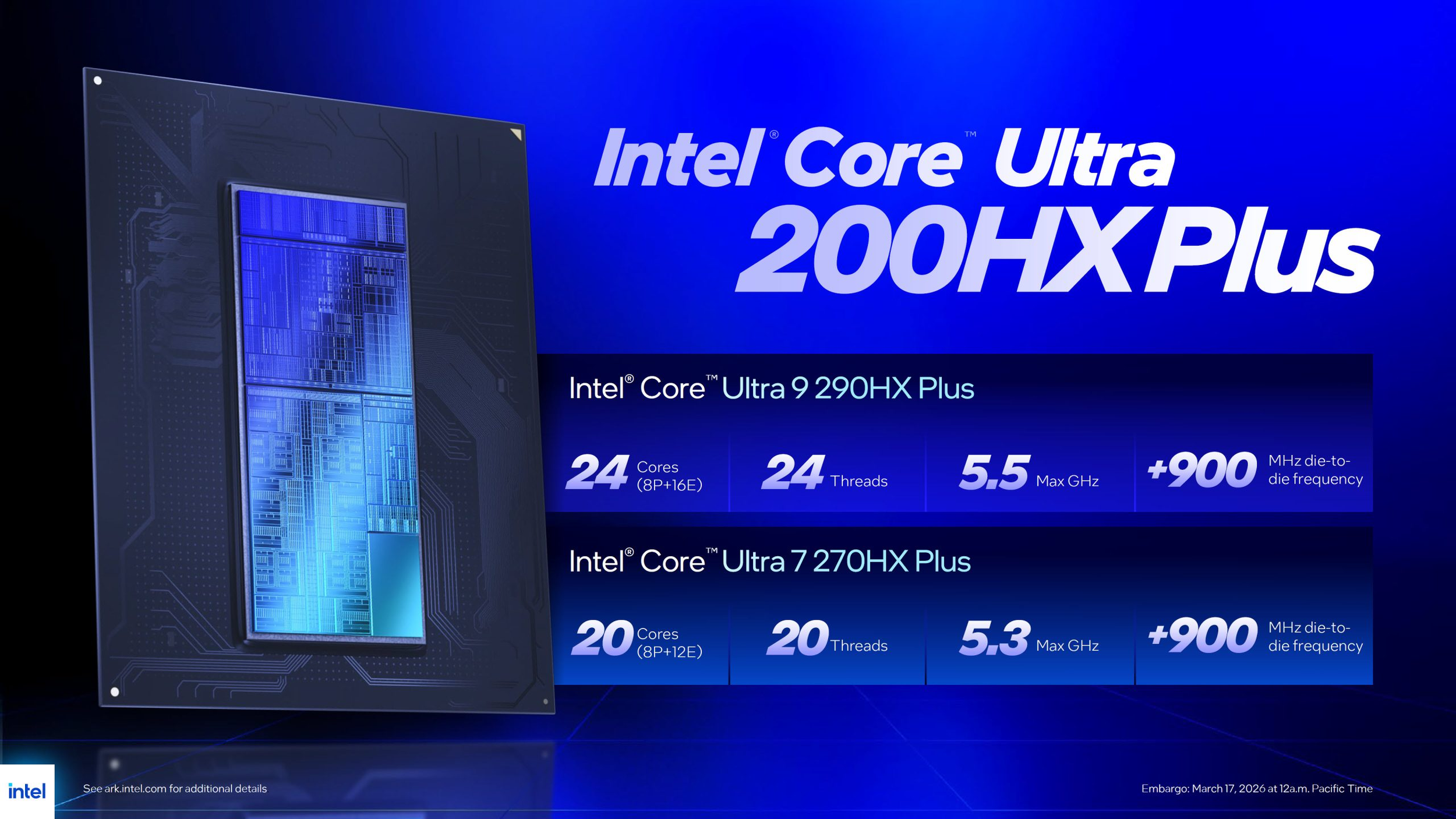
The Core Ultra 7 270HX Plus follows a similar strategy, coming in with 20 cores made up of 8 Performance cores and 12 Efficient cores, a 5.3 GHz max turbo frequency, 30 MB Intel Smart Cache, 36 MB total L2 cache, and the same 160 W maximum turbo power ceiling. Its integrated graphics also feature 4 Xe cores, though clocked slightly lower at 1.9 GHz, and Intel lists the chip at 33 total platform TOPS.
What Intel is really selling here is not a core count jump, but a platform refinement. The company says the new Plus chips raise die to die frequency by up to 900 MHz versus the comparable non Plus parts, pushing the CPU and memory controller link to 3.0 GHz. Intel argues that this reduces latency and improves gaming responsiveness, which helps explain why this refresh is being framed more around tuning and efficiency inside the same platform than around raw headline specs alone.
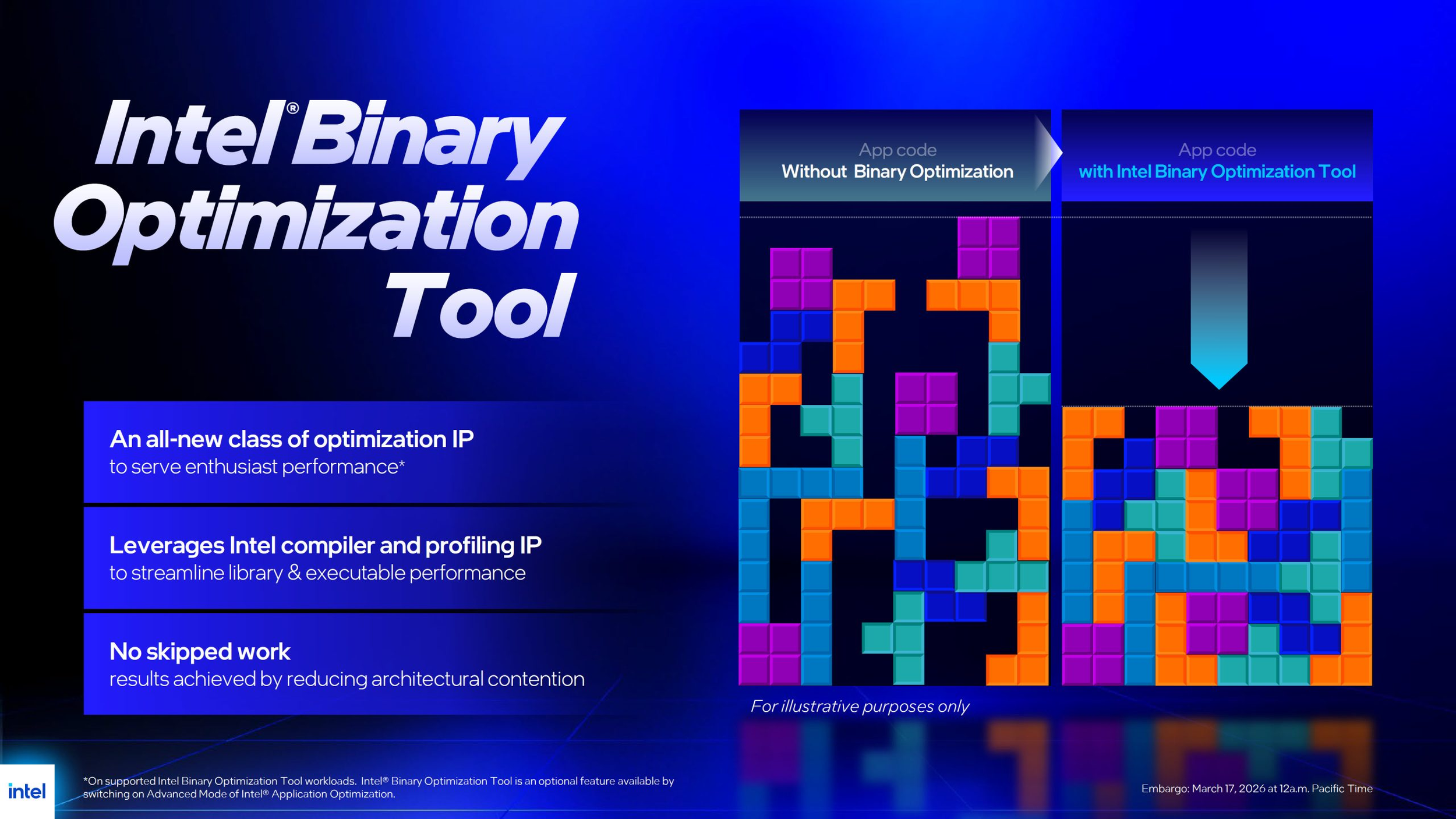
Intel is also introducing the Intel Binary Optimization Tool, which it describes as a new optimization capability that can improve native performance in select games. The company positions it as part of a longer term enthusiast roadmap, using Intel compiler and profiling experience to improve instructions per cycle and workload behavior, even when software was not originally tuned around this exact architecture. That could make it one of the more interesting parts of the launch, especially if support broadens across more games and creator applications over time.
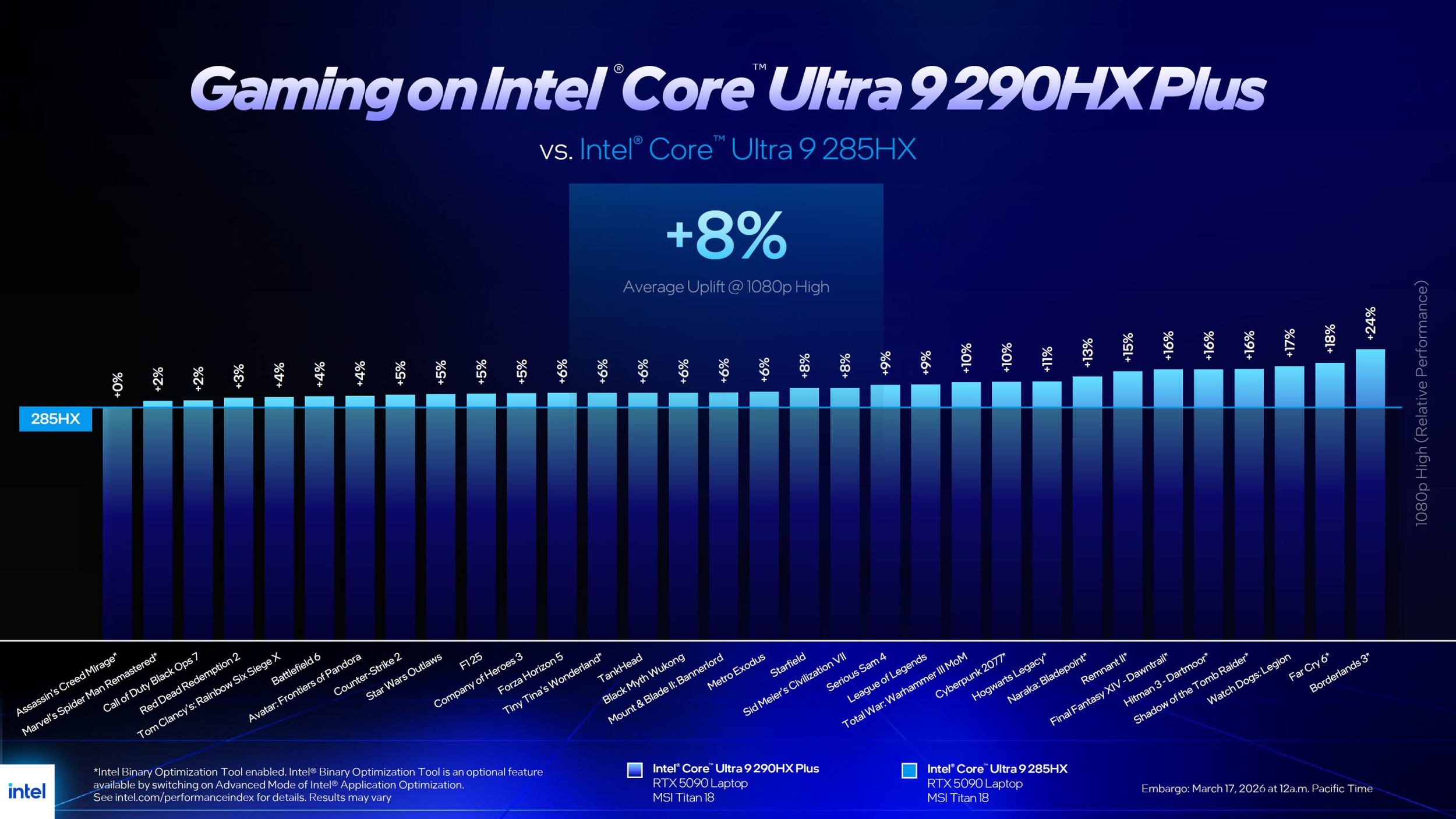
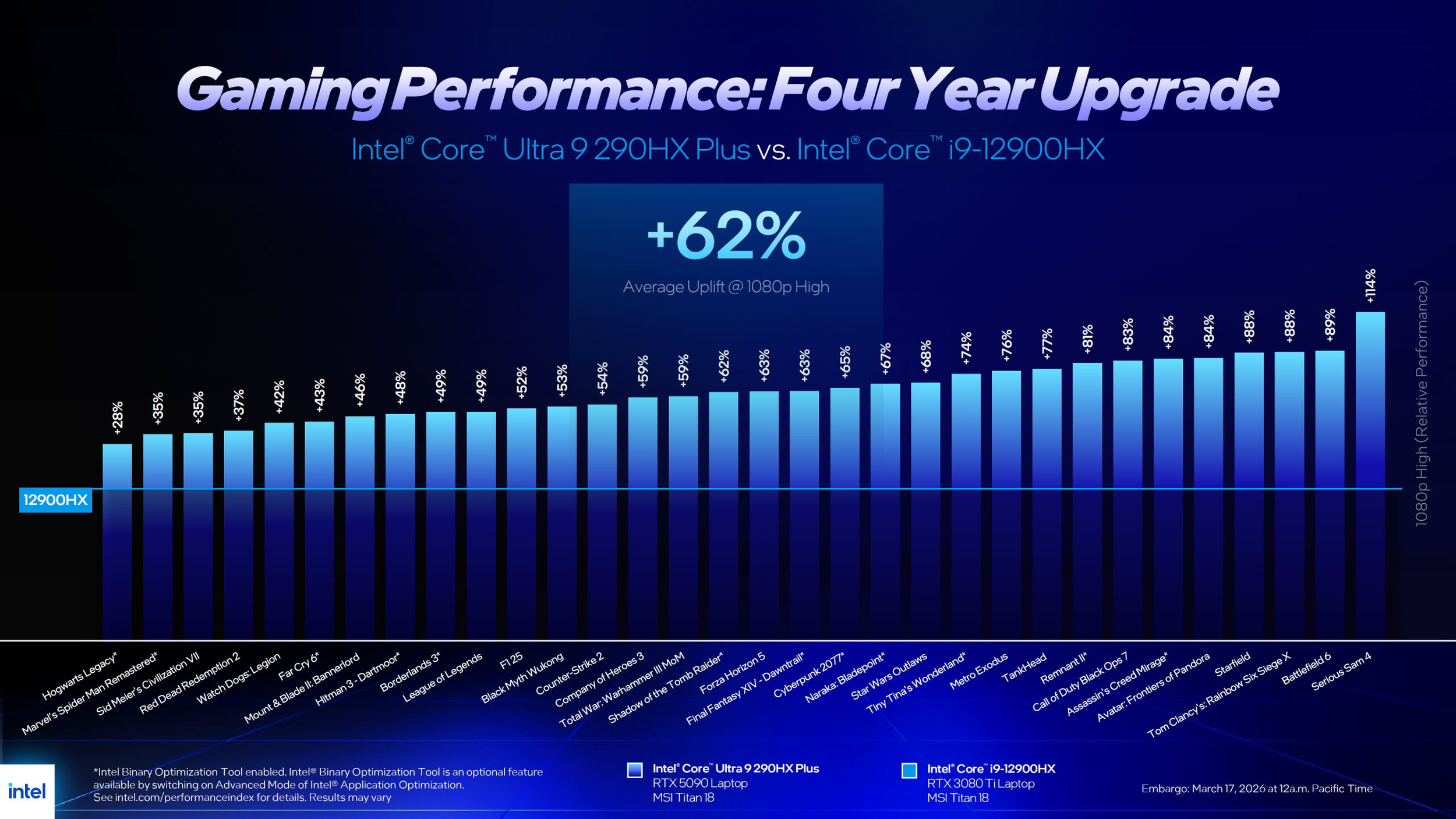
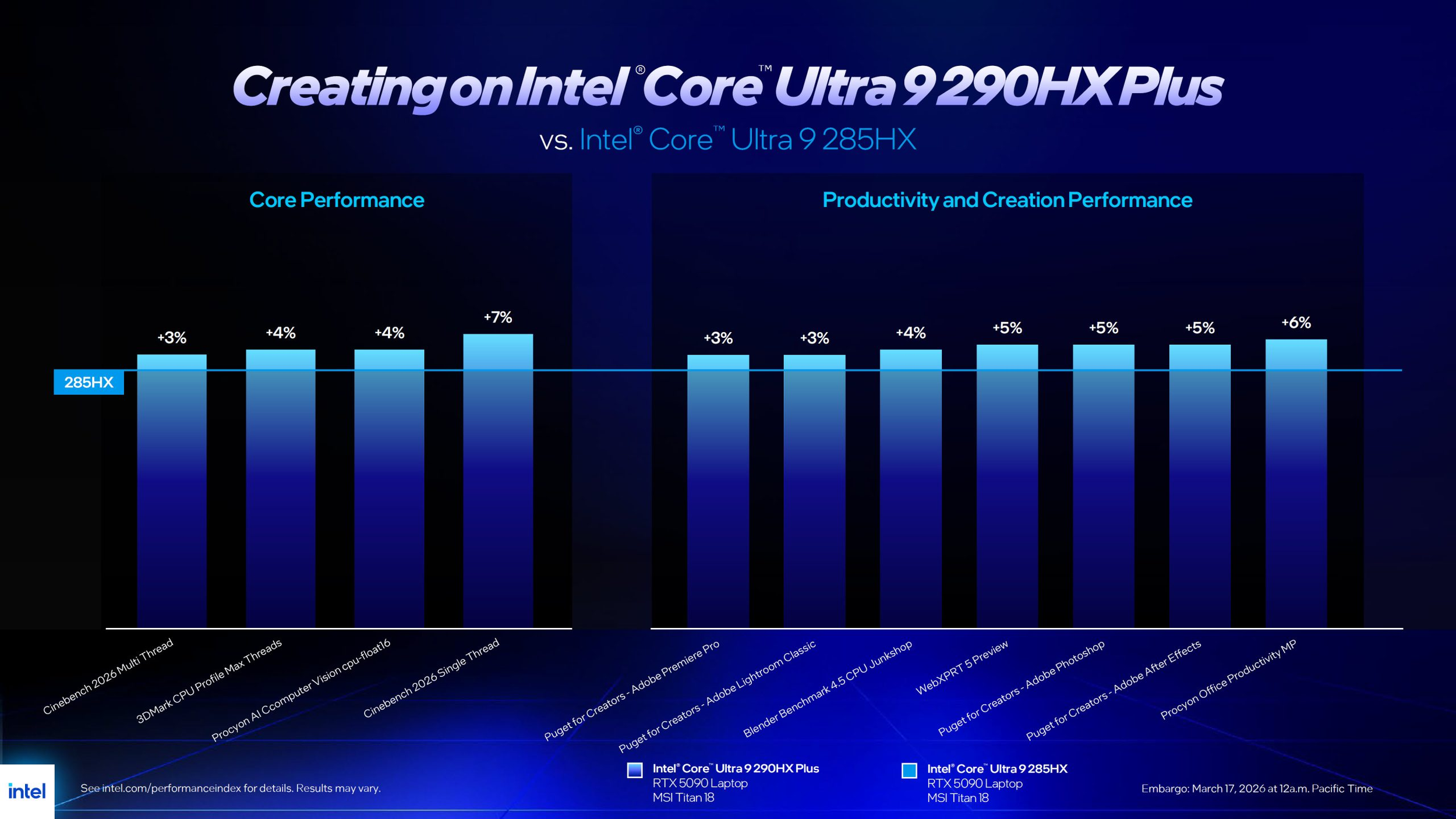
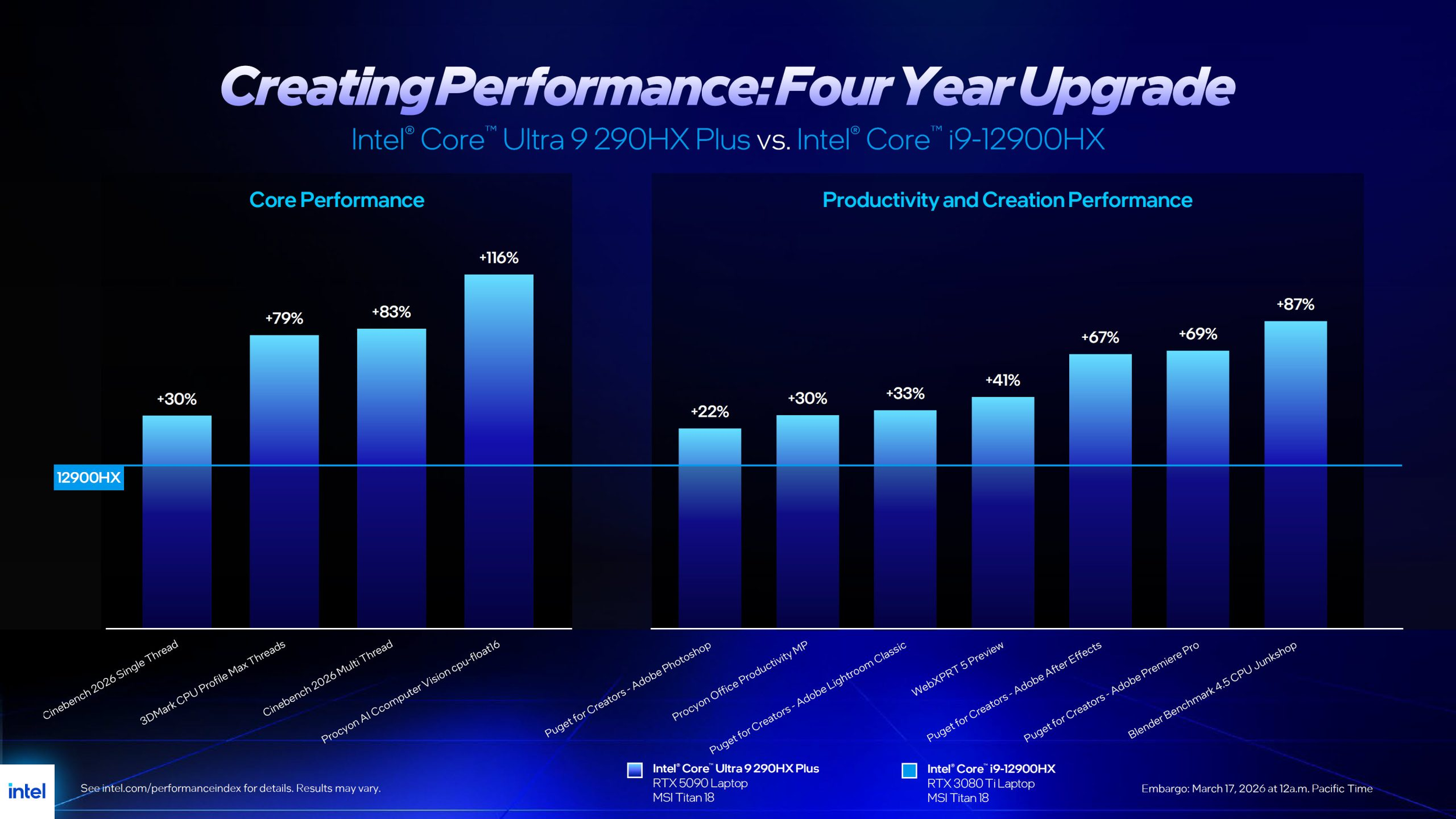
On performance, Intel says the Core Ultra 9 290HX Plus can deliver up to 8% faster gaming performance and up to 7% faster single thread performance versus the Core Ultra 9 285HX in its own testing. Intel also claims upgrades from older platforms can be much larger, with up to 62% faster gaming performance and up to 30% faster single thread performance compared with the Core i9 12900HX, though those types of generational comparisons naturally depend heavily on total laptop configuration, including the GPU.
Intel says systems powered by the new Core Ultra 200HX Plus family are available starting March 17, 2026, with partner devices arriving from
-
-
-
-
-
HyperX OMEN 15
HyperX OMEN 16
HyperX OMEN MAX 16
-
-
-
-
-
-
-
| CPU Name | Cores / Threads | Base Clocks (P/E Cores) | Max Boost Clocks (P/E) | Single Core Boost (P/E) | iGPU EUs / Clock | TVB / TVB3 Support |
|---|---|---|---|---|---|---|
| Core Ultra 9 290HX Plus | 8+16 (24/24) | 2.7 / 1.8 GHz | 5.5 / 4.7 GHz | TBD | 64 / 2.0 GHz | Yes / Yes |
| Core Ultra 9 285HX | 8+16 (24/24) | 2.8 / 2.1 GHz | 5.5 / 4.6 GHz | 5.2 / 4.6 GHz | 64 / 2.0 GHz | Yes / Yes |
| Core Ultra 9 275HX | 8+16 (24/24) | 2.7 / 2.1 GHz | 5.4 / 4.6 GHz | 5.3 / 4.6 GHz | 64 / 2.0 GHz | Yes / Yes |
| Core Ultra 7 270HX Plus | 8+12 (20/20) | 2.4 / 1.8 GHz | 5.3 / 4.7 GHz | TBD | 64 / 1.9 GHz | Yes / Yes |
| Core Ultra 7 265HX | 8+12 (20/20) | 2.6 / 2.3 GHz | 5.3 / 4.6 GHz | 5.2 / 4.6 GHz | 64 / 1.9 GHz | Yes / Yes |
| Core Ultra 7 255HX | 8+12 (20/20) | 2.4 / 1.8 GHz | 5.2 / 4.5 GHz | 5.0 / 4.5 GHz | 64 / 1.9 GHz | Yes / Yes |
| Core Ultra 5 245HX | 6+8 (14/14) | 3.1 / 2.6 GHz | 5.1 / 4.5 GHz | 5.0 / 4.5 GHz | 48 / 1.8 GHz | Yes / No |
| Core Ultra 5 235HX | 6+8 (14/14) | 2.9 / 2.6 GHz | 5.1 / 4.5 GHz | 5.0 / 4.5 GHz | 48 / 1.8 GHz | Yes / No |
The bigger story here is that Intel is trying to extract more value from Arrow Lake HX without forcing a full platform replacement. In a laptop market where premium gaming systems are already pushing extreme power limits and pairing these CPUs with top tier mobile GPUs, a refined processor with lower latency, smarter software tuning, and a modest uplift can still be commercially meaningful. This is not the kind of launch that rewrites the category overnight, but for upcoming gaming notebooks, it does give Intel a stronger talking point against both its previous HX lineup and rival high end mobile chips.
Do you think Intel’s HX Plus refresh is a smart platform tune up for gaming laptops, or were you hoping for a bigger jump than this?
