
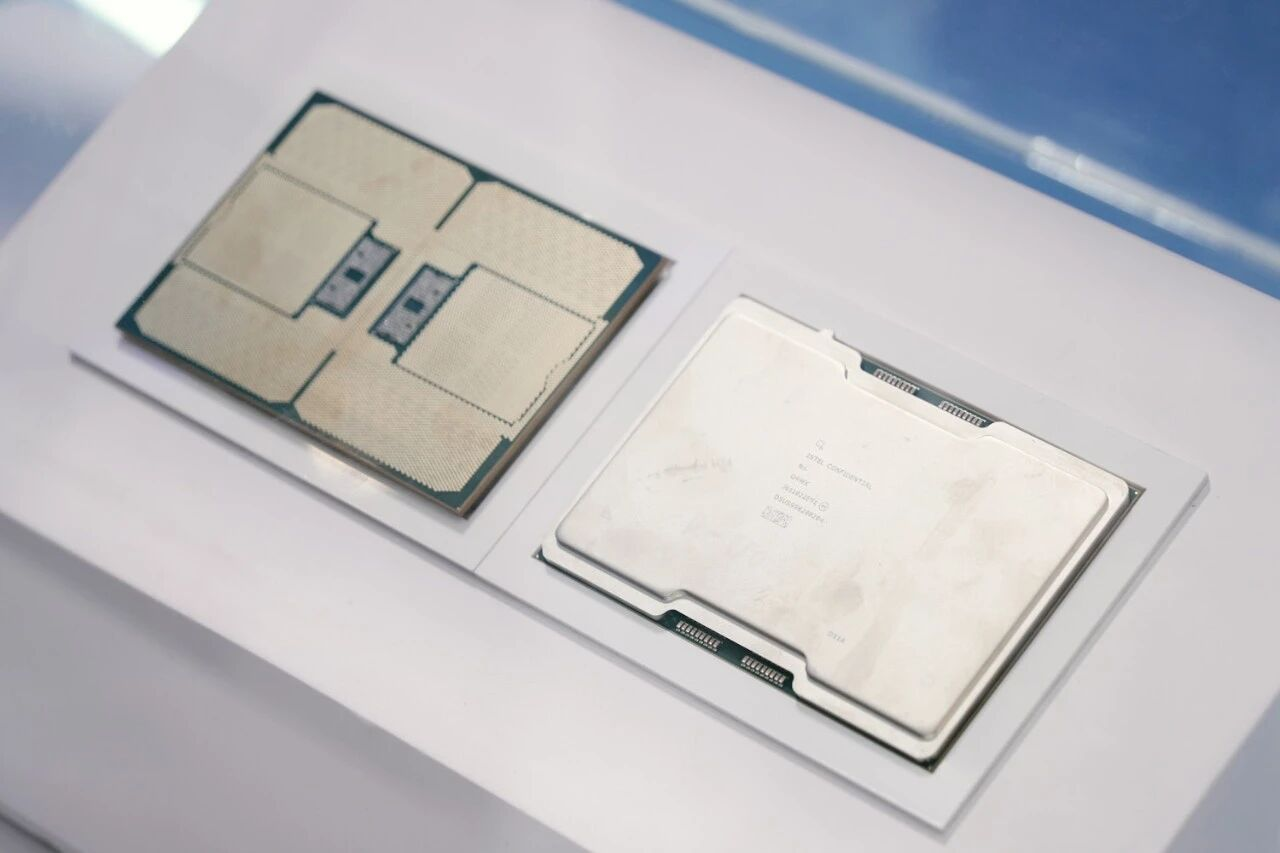
Intel has publicly showcased its next generation Xeon 7 Diamond Rapids processor, revealing the physical package of its upcoming 256 core server CPU ahead of its expected 2027 launch. The processor appeared during Tencent's Global Digital Ecosystem Conference in Shenzhen, China, highlighting Intel's latest advancements in chiplet packaging, semiconductor manufacturing, and high performance server computing. Built using Intel's advanced 18A P manufacturing technology, Diamond Rapids aims to compete directly with AMD's recently launched EPYC Venice processors.
According to images presented during the October 29 event and subsequently reported by TechPowerUp, Intel displayed 2 Diamond Rapids packages, revealing both the redesigned integrated heat spreader and the processor's enormous contact surface. The CPU is designed for the new LGA 9324 socket, part of Intel's Oak Stream server platform. Its unusually large physical dimensions reflect the substantial connectivity and power delivery requirements of a processor combining hundreds of CPU cores with advanced memory and input output technologies.
Intel previously detailed the architecture during Hot Chips 2026, confirming that Diamond Rapids will feature up to 256 performance cores and 1.28 GB of last level cache. The flagship design uses 16 compute chiplets organized into 4 compute building blocks, with each chiplet containing 16 CPU cores. These are connected through Intel's Foveros Direct 3D packaging technology and UCIe interfaces, allowing the processor to distribute computing resources across an advanced modular design.
Unlike AMD's EPYC Venice flagship, which supports 256 cores and 512 threads, Diamond Rapids does not implement simultaneous multithreading in this generation. Consequently, the highest configuration supports 256 cores and 256 threads, emphasizing physical core performance rather than additional logical threads.
Intel Diamond Rapids Xeon 7 Specifications
| Specification | Intel Xeon 7 Diamond Rapids |
|---|---|
| CPU Architecture | Panther Cove performance cores |
| Maximum CPU Cores | 256 |
| Maximum Threads | 256 |
| Compute Chiplets | 16 |
| Manufacturing Process | Intel 18A P |
| Last Level Cache | Up to 1.28 GB |
| Memory Channels | 16 |
| DDR5 RDIMM Speed | Up to 8000 MT/s |
| MRDIMM Speed | Up to 12,800 MT/s |
| PCIe Connectivity | 128 PCIe 6.0 lanes |
| CXL Support | CXL 3.0 |
| Socket | LGA 9324 |
| Platform | Oak Stream |
| Expected Launch | 2027 |
Specifications represent Intel's disclosed maximum architectural capabilities and reported platform configuration. Individual processor models may offer different specifications.
The new memory subsystem represents another significant improvement. Diamond Rapids supports 16 DDR5 memory channels, compared with the 12 channels available on flagship Granite Rapids processors. With MRDIMM technology reaching 12,800 MT/s, the architecture can theoretically deliver approximately 1.64 TB/s of memory bandwidth, providing additional capacity for memory intensive workloads such as scientific computing, virtualization, databases, and AI inference.
Intel is also introducing additional processing improvements through Advanced Performance Extensions (APX), enhanced Advanced Matrix Extensions (AMX), and AVX 10.2 support. These capabilities aim to improve instruction execution efficiency and accelerate matrix operations without relying exclusively on dedicated graphics accelerators.
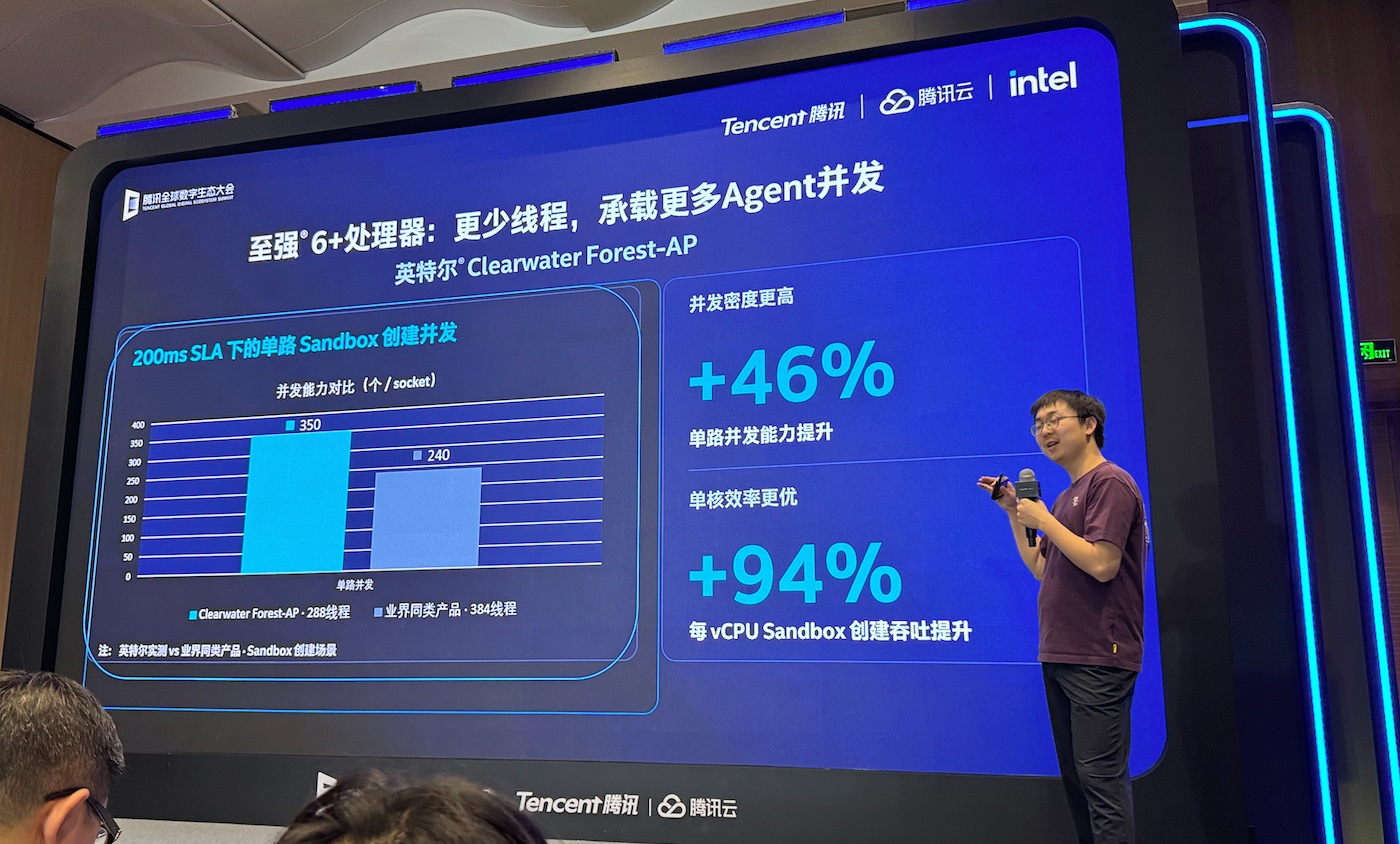
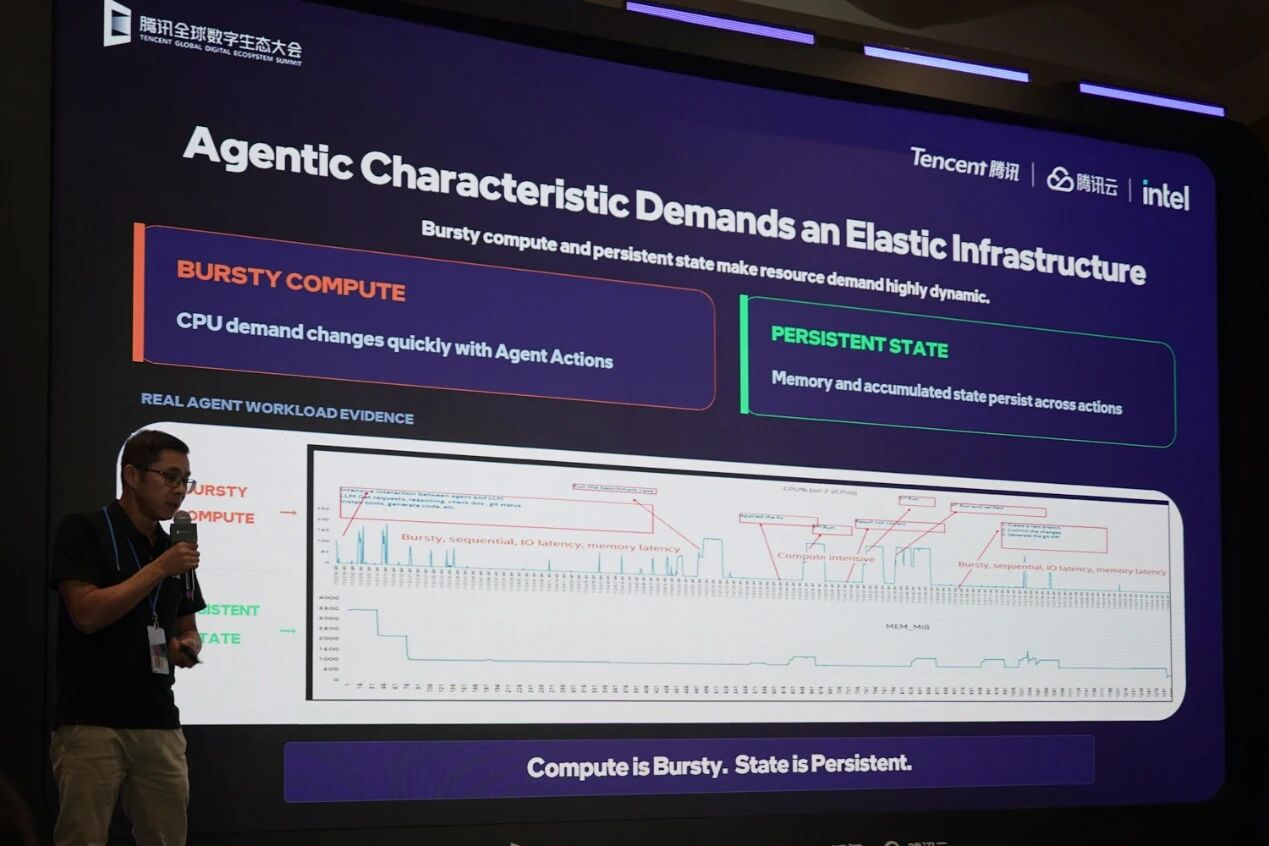
The processor's appearance coincided with an expanded collaboration between Intel and Tencent Cloud. During the event, the companies announced new cloud instances using Xeon 6+ Clearwater Forest processors, with Intel reporting support for more than 350 concurrent sandbox environments and average creation latency of approximately 200 milliseconds. These performance figures relate to Clearwater Forest, not Diamond Rapids. The companies also discussed future collaboration involving Diamond Rapids for increasingly demanding agentic AI workloads.
However, the most important challenge remains competition from AMD. As detailed in the latest Zen 6 architectural developments, AMD's EPYC 9006 Venice processors are already commercially available, offering up to 256 Zen 6c cores, 512 threads, and approximately 1.6 TB/s of memory bandwidth.
Intel will therefore enter the market after its competitor, making actual performance, energy efficiency, pricing, and software compatibility crucial factors in determining Diamond Rapids' competitiveness.
Although the physical processors have now been shown publicly, Intel has not disclosed final retail frequencies, pricing, complete model configurations, or independent performance benchmarks. The display also does not establish that commercial volume production has begun. Diamond Rapids remains scheduled for 2027, with additional technical information expected before launch.
Diamond Rapids represents one of Intel's most ambitious server CPU architectures, combining 256 performance cores, enormous cache capacity, and advanced packaging technology into a single processor.
The move to Intel 18A P is particularly important because it will demonstrate whether Intel Foundry can deliver competitive manufacturing technology for high performance data center products rather than relying on external foundries.
However, matching AMD's core count will not automatically make Diamond Rapids competitive. AMD already offers 256 cores with simultaneous multithreading, while Intel must demonstrate advantages in instruction performance, memory efficiency, power consumption, or total platform cost to justify adoption.
The larger concern for consumers is the growing concentration of advanced semiconductor manufacturing around AI infrastructure. Although server processors require different designs from gaming CPUs, manufacturing resources and engineering investment remain increasingly focused on enterprise customers.
Competition between Intel and AMD is beneficial, but these advancements should eventually contribute to more efficient and affordable consumer processors rather than exclusively serving high margin data centers.
The real test for Diamond Rapids will be performance per watt and pricing, not simply reaching 256 cores.
Do you believe Intel's 256 performance core Diamond Rapids processors can challenge AMD EPYC Venice, or will AMD's earlier launch and simultaneous multithreading support provide a lasting advantage?
