
AMD has officially detailed its next generation Zen 6 architecture, introducing significant improvements to instruction execution, cache capacity, memory bandwidth, and core density. The architecture debuts with the 6th Gen EPYC 9006 Venice processors, delivering an average 27% IPC improvement in AMD's selected server benchmarks, up to 256 CPU cores, and 1.6 TB/s of theoretical memory bandwidth. With Zen 6, AMD is targeting higher performance across enterprise computing, cloud infrastructure, scientific workloads, and AI applications while introducing architectural improvements that could eventually benefit consumer Ryzen processors.
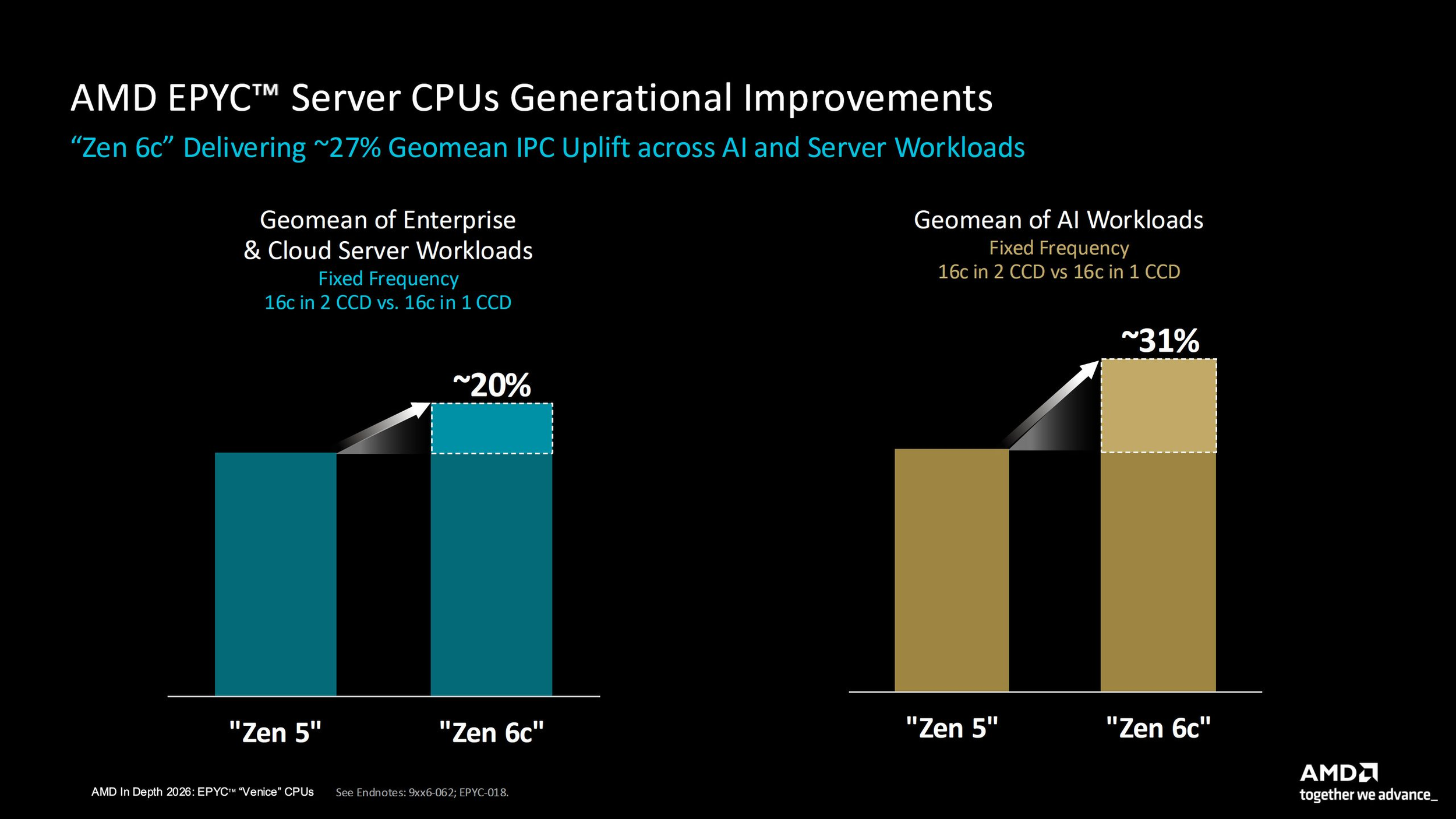
According to AMD's official Zen architecture documentation, the reported 27% IPC improvement comes from comparing the new Zen 6c architecture against Zen 5 under fixed frequency conditions. The company reports a 20% improvement across enterprise and cloud benchmarks and a 31% increase in AI workloads. These figures were measured using server applications and do not establish equivalent performance improvements for desktop gaming or future Ryzen CPUs. Nevertheless, the architectural changes responsible for these gains provide an early indication of AMD's direction for its next generation processors.
One of the most important improvements involves instruction processing. Zen 6 introduces a larger 6.75K operation cache, an execution window containing 640 reorder buffer entries, and expanded integer and floating point schedulers. The architecture retains an 8 wide dispatch design while improving instruction fusion and branch prediction, reducing the penalties associated with incorrectly predicted execution paths. AMD has also increased load and store queue capacity, allowing processors to manage more simultaneous memory operations.
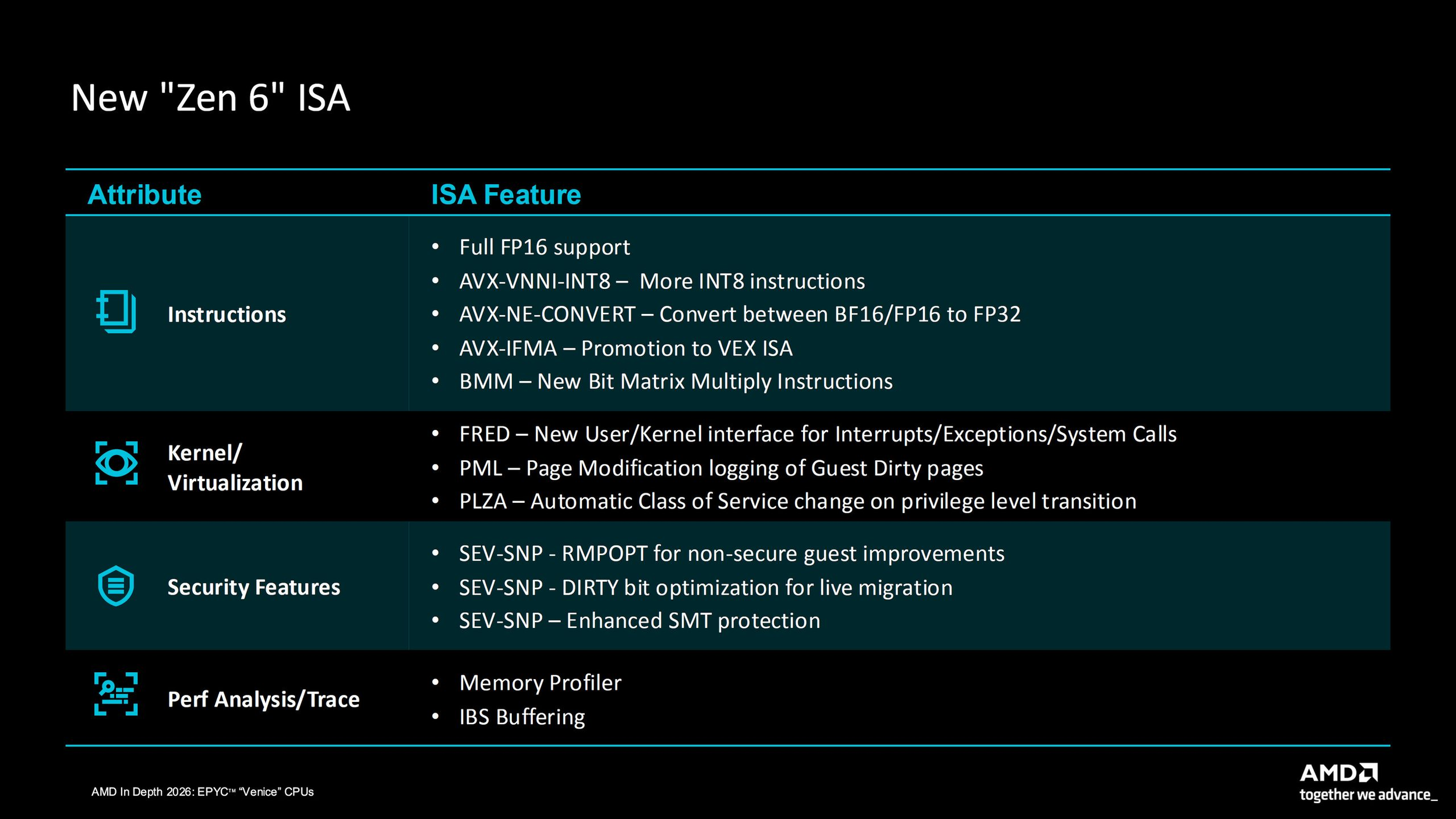
The floating point subsystem receives additional attention, introducing full AVX 512 FP16 support, new bit matrix multiplication instructions, and expanded INT8 processing capabilities. These changes are particularly relevant for AI inference, scientific calculations, and other workloads that benefit from vectorized mathematical operations.
AMD Zen 5 vs Zen 6 Architecture
| Specification | Zen 5 / Zen 5c | Zen 6 / Zen 6c |
|---|---|---|
| Manufacturing Process | 4 nm / 3 nm | 2 nm |
| Maximum Standard Core Complex | 8 cores | 12 cores |
| Maximum Dense Core Complex | 16 cores | 32 cores |
| L1 Data Cache per Core | 48 KB | 48 KB |
| L2 Cache per Core | 1 MB | 1 MB |
| Standard Core Complex L3 | 32 MB | 48 MB |
| Dense Core Complex L3 | 32 MB | 128 MB |
| Reorder Buffer | 448 entries | 640 entries |
| Load Queue | 64 entries | 80 entries |
| Store Queue | 96 entries | 128 entries |
| Maximum EPYC Core Count | 192 | 256 |
| Maximum EPYC L3 Cache | 512 MB | 1,024 MB |
| Peak Server Memory Bandwidth | Platform dependent | Up to 1.638 TB/s |
| Measured IPC Improvement | Baseline | Up to 31% in selected AI workloads |
Specifications compare the respective server architectures and their highest capacity configurations. Results and available features vary by processor model.
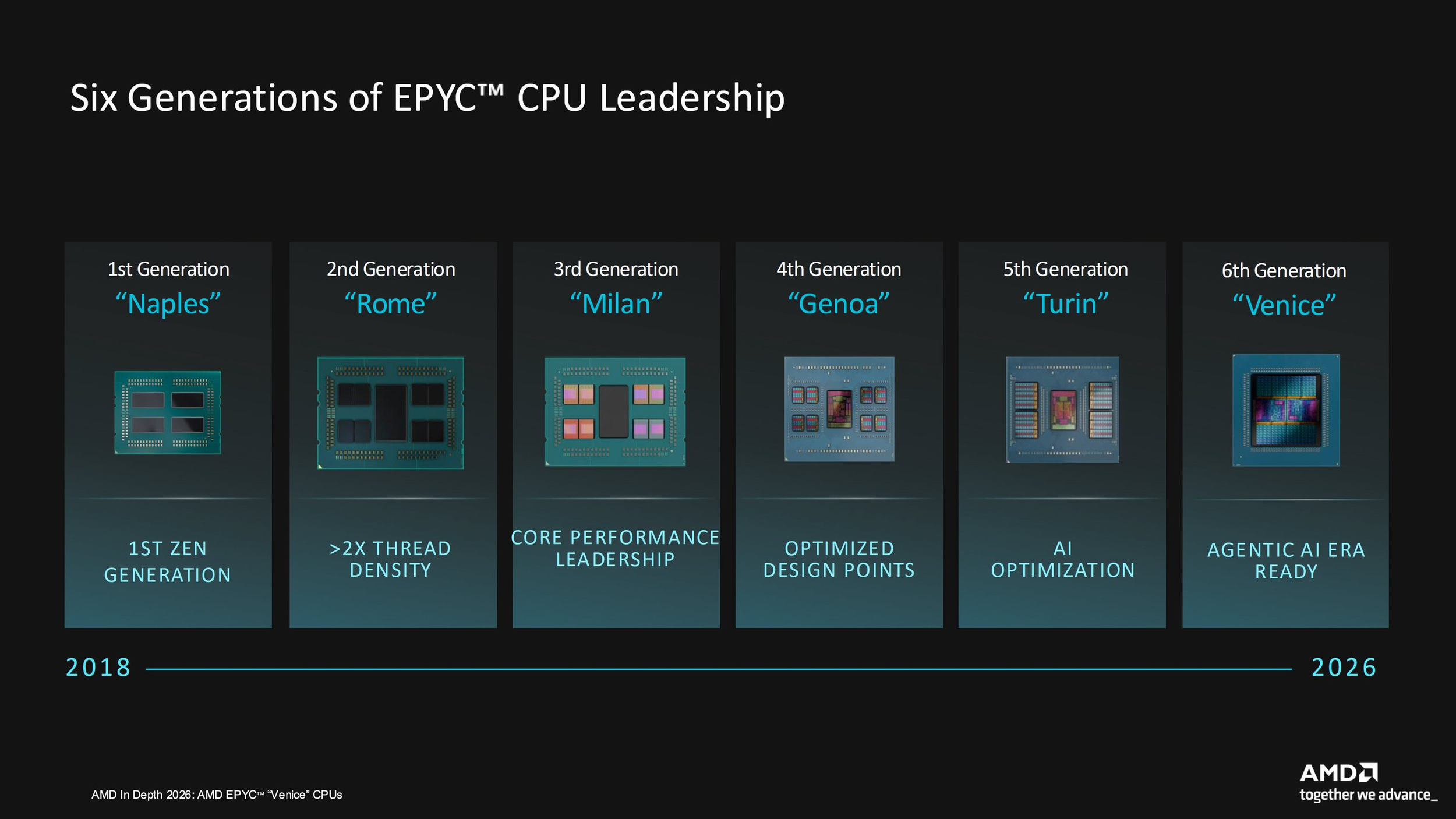
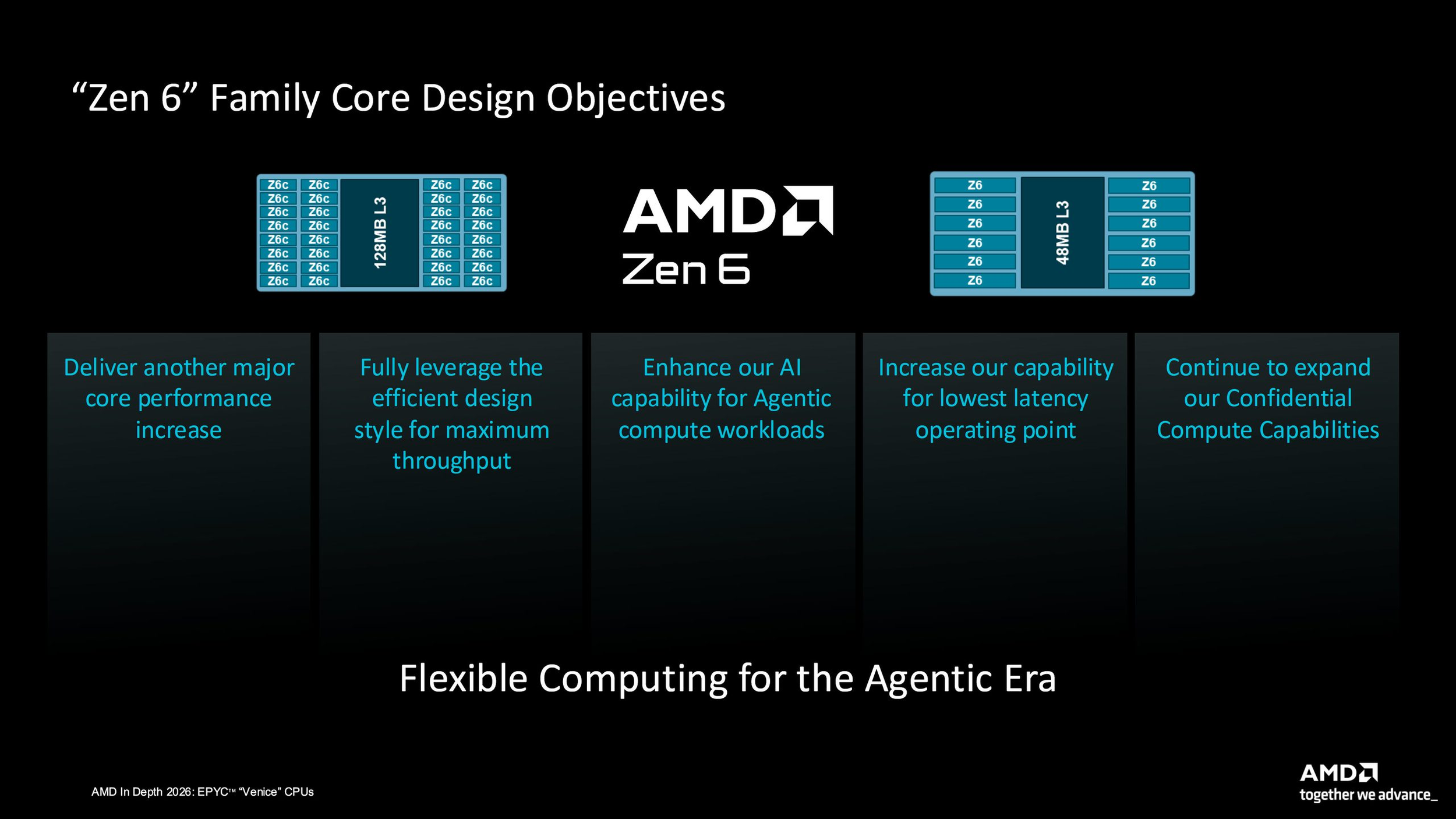
AMD has also redesigned its core complex structure. Standard Zen 6 configurations now support 12 cores sharing 48 MB of L3 cache, while the denser Zen 6c design accommodates 32 cores with 128 MB of shared L3 cache. This allows the flagship EPYC 9996 to combine 8 compute chiplets for 256 cores, 512 threads, and 1,024 MB of L3 cache, representing a 33.3% increase in maximum core count over EPYC Turin.
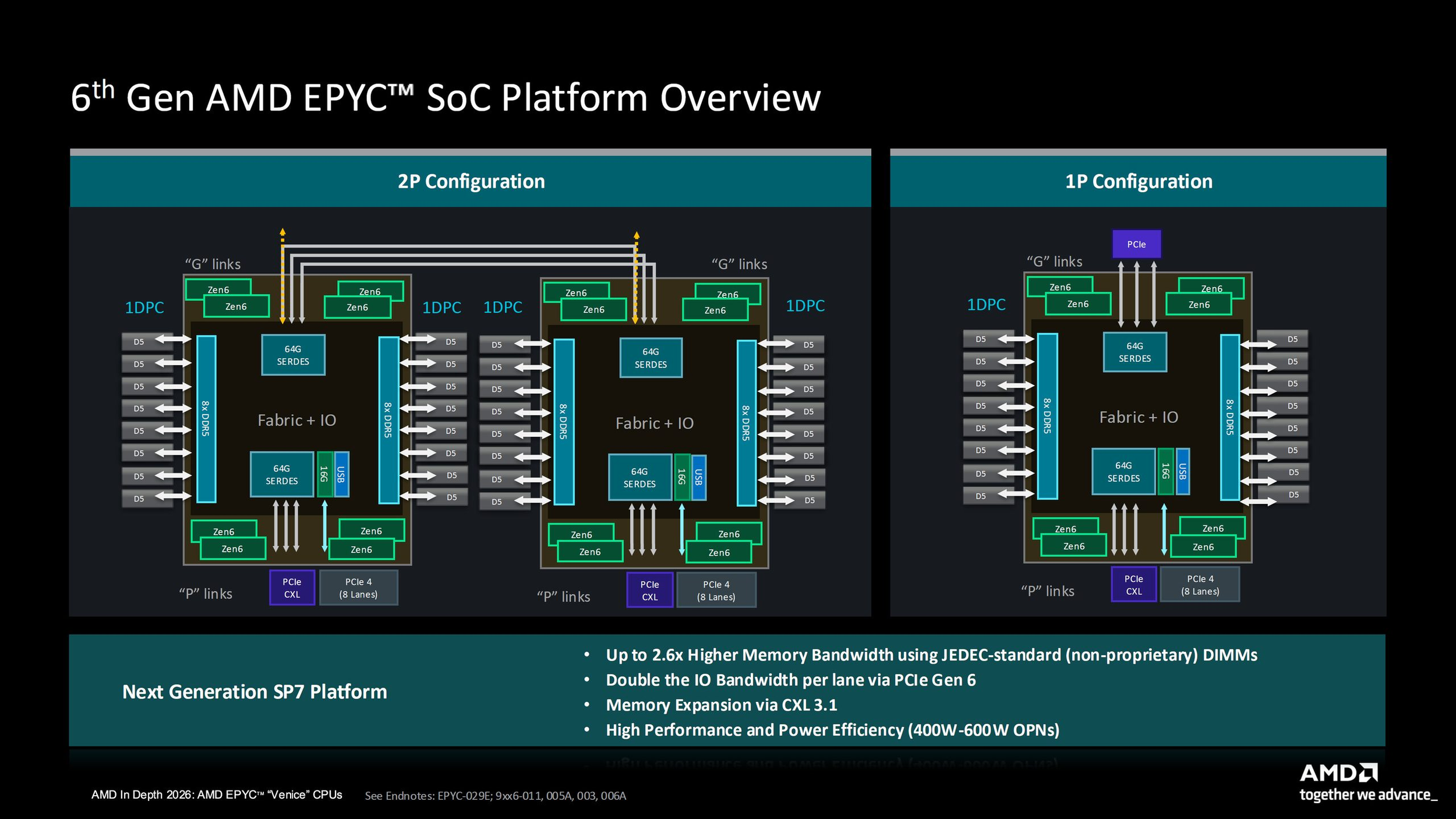
As explored in earlier coverage of AMD's Venice chiplet design, the processor also introduces a substantial redesign of its memory and connectivity infrastructure. The SP7 platform supports 16 DDR5 memory channels, with compatible MRDIMM configurations reaching 12,800 MT/s and delivering up to 1.638 TB/s of theoretical bandwidth per socket. This represents a major improvement for memory intensive computing, where processing performance can otherwise be limited by the speed at which data reaches the CPU.
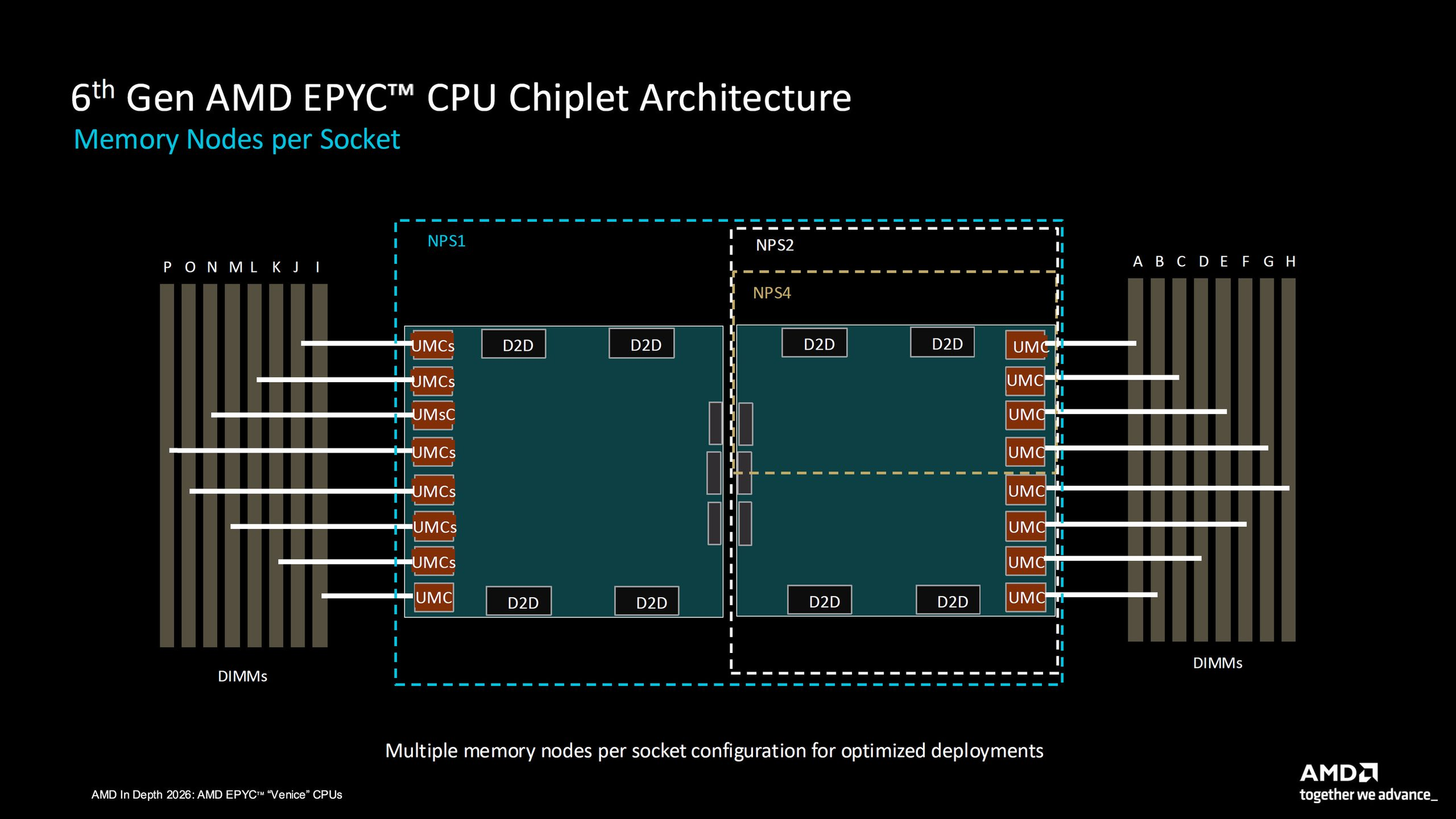
The platform also introduces PCIe 6.0 connectivity, improvements to Infinity Fabric, and additional security and virtualization instructions. Combined with TSMC's 2 nm manufacturing technology, these changes allow AMD to increase performance density while addressing the growing bandwidth requirements of modern data centers.
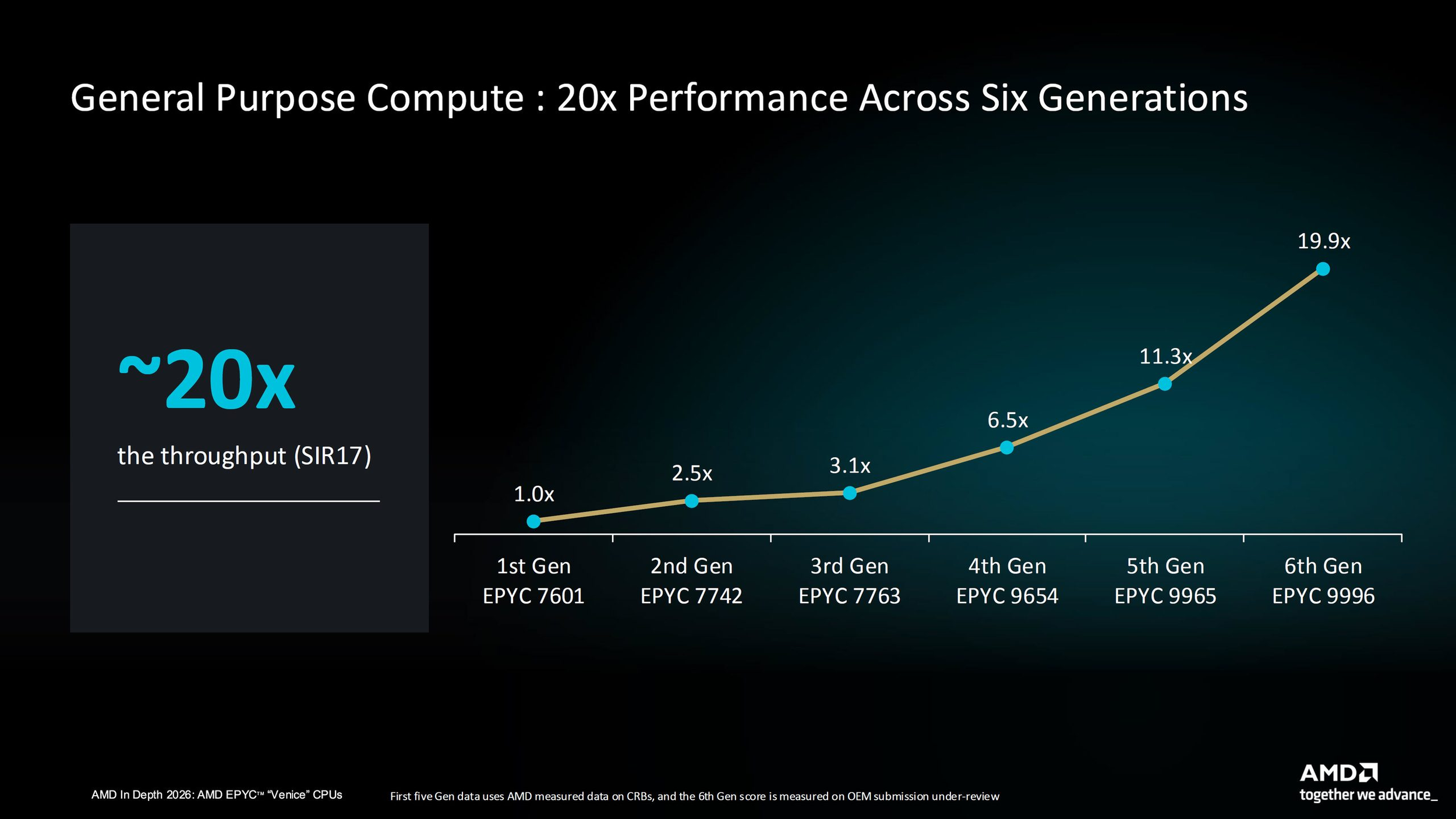
AMD officially announced general availability of its EPYC SP7 processors on November 10, 2026, with systems shipping from major server manufacturers. The company claims that EPYC 9996 systems can deliver up to 2.2 times the performance of Intel's Xeon 6980P in selected workloads, although these results are manufacturer benchmarks rather than independent testing.
For PC enthusiasts, the most interesting question is how these architectural improvements will translate to future Ryzen desktop processors. Larger execution resources, improved branch prediction, and expanded core complexes could benefit gaming, productivity, and content creation. However, AMD has not established a 27% gaming IPC improvement, and consumer performance will depend on clock speeds, cache configurations, memory latency, and final desktop processor designs.
Zen 6 represents more than another increase in CPU core counts. AMD is improving the underlying architecture responsible for executing instructions efficiently, while simultaneously addressing memory bandwidth and cache limitations that increasingly affect modern applications.
The 27% measured IPC improvement is impressive, but it is important to understand that these figures originate from server workloads. Gaming performance depends on different execution patterns, memory latency, cache behavior, and software optimization. Higher IPC in enterprise applications does not automatically translate into identical FPS improvements.
The increased core complex capacity is particularly interesting for future Ryzen processors. If AMD brings the 12 core Zen 6 complex to consumer desktops, it could introduce new opportunities for higher core counts and more effective cache designs without depending exclusively on additional chiplets.
However, AMD should continue prioritizing affordable, upgradeable consumer platforms alongside its increasingly profitable enterprise business. Server innovation is valuable, but its benefits should eventually reach PC gamers, creators, and enthusiasts through competitive pricing, meaningful performance improvements, and long term platform support.
The real test will come when Zen 6 reaches consumer hardware and independent benchmarks establish whether AMD can translate its server architecture improvements into equally compelling gaming performance.
Would a 27% IPC improvement make Zen 6 worth upgrading to, or would you rather see AMD prioritize more cache, better gaming performance, and affordable Ryzen processors?
