
Samsung Begins Mass Production of 24 Gb GDDR7 Memory; 32 Gbps and 36 Gbps Variants Enter Sampling
Samsung has officially commenced mass production of its 24 Gb (3 GB) GDDR7 memory chips, marking a significant milestone in the rollout of next generation graphics memory. These same chips were previously showcased in NVIDIA’s GeForce RTX 5090 teaser, confirming their integration into upcoming high end GPUs.
Samsung’s update also reveals two faster 3 GB GDDR7 variants, rated at 32 Gbps and 36 Gbps, which are now in the sampling stage. While only the 28 Gbps version has entered full production, all three products share the same density and form factor, enabling straightforward scalability across future graphics card models.
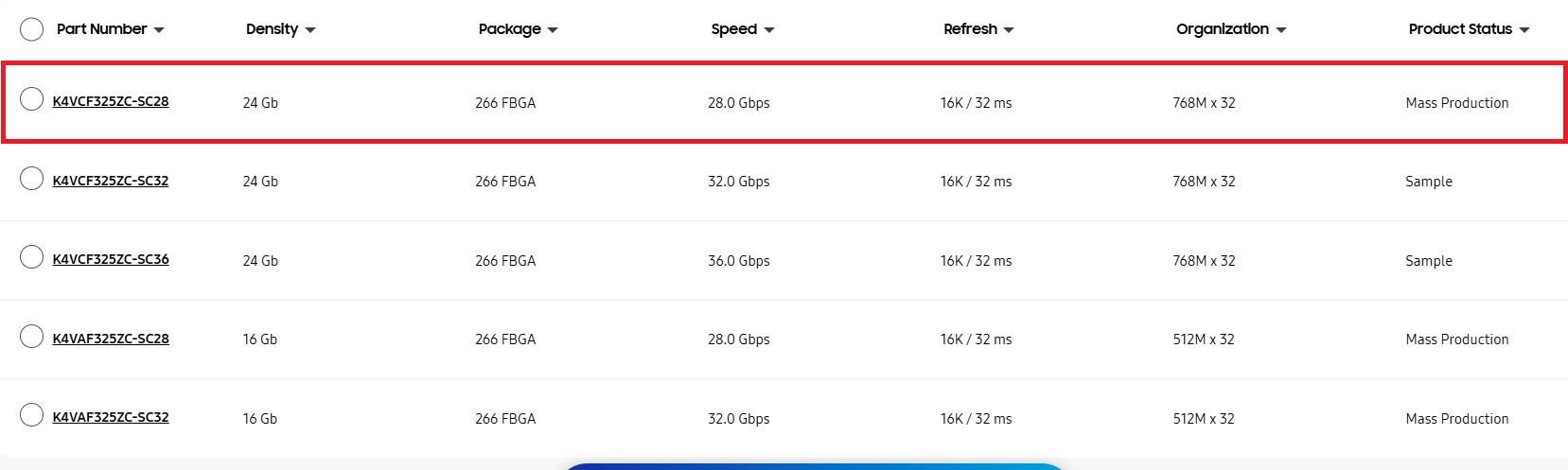
As identified by @unikoshardware, the memory chips used in NVIDIA’s RTX 5090 Founders Edition carry the identifier K4vcf325zc sc28, matching Samsung’s production listing. The higher speed variants adopt the corresponding sc32 and sc36 suffixes.
While DRAM market volatility has created uncertainty around launch timelines, Samsung’s GDDR7 production strategy remains on track. The cost driven delay of NVIDIA’s RTX 50 Super series into Q3 2026 does not affect Samsung’s roadmap. The company expects its 24 Gb GDDR7 modules to appear across the RTX 50 lineup, with base 28 Gbps modules powering most cards and the RTX 5080 already confirmed to ship with 30 Gbps GDDR7.
The availability of higher speed 32 Gbps and 36 Gbps options provides NVIDIA with the opportunity to significantly enhance the bandwidth profile of the Super refresh. Cards such as the rumored GeForce RTX 5070 Super, moving from 12 GB to 18 GB of VRAM using 3 GB chips, would benefit from both increased capacity and elevated throughput.
At present, it remains unclear whether NVIDIA will adopt the faster modules for the entire Super series or reserve them for select SKUs. However, given the escalating bandwidth demands of modern gaming and AI accelerated workloads, integration of these top tier GDDR7 variants would provide meaningful gains in real world performance.
Samsung’s move into mass production signals that next generation GPU memory is rapidly approaching commercial readiness. Despite ongoing DRAM pricing pressures, the arrival of high density, high bandwidth GDDR7 sets the stage for substantial generational improvements as the industry transitions into late 2025 and beyond.
What speed tier do you think NVIDIA should prioritize for the Super series: 28, 32 or 36 Gbps? Share your thoughts below.
