
HWiNFO Adds Per Chip VRAM Temperature Monitoring to AMD Navi GPUs
HWiNFO has expanded its detailed graphics memory monitoring to AMD Radeon GPUs, allowing users to inspect the temperature of individual VRAM chips instead of relying only on a single combined memory reading. The feature is available through the HWiNFO 8.51 Build 6045 beta and follows similar support introduced for NVIDIA graphics cards using GDDR6X and GDDR7 memory.
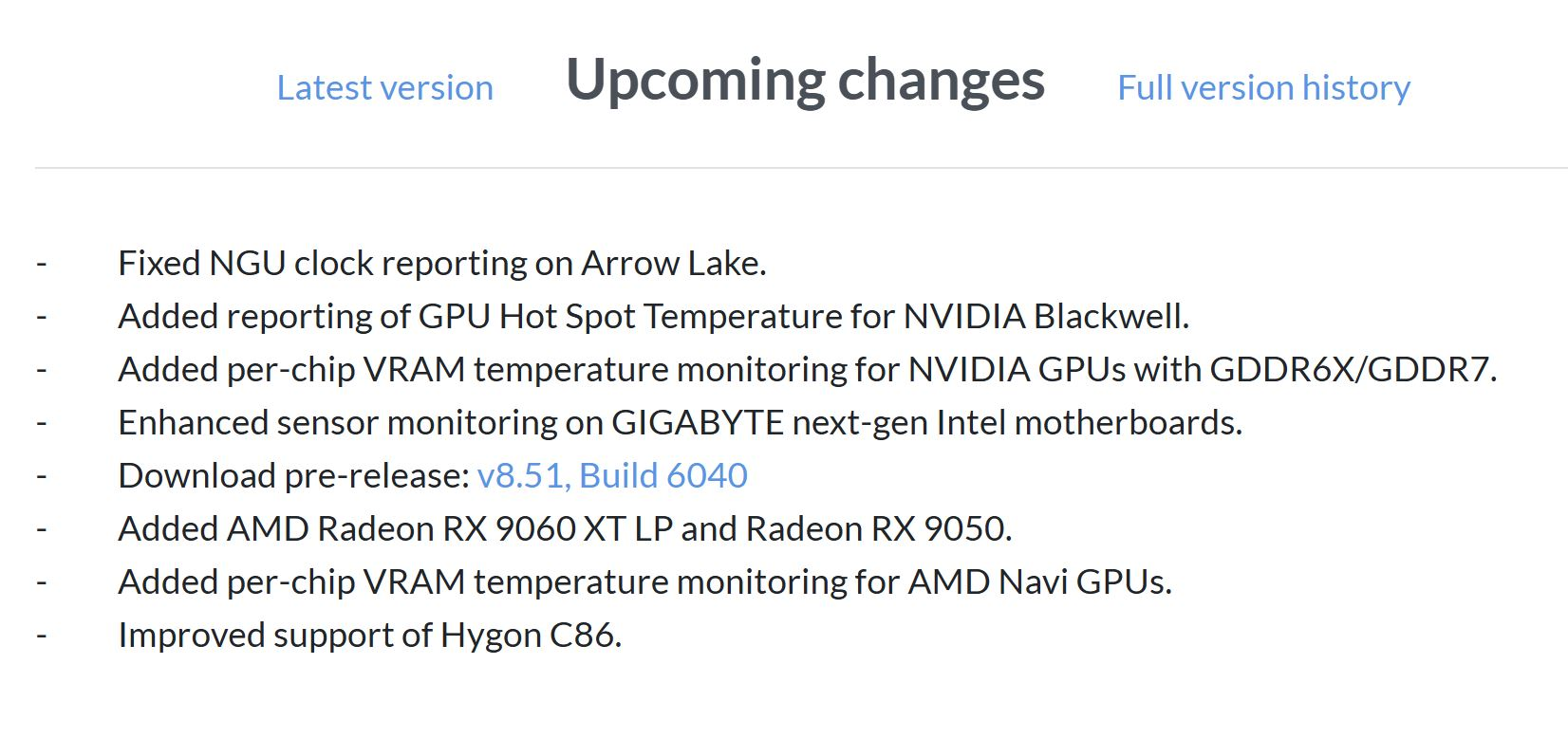
The official HWiNFO development history lists per chip VRAM temperature monitoring for AMD Navi GPUs among the upcoming changes. The same beta also adds GPU Hot Spot Temperature reporting for NVIDIA Blackwell, individual memory chip monitoring for NVIDIA cards using GDDR6X or GDDR7, and recognition for the Radeon RX 9060 XT LP and Radeon RX 9050.
| Monitoring Feature | AMD Radeon Support | NVIDIA GeForce Support |
|---|---|---|
| Individual VRAM Chip Temperature | AMD Navi GPUs | GPUs using GDDR6X or GDDR7 |
| General Memory Temperature | Supported on compatible models | Supported on compatible models |
| GPU Hot Spot Temperature | Available on supported Radeon GPUs | Added for NVIDIA Blackwell |
| Current Software Release | HWiNFO 8.51 Build 6045 beta | HWiNFO 8.51 Build 6045 beta |
| Stable Release Availability | Not included in HWiNFO 8.50 | Not included in HWiNFO 8.50 |
HWiNFO has not published a complete list of compatible Radeon models. Its supported hardware database includes AMD RDNA1 Navi 10, Navi 12, and Navi 14, followed by RDNA2 Navi 21 through Navi 24, RDNA3 Navi 31 through Navi 33, and RDNA4 Navi 44 and Navi 48. This covers graphics families ranging from the Radeon RX 5000 Series through the Radeon RX 9000 Series, but individual sensor availability may still depend on the graphics processor, board design, memory configuration, firmware, and driver access.
The additional readings provide considerably more information than a single memory junction temperature. A graphics card may report an acceptable average while 1 memory package operates significantly hotter because of uneven thermal pad contact, incorrect pad thickness, cooler mounting pressure, limited airflow, or differences in circuit board positioning.
This makes the feature particularly valuable for graphics card repair, cooler maintenance, water block installation, overclocking, memory tuning, and thermal troubleshooting. Users can compare every detected VRAM package under the same gaming or stress test workload and identify whether a particular chip consistently operates above the rest.
The feature could also help evaluate second hand graphics cards and modified cooling systems. A card that has been disassembled for thermal pad replacement may appear stable while still suffering from incomplete contact on 1 or more memory packages. Individual temperature readings provide another diagnostic layer before sustained heat causes throttling, instability, or memory errors.
HWiNFO recently demonstrated the same approach on NVIDIA hardware, where detailed monitoring exposed the temperature of every memory package on compatible GeForce RTX cards. The NVIDIA implementation focuses on GDDR6X and GDDR7, while the AMD entry broadly references Navi GPUs without restricting support to a particular GDDR6 generation.
The new capability strengthens HWiNFO’s position among detailed system monitoring applications. AIDA64 has also expanded its hardware support, while HWiNFO is frequently used to verify information that may be displayed incorrectly inside manufacturer software. One recent example involved AMD Adrenalin incorrectly reporting Smart Access Memory status, where independent monitoring tools helped confirm that Resizable BAR remained active.
Users should remember that HWiNFO 8.51 Build 6045 remains a beta release. The latest stable version is HWiNFO 8.50, released on July 8, 2026, and the developer has not announced when individual AMD VRAM temperature monitoring will enter a completed stable build.
Individual VRAM chip monitoring is far more useful than another general temperature number. Graphics memory cooling depends heavily on pad alignment, pressure, material thickness, circuit board shape, and airflow, meaning a single poorly cooled package can remain hidden behind an acceptable overall reading.
The feature should be especially valuable for Radeon owners who replace thermal pads, install water blocks, repair used graphics cards, or tune memory frequencies. It could also improve graphics card reviews by showing whether cooler designs distribute pressure evenly across every memory package.
Compatibility will be the main question. AMD Navi covers several generations and many custom circuit boards, but not every graphics card necessarily exposes identical telemetry. Testing across Radeon RX 5000, RX 6000, RX 7000, and RX 9000 models will be required before the practical support range becomes clear.
Would individual VRAM chip temperatures influence how you tune or maintain your graphics card, or is the general memory temperature already enough?
