
G.Skill’s First AMD EXPO ULL Kits Reach 1,099.99$ as Pricing Far Exceeds Standard EXPO Models
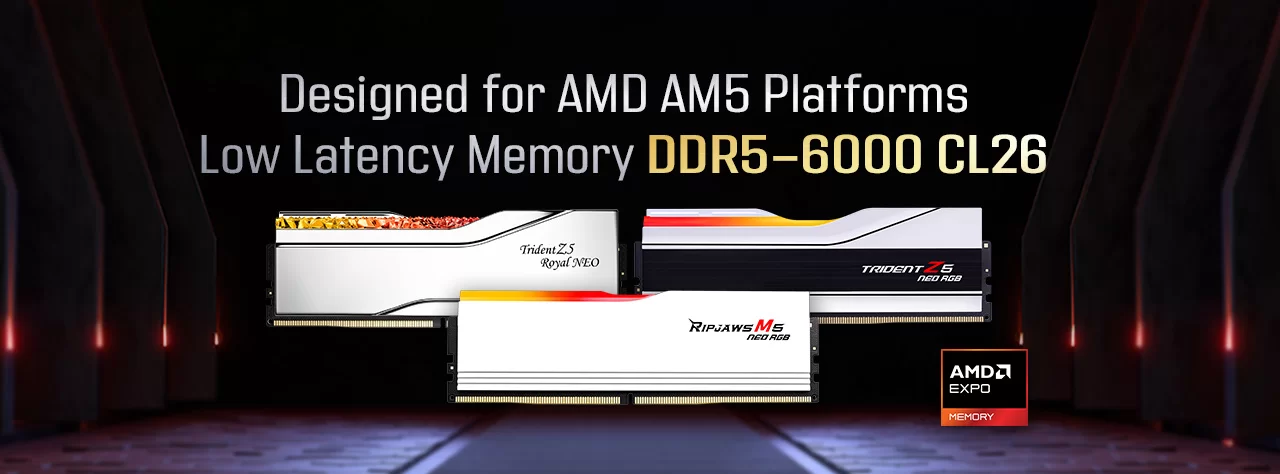
AMD EXPO Ultra Low Latency memory has officially reached retail shelves, but the first G.Skill kits are arriving at prices dramatically higher than comparable standard EXPO products. The most aggressive 32 GB Trident Z5 NeoX RGB kit is currently listed at 1,099.99$, approximately 400$ more than the equivalent Trident Z5 Neo model with the same DDR5 6000 data rate and CL26 primary latency.
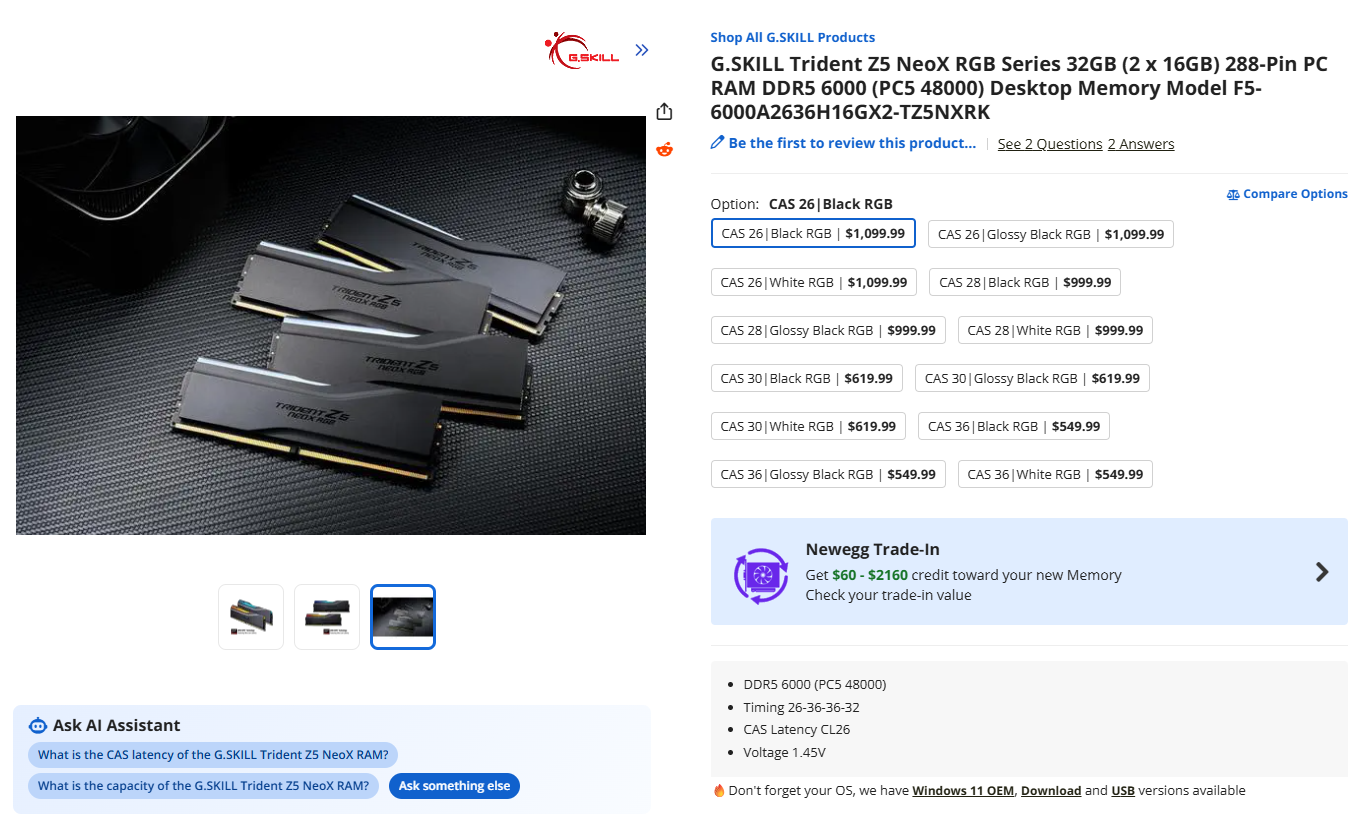
According to Tom’s Hardware, Newegg has listed several G.Skill Trident Z5 NeoX RGB configurations ranging from 549.99$ to 1,099.99$. All currently listed models use a 32 GB configuration consisting of 2 × 16 GB modules running at DDR5 6000, with differences in primary timings and internal memory binning.
AMD introduced EXPO ULL during Computex 2026 as an evolution of its existing Extended Profiles for Overclocking technology. The company claims the new profile can provide an average 4% gaming performance improvement compared with standard EXPO memory at the same DDR5 6000 data rate. AMD also reported an average 13% improvement compared with JEDEC standard DDR5 5600 memory, although those figures were produced through AMD’s internal testing and have not yet been broadly validated through independent reviews.
G.Skill’s official Trident Z5 NeoX announcement confirms that the first lineup includes DDR5 6000 CL36, CL30, CL28, and CL26 kits. The company says EXPO ULL adds more advanced subtiming information to the profile stored on the memory modules, allowing compatible AMD motherboards to automatically apply lower latency settings through the BIOS. G.Skill expects the largest benefit to appear on Ryzen processors without 3D V Cache, where system memory latency can have a greater influence on gaming performance.
Before the retail launch, AMD indicated that the new kits were not expected to carry a substantial premium over conventional EXPO memory.
“Effectively the same price points that the current kits are at.”
— David McAfee, AMD
The initial listings do not currently reflect that expectation.
| Memory Kit | Capacity | Speed | Primary Timings | Price |
|---|---|---|---|---|
| Trident Z5 NeoX | 2x 16 GB | 6000 MT/s | 26-36-36-32 | $1,099 |
| Trident Z5 Neo | 2x 16 GB | 6000 MT/s | 26-36-36-96 | $699 |
| Trident Z5 NeoX | 2x 16 GB | 6000 MT/s | 28-36-36-32 | $999 |
| Trident Z5 Neo | 2x 16 GB | 6000 MT/s | 28-36-36-96 | $559 |
| Trident Z5 NeoX | 2x 16 GB | 6000 MT/s | 30-38-38-32 | $619 |
| Trident Z5 Neo | 2x 16 GB | 6000 MT/s | 30-38-38-96 | $544 |
| Trident Z5 NeoX | 2x 16 GB | 6000 MT/s | 36-36-36-76 | $549 |
| Trident Z5 Neo | 2x 16 GB | 6000 MT/s | 36-36-36-96 | $499 |
The difference is most severe among the tighter configurations. The CL26 NeoX kit costs approximately 57% more than its conventional counterpart, while the CL28 version carries a premium of approximately 79%. The CL30 and CL36 models are more restrained, with differences of approximately 14% and 10%. These prices were recorded from retailer listings and may change as inventory, availability, and market conditions evolve.
G.Skill told Tom’s Hardware that the price differences may partially reflect inventory timing. Retailers may still be selling older standard EXPO kits purchased before the latest DDR5 price increases, while the newly manufactured NeoX products are entering the market at current component costs. If that explanation is accurate, the apparent ULL premium could decline as older inventory is replaced and pricing becomes more consistent across both product families.
The most visible primary timing difference is the significantly reduced tRAS value. The CL26 NeoX kit uses 26-36-36-32 timings, compared with 26-36-36-96 on the standard model. However, the main purpose of EXPO ULL extends beyond the 4 primary values normally displayed by retailers. The updated profile can include additional settings for refresh behavior, row access, write recovery, and other subtimings that users would normally need to configure manually.
EXPO ULL does not automatically mean that every kit operates at a lower voltage than its standard equivalent. The primary advantage is profile level optimization, memory chip selection, validation, and tighter latency behavior. G.Skill must identify DRAM chips capable of maintaining those settings, test them across compatible motherboards, and guarantee that the advertised profile operates without requiring detailed manual tuning.
Support also depends on the motherboard BIOS. Newegg’s Trident Z5 NeoX listing states that buyers need a compatible AMD motherboard with updated firmware supporting EXPO ULL. Installing the memory into an older BIOS does not guarantee that the Ultra Low Latency profile will appear or operate correctly. The launch also arrives during an unusually expensive period for consumer memory. AI infrastructure demand continues to absorb large quantities of advanced DRAM, encouraging manufacturers to prioritize high margin server, data center, and high bandwidth memory products.
AMD platform memory development is nevertheless progressing quickly. ASUS has already demonstrated its first ROG DDR5 kit reaching 8800 MT/s on the Crosshair X870E APEX. These demonstrations show that AM5 memory tuning is becoming more capable, but they also reinforce the difference between technical potential and practical value for mainstream gaming systems.
EXPO ULL is a meaningful technical improvement. Bringing advanced subtiming optimization into a certified BIOS profile can give enthusiasts stronger performance without requiring hours of manual testing, stability validation, and memory timing adjustments.
The initial pricing, however, is difficult to justify. Paying as much as 1,099.99$ for 32 GB of DDR5 memory creates an extreme value imbalance, especially when AMD’s own performance claim averages only 4% over standard EXPO. Even if certain processor and game combinations show larger gains, most PC builders would receive substantially greater performance by allocating that budget toward a stronger graphics card, processor, display, or storage configuration.
The lower priced CL30 and CL36 NeoX kits present a more reasonable proposition, particularly if their premiums stabilize near 10% to 15%. The CL26 and CL28 models currently appear designed for competitive overclockers, benchmark enthusiasts, and buyers seeking the tightest certified configuration regardless of cost.
This may ultimately be a temporary launch problem rather than the permanent price structure of EXPO ULL. More memory manufacturers are preparing compatible products, BIOS support is expanding, and standard EXPO inventory will eventually reflect current DRAM costs. Until then, early adopters are paying a significant premium for convenience, validation, and optimized subtimings rather than a revolutionary improvement in gaming performance.
Would you pay a major premium for a certified EXPO ULL profile, or would you choose standard EXPO memory and tune the subtimings manually?
