
GMKtec Launches EVO X3 With Ryzen AI Max Plus 395 And 126 TOPS AI Power Starting At $3,600
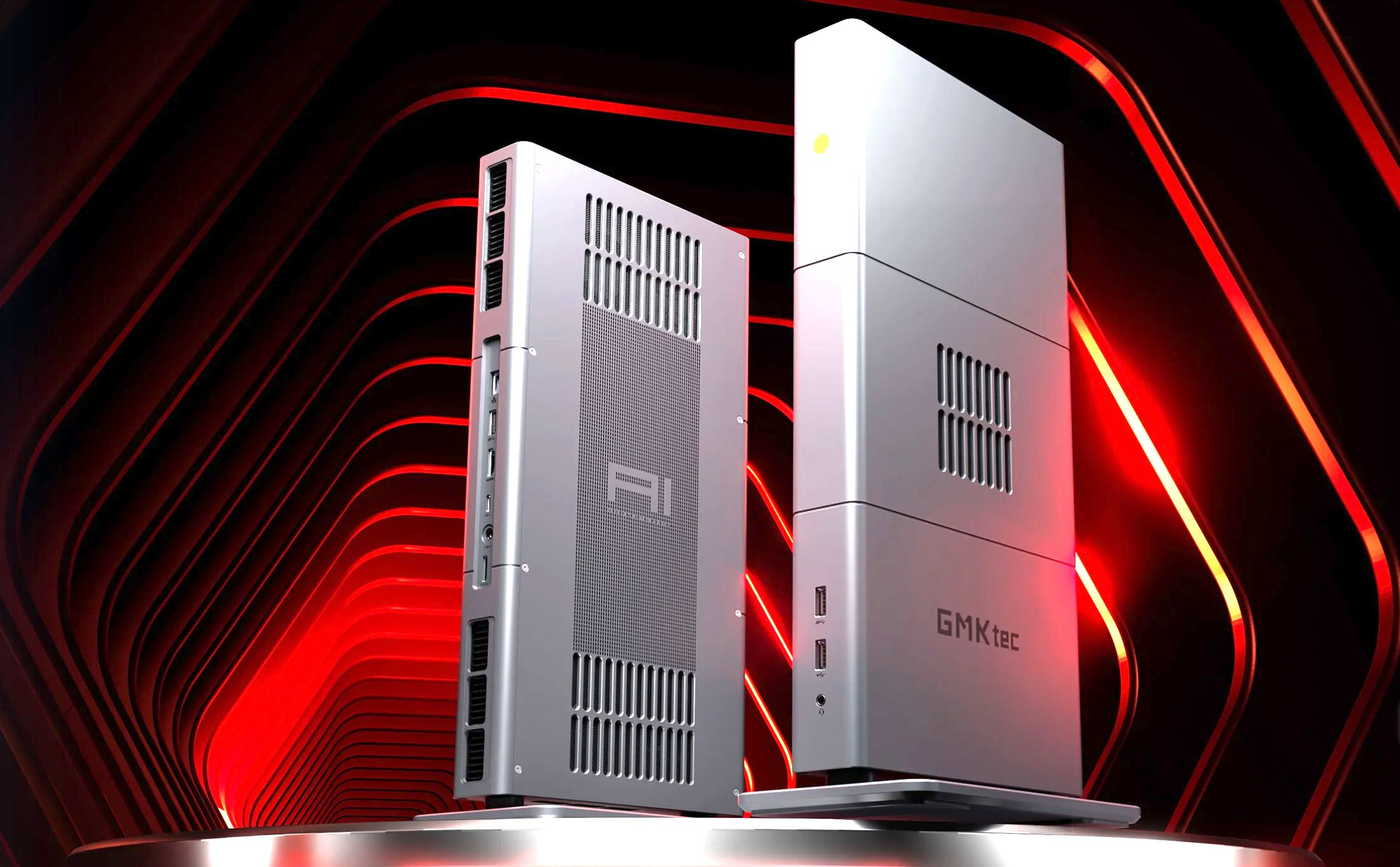
GMKtec has officially listed the EVO X3, a compact vertical AI mini workstation built around AMD’s Ryzen AI Max Plus 395 processor. The new system targets local AI workloads, creator workflows, compact gaming setups, and users who want high end compute hardware without moving to a full size desktop tower. Pricing starts at $3,600 for the 128GB RAM and 2TB SSD model, while the 128GB RAM and 4TB SSD version has been reported at $3,849 for the global launch configuration.
The EVO X3 follows the earlier GMKtec EVO X2, which already used the same Ryzen AI Max Plus 395 platform. The difference is that the EVO X3 moves into a slimmer vertical blade style chassis with a full metal CNC body, measuring 353 x 186 x 41 mm without the stand and weighing around 2.3 kg. That gives GMKtec a more workstation focused design, especially for users who want a premium desk setup with strong local AI performance in a smaller footprint.
At the center of the machine is AMD’s Ryzen AI Max Plus 395, also known as Strix Halo. AMD lists the processor with 16 Zen 5 cores, 32 threads, up to 5.1GHz boost clock, 16MB L2 cache, 64MB L3 cache, and configurable TDP support from 45W to 120W. GMKtec configures the EVO X3 with three power modes: Silent at 54W, Balanced at 85W, and Performance with a 140W peak profile.
Graphics are handled by the integrated Radeon 8060S, which uses RDNA 3.5 with 40 compute units and clocks up to 2900MHz according to GMKtec’s specification sheet. For a mini PC, this is one of the most important parts of the platform because the iGPU gives the EVO X3 enough graphics capability for accelerated creative applications, AI assisted workflows, media work, and gaming without requiring a discrete GPU inside the chassis.
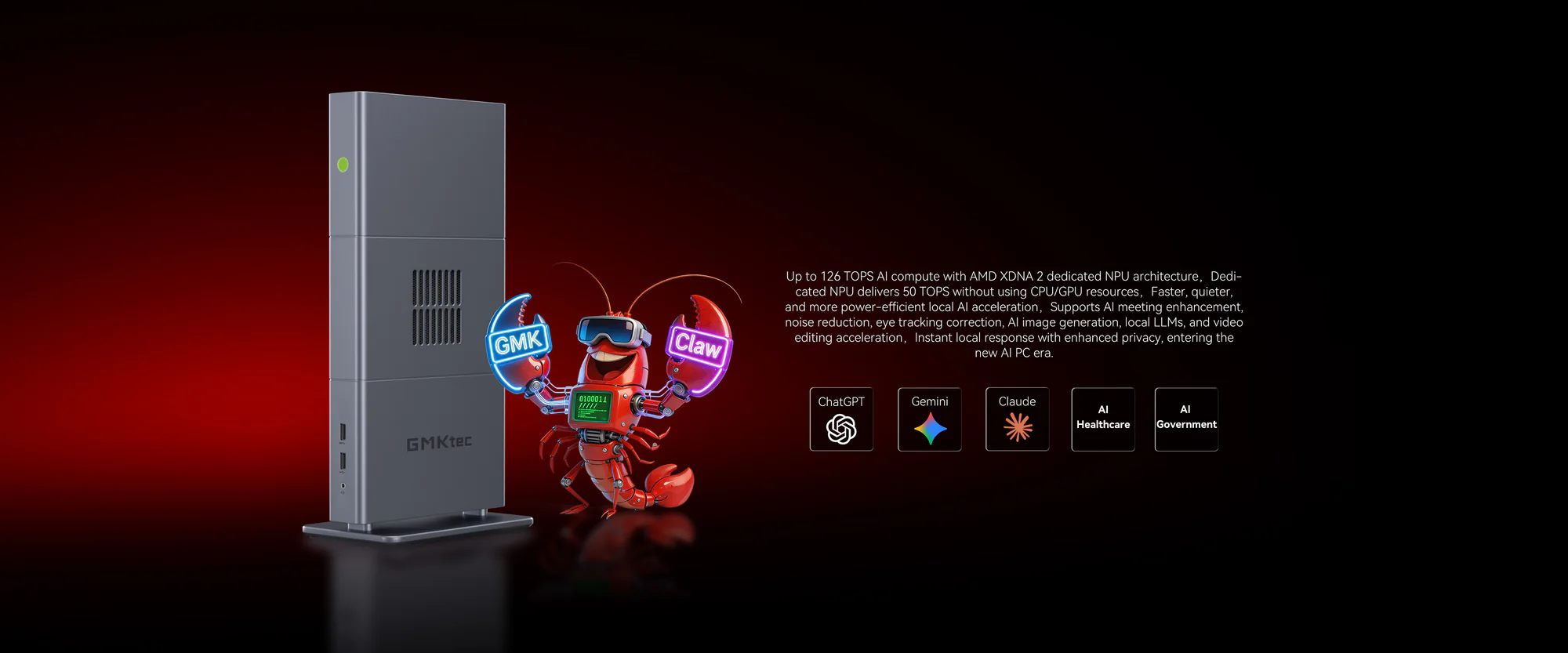
The AI side is built around AMD’s XDNA 2 NPU, which GMKtec lists at 50 TOPS, while the full processor platform reaches up to 126 TOPS of total AI performance. GMKtec also promotes support for large local models, including 70B class LLMs and up to 235B model support depending on configuration and workload. The company preloads its Claw local AI software, which is designed to simplify local model deployment and support cloud or local switching for tools such as GPT, Qwen, DeepSeek, and other major LLMs.
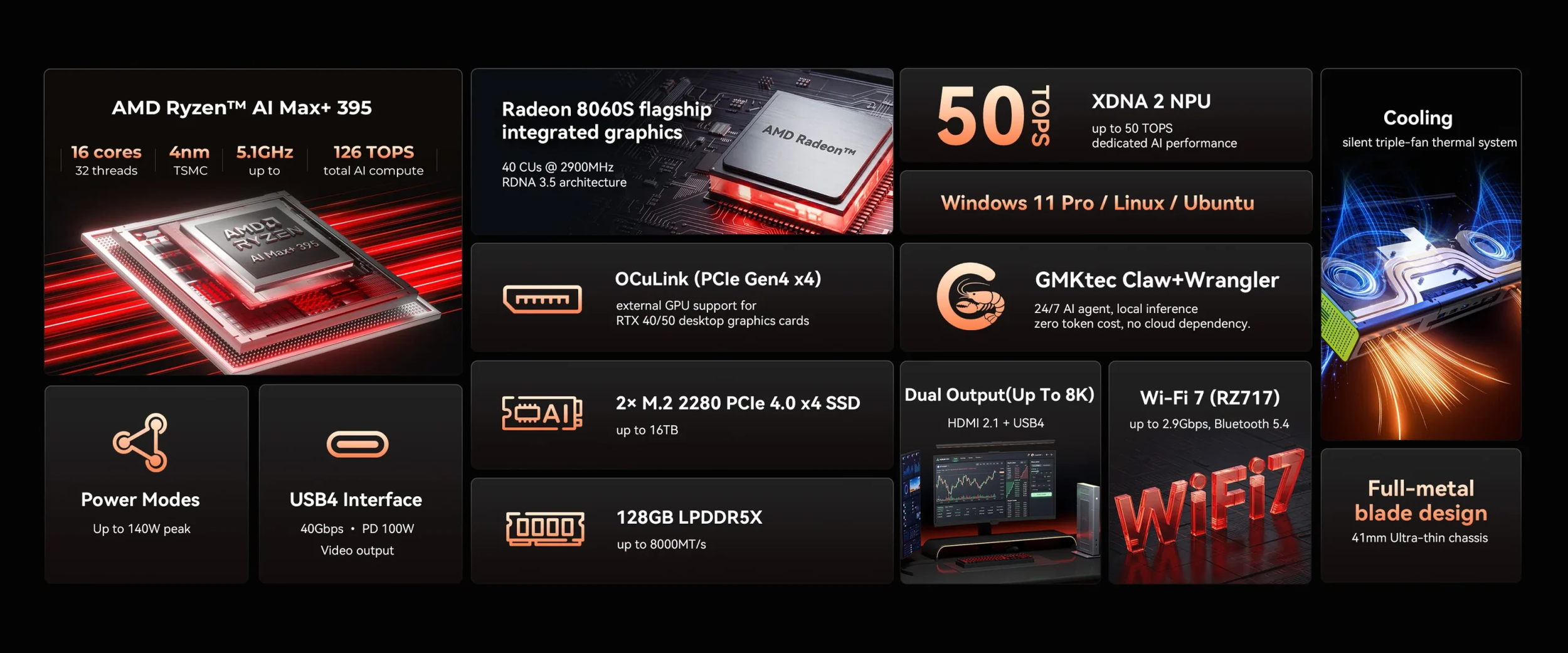
Memory is fixed at 128GB onboard LPDDR5X running at 8000MT/s, which is non upgradable. That limitation matters for long term upgrade flexibility, but the high starting capacity is clearly aimed at local AI users who need large memory pools rather than traditional gaming PC buyers who prioritize modular upgrades. GMKtec also says the system can allocate up to 96GB as VRAM, giving AI and graphics workloads more room than conventional integrated graphics platforms.
Storage is handled through M.2 2280 PCIe 4.0 x4 SSD support, with 2TB and 4TB launch configurations available. Internally, the system includes dual M.2 2280 PCIe 4.0 x4 slots and supports up to 16TB total storage through 8TB drives in each slot. This is important for AI workflows because local model files, datasets, checkpoints, creator assets, and game libraries can quickly consume storage capacity.
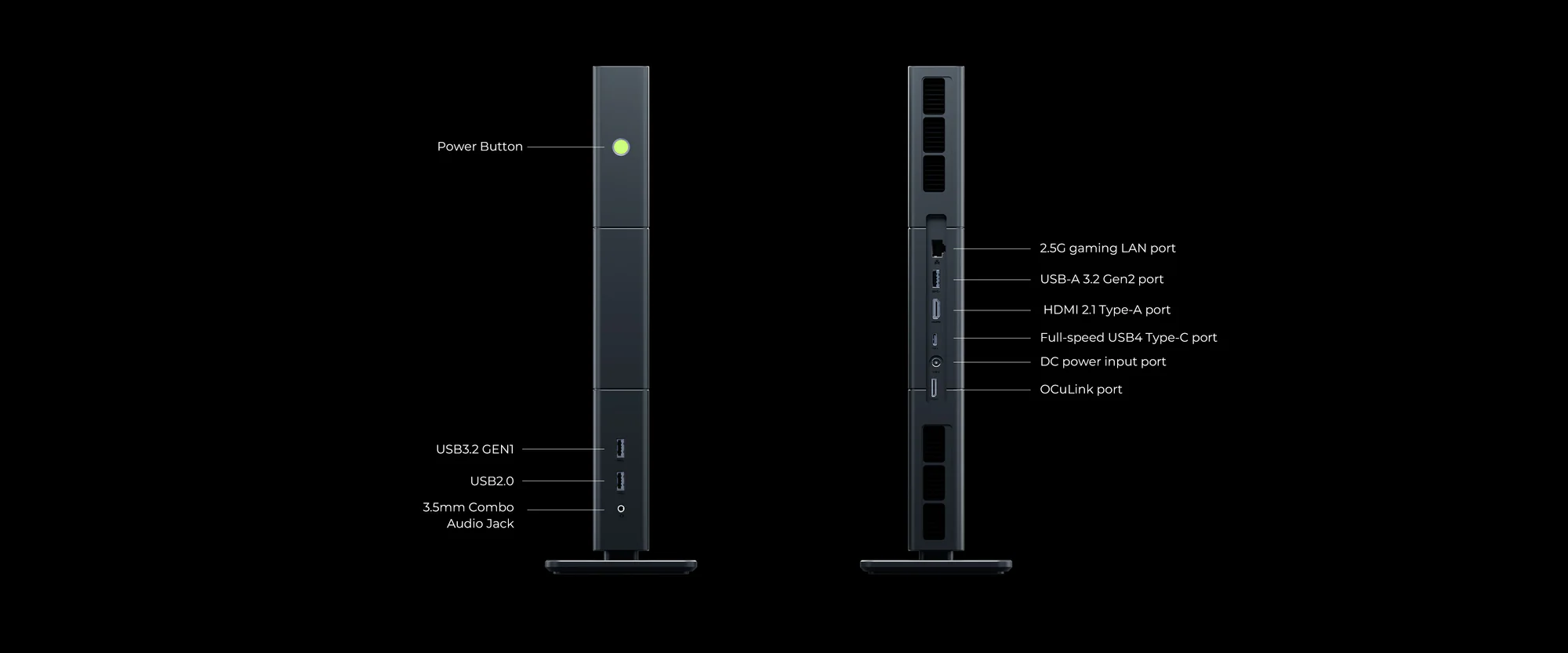
For expansion, the EVO X3 includes an OCuLink port running PCIe Gen4 x4 for external GPU docks. GMKtec says the system supports RTX 40 and RTX 50 series desktop graphics cards through an external dock, although the dock is sold separately and hot plugging is not supported. Users must power down before connecting or disconnecting the external GPU, and the PCIe Gen4 x4 link will not provide the same bandwidth as a full desktop PCIe x16 slot. Still, OCuLink gives the EVO X3 a useful upgrade path for gaming, rendering, and GPU accelerated AI workloads.
The I O package includes HDMI 2.1 with 8K 60Hz output, USB4 Type C with 40Gbps data and video output, USB A 3.2 Gen2, USB A 3.2 Gen1, USB A 2.0, a 3.5mm audio combo jack, 2.5G Ethernet, WiFi 7, and Bluetooth 5.4. GMKtec also lists Windows 11 Pro, Ubuntu, and Linux support, which makes the platform more attractive for developers and AI users who may prefer Linux based local inference environments.
Cooling is handled by a triple heat pipe and triple fan system, with GMKtec advertising stable performance up to the 140W peak mode. That will be one of the key real world validation points for the EVO X3, because the Ryzen AI Max Plus 395 can deliver impressive specifications on paper, but sustained CPU, GPU, and AI performance inside a 41 mm chassis will depend heavily on thermals, fan noise, firmware tuning, and power delivery.
AMD sees unified memory architectures as a major future direction, The EVO X3 fits directly into that trend because Ryzen AI Max systems combine CPU, GPU, NPU, and a large memory pool into a single compact platform. For local AI, that memory architecture can be as important as raw TOPS because model size, context handling, and GPU allocation are often limited by available memory.
The pricing also places GMKtec in a more serious premium workstation category, ACEMAGIC TANK CENTRE M1A PRO Plus, another Ryzen AI Max Plus 395 compact system that started at $2,499. Against that backdrop, the EVO X3’s $3,600 starting price will need to be justified through build quality, thermal behavior, software support, AI deployment experience, and long term platform stability.
The GMKtec EVO X3 is not a normal mini PC, and it should not be judged only as a small gaming box. Its real value is in the combination of 128GB LPDDR5X memory, Ryzen AI Max Plus 395 compute, Radeon 8060S graphics, local AI software, and OCuLink expansion. That gives it a clear position as a compact AI workstation for users who want local inference, development, creator acceleration, and strong integrated graphics in one desk friendly machine.
The risk is price positioning. At $3,600, buyers will expect more than a strong spec sheet. GMKtec needs to prove that the chassis can sustain performance, that the cooling system is not disruptive under long AI or rendering workloads, that the software layer is useful rather than promotional, and that the OCuLink implementation works reliably with external GPUs.
For gamers, the EVO X3 is interesting but highly specialized. The Radeon 8060S should handle a wide range of games at reasonable settings, while OCuLink gives the system a route toward higher performance. However, a full desktop tower will still offer stronger GPU bandwidth, easier upgrades, and better cost efficiency. For AI developers, creators, and users working with local models, the EVO X3 makes more sense because the 128GB unified memory pool is the feature that truly separates it from mainstream mini PCs.
Would you pay $3,600 for a compact Ryzen AI Max Plus 395 workstation with 128GB memory, or would you rather build a traditional desktop with a discrete GPU?
