
Colorful Pushes CXMT DDR5 to 8800 MT/s on AMD AM5
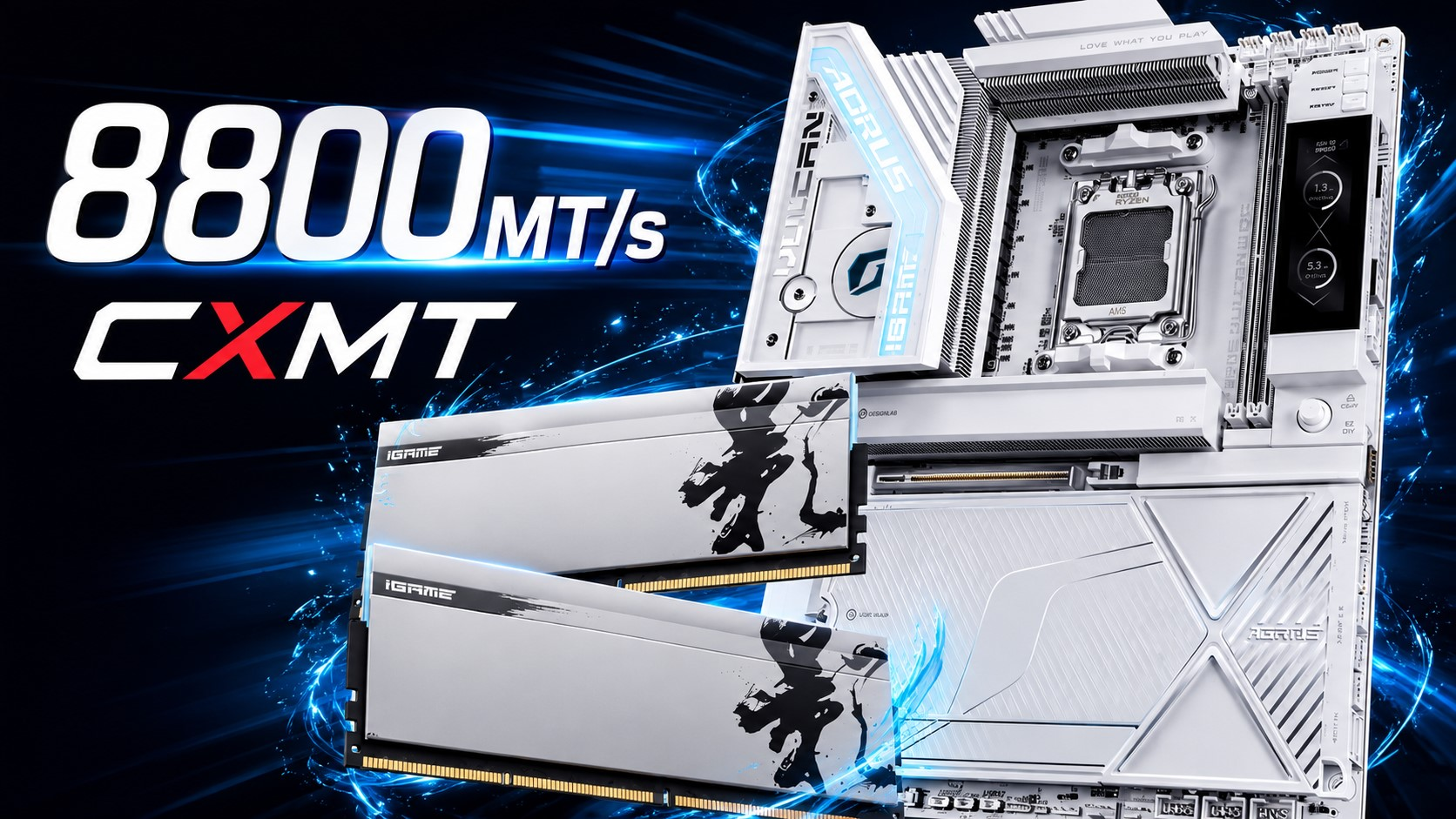
Colorful has pushed DDR5 memory using Chinese manufactured CXMT chips to more than 8800 MT/s on AMD's AM5 platform, extending the overclocking capability of domestic Chinese DRAM only weeks after the same memory reached 8600 MT/s. The latest demonstration used Colorful iGame Shadow II memory with the iGame X870E Vulcan W OC motherboard, showing that CXMT based DDR5 is continuing to improve rapidly as motherboard manufacturers refine BIOS support and memory training for the chips.
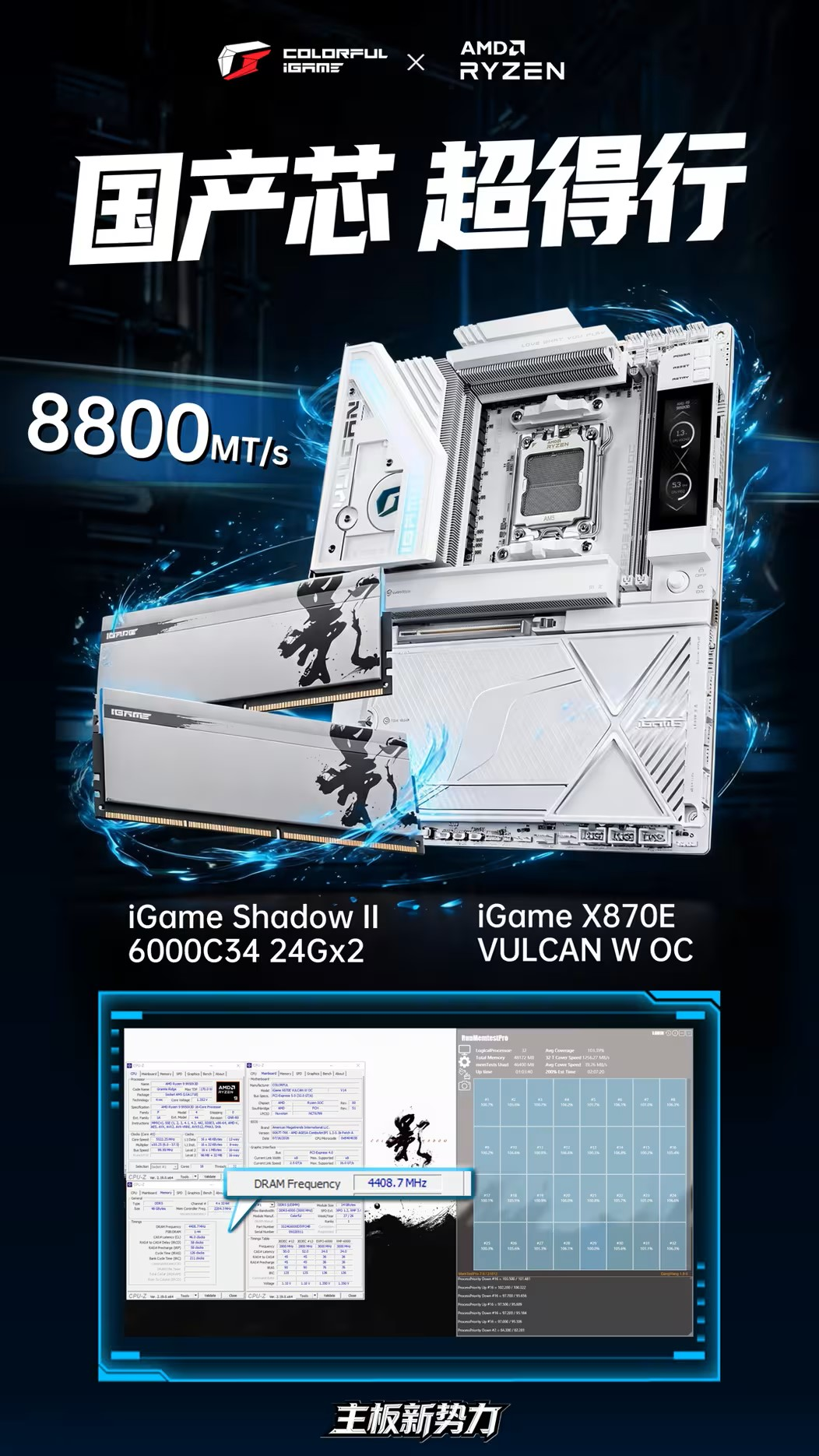
The most notable result came from a 32 GB configuration using 2 × 16 GB modules, which reached DDR5 8812. A second 48 GB configuration using 2 × 24 GB modules pushed slightly further to DDR5 8817. Both configurations were reported as stable during testing. The iGame Shadow II modules are originally rated at DDR5 6000 CL34, meaning the 32 GB kit was operating more than 2800 MT/s above its commercial specification. Detailed timings and DRAM voltage for the latest test have not been clearly disclosed.
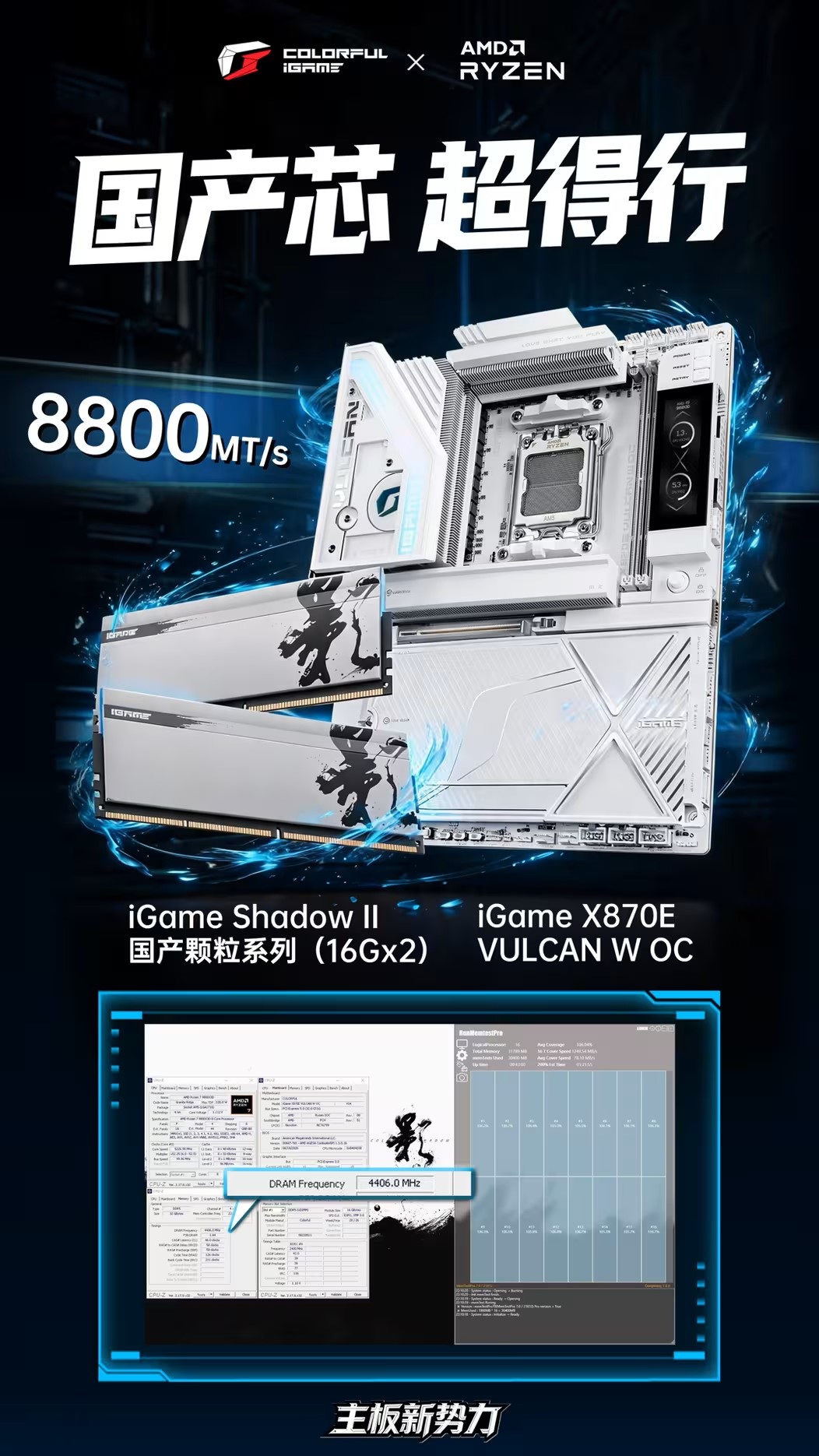
The 2 × 16 GB result is particularly interesting because high frequency DDR5 kits above 8600 MT/s are commonly built around 24 GB modules using highly optimized 3 GB DRAM dies. Colorful instead achieved more than 8800 MT/s using 16 GB modules equipped with CXMT 2 GB dies, creating a more demanding configuration for both the memory silicon and the Ryzen memory controller. It represents another meaningful improvement over Colorful's previous 8600 MT/s CXMT demonstration, which used a 32 GB configuration on the same AMD X870E overclocking platform.
CXMT memory has advanced quickly across AM5 during 2026. MSI has validated CXMT based memory at up to 8200 MT/s on selected 2 DIMM AMD motherboards, while ASUS has demonstrated speeds around 8400 MT/s. GIGABYTE has also introduced broader CXMT compatibility with validation reaching 8200 MT/s on AM5. Colorful's latest 8800 MT/s result now places Chinese DDR5 much closer to the frequencies normally associated with established high performance memory ICs from SK hynix.
The result should not be interpreted as proof that every CXMT memory kit will reach these frequencies. Previous testing has shown considerable variation between CXMT production batches, weaker voltage scaling, and less consistent manual tuning compared with mature SK hynix DDR5 dies. Memory overclocking also depends heavily on CPU memory controller quality, motherboard topology, BIOS optimization, voltage, cooling, and module binning.
Duck IT Take
The important part is not simply another 200 MT/s increase. CXMT based DDR5 has moved from being viewed primarily as a domestic supply alternative to demonstrating frequencies that would have looked unrealistic for Chinese DRAM only months ago. Reaching 8800 MT/s with 2 × 16 GB modules on AM5 shows meaningful progress in both the silicon and the platform optimization surrounding it.
SK hynix, Samsung, and Micron still hold major advantages in production maturity, consistency, timings, efficiency, and proven high frequency binning. However, if CXMT can translate demonstrations like this into commercially validated DDR5 8000 and faster kits with consistent yields, Chinese memory could become a much more serious competitor in the enthusiast PC market.
Question for readers
Would you consider a CXMT based DDR5 gaming kit if it offered 8000 MT/s or faster performance at a competitive price?
