
Colorful Pushes CXMT Based iGame Shadow II DDR5 to 8600 MT/s on AMD X870E
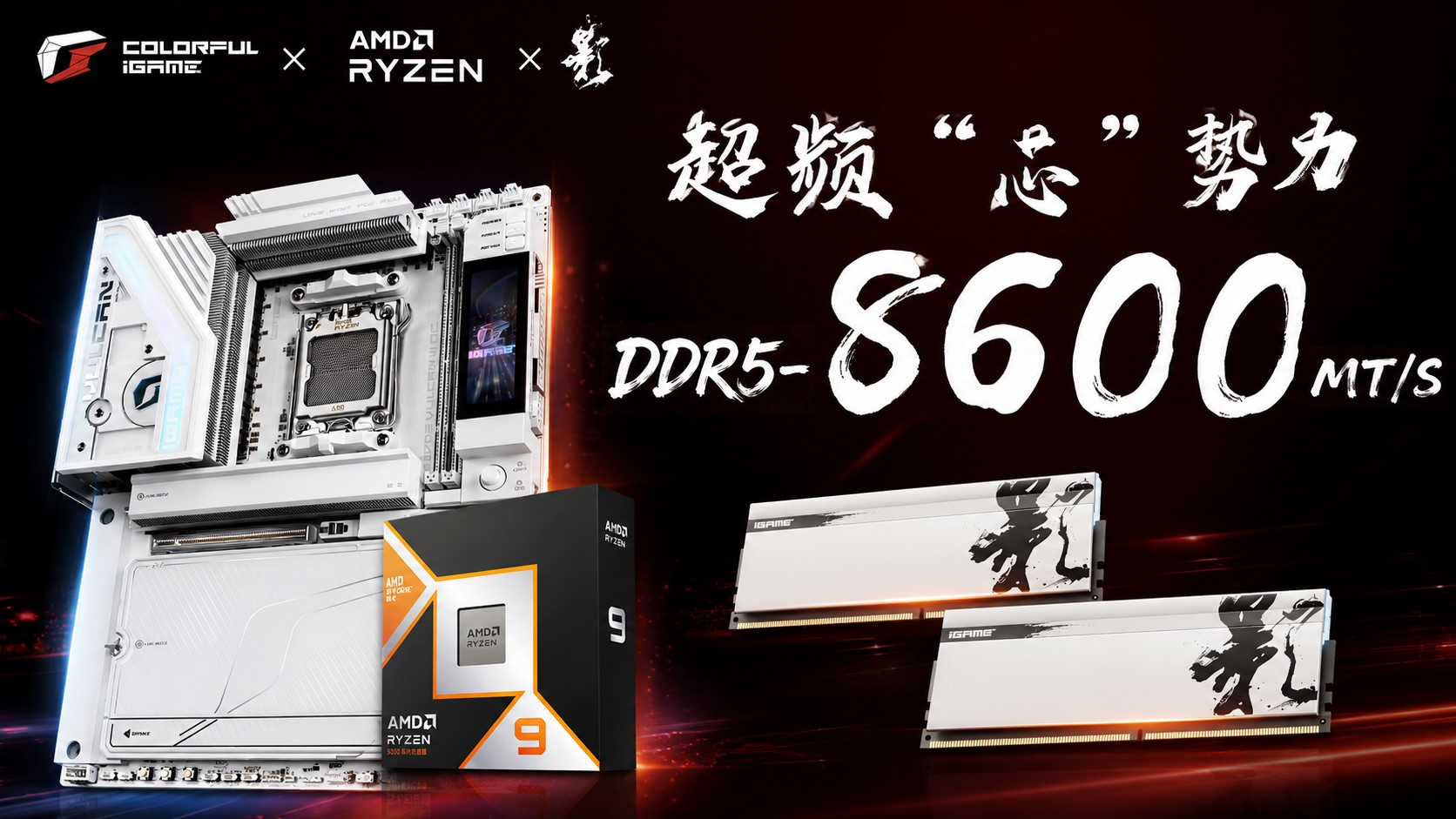
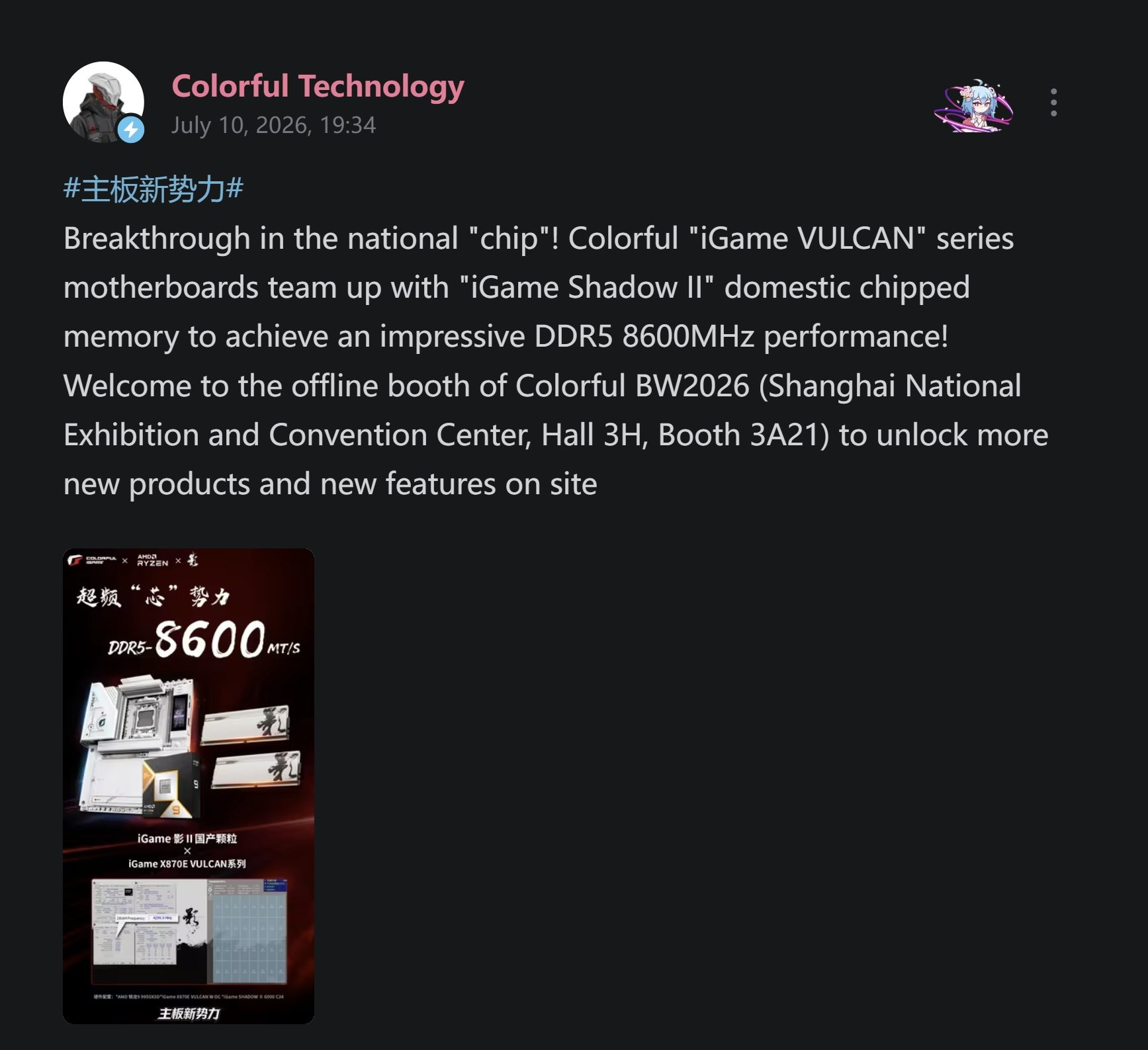
Colorful has pushed its CXMT based iGame Shadow II DDR5 memory kit to 8600 MT/s on an AMD X870E platform, establishing one of the fastest publicly demonstrated results for consumer DDR5 modules using Chinese manufactured DRAM chips.
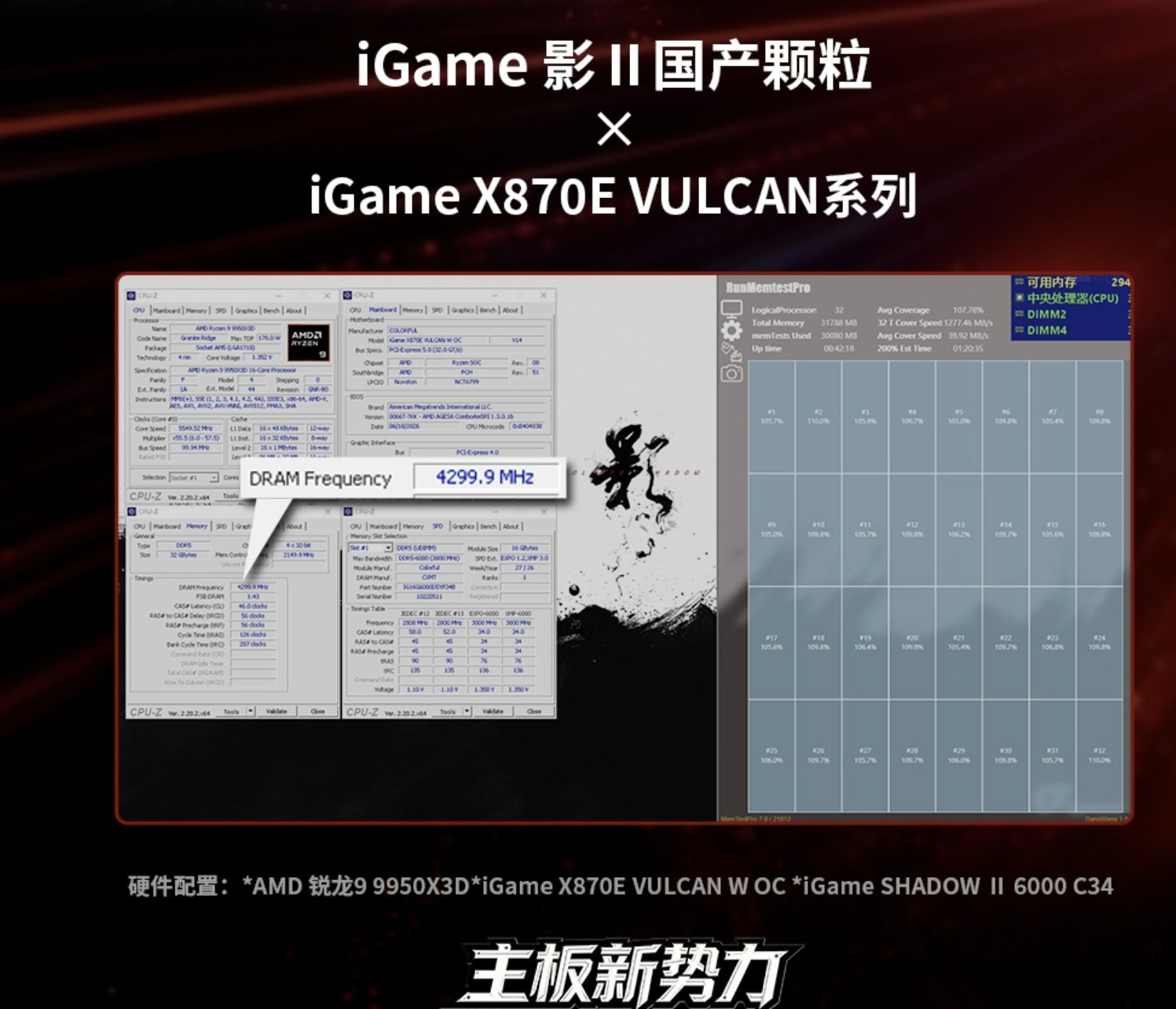
The demonstration used a 32 GB iGame Shadow II kit consisting of 2 × 16 GB modules installed on the Colorful iGame X870E Vulcan OC V14 motherboard. The system was powered by an AMD Ryzen 9 9950X3D processor, while CPU Z recorded a physical DRAM frequency of 4299.9 MHz, corresponding to an effective DDR5 data rate of approximately 8600 MT/s. The memory operated at CL46 and completed a 100% RunMemTestPro stability test, according to results shared by UNIKO’s Hardware.
The iGame Shadow II kit is originally rated for DDR5 6000 operation and uses 2 GB DDR5 dies manufactured by ChangXin Memory Technologies, better known as CXMT. Reaching 8600 MT/s represents a substantial 2600 MT/s increase over the rated profile and demonstrates that the practical overclocking ceiling of CXMT memory is considerably higher than previously assumed.
CXMT based DDR5 memory had historically been associated with mainstream speeds around 6000 MT/s, partly because of limited motherboard BIOS optimization and memory training support. Recent firmware developments from major motherboard manufacturers are now beginning to remove those limitations, allowing memory kits using Chinese DRAM chips to reach significantly higher transfer rates on current AMD platforms.
MSI recently introduced new BIOS versions for selected AM5 motherboards that enabled CXMT based modules to operate at up to 8200 MT/s on boards with 2 memory slots. MSI also validated speeds of up to 7200 MT/s on selected 4 slot models, with testing involving both 2 GB and 3 GB CXMT dies. The demonstrated configurations completed memory stability testing, indicating that the improvement was not limited to basic system booting or short benchmark runs.
ASUS followed with results reaching approximately 8400 MT/s on its AMD 800 series platform, while Lexar has moved closer to commercializing higher speed CXMT memory through officially announced DDR5 7600 kits operating at CL38. Colorful has now extended the reported limit by another 200 MT/s, placing the iGame Shadow II result at the front of this emerging competition.
The 8600 MT/s result is particularly notable because it was completed using 2 modules rather than a single DIMM demonstration. Running 2 memory modules places greater electrical and training demands on the processor memory controller and motherboard layout, making stable high frequency operation more difficult.
The iGame X870E Vulcan OC V14 is designed specifically for memory and processor overclocking, with a layout optimized for signal integrity and high speed DDR5 tuning. Colorful has previously used the motherboard to demonstrate considerably faster memory speeds with other DRAM suppliers, but this result is focused specifically on the progress of CXMT silicon rather than the absolute performance limit of the motherboard.
This distinction is important because Colorful previously demonstrated iGame Shadow II memory running at speeds as high as 9600 MT/s on an AMD platform using different memory chips and configurations. The new 8600 MT/s result is therefore not a record for the Shadow II product family or DDR5 memory overall. It is significant because it demonstrates how quickly CXMT based modules are closing the performance gap with established DRAM manufacturers.
CL46 is also a reasonable timing for DDR5 8600, particularly for memory based on dies that were originally positioned closer to mainstream operating speeds. However, raw transfer rate alone does not determine real world gaming or application performance. Overall latency, memory controller ratio, secondary timings, voltage, workload behavior, and platform stability can all influence the practical benefit.
On Ryzen 9000 processors, extremely high DDR5 frequencies generally operate with the memory controller running at a divided ratio, which can introduce additional latency. In some gaming workloads, a lower frequency configuration with tighter timings may still outperform a higher frequency setting. The Colorful result should therefore be viewed primarily as a demonstration of silicon capability, BIOS maturity, and motherboard signal quality rather than evidence that DDR5 8600 is automatically the best configuration for every Ryzen gaming system.
The broader importance of the demonstration lies in the diversification of the global DRAM market. Samsung, SK hynix, and Micron continue to dominate advanced memory production, while a growing percentage of their investment and manufacturing resources is being directed toward higher margin products such as HBM and enterprise DRAM. This shift has encouraged consumer memory brands to evaluate alternative suppliers for gaming and mainstream DDR5 products.
CXMT could benefit from this market transition if it can consistently deliver competitive yields, stability, pricing, and overclocking capability. Higher speed validation from Colorful, MSI, ASUS, and Lexar suggests that the company’s latest DDR5 dies may be capable of serving a wider part of the enthusiast market than earlier generations.
However, an overclocking demonstration does not guarantee that every retail kit will reach the same speed. Memory overclocking depends on silicon quality, processor memory controller capability, motherboard design, BIOS version, cooling, and manual voltage tuning. Retail modules using the same CXMT dies could produce different results depending on binning and system configuration.
A future move toward officially rated CXMT DDR5 8000 or faster kits would represent a more meaningful commercial milestone. It would require memory manufacturers to validate those speeds across supported motherboards while providing production consistency and warranty coverage. Lexar’s DDR5 7600 announcement shows that this transition has already started, while Colorful’s 8600 MT/s demonstration provides a preview of what highly binned modules may eventually offer.
Colorful reaching 8600 MT/s with CXMT based DDR5 is more important for what it represents than for the benchmark number alone. The result shows that CXMT memory is rapidly moving beyond the perception that Chinese DDR5 is limited to mainstream frequencies and basic value focused products.
The largest improvement appears to be coming from the complete platform rather than the DRAM chips alone. Better BIOS training, motherboard signal optimization, improved memory controller tuning, and more aggressive module binning are unlocking performance that may have already existed inside the silicon but was previously inaccessible.
Colorful also deserves credit for validating the configuration through a full RunMemTestPro pass rather than presenting only a CPU Z screenshot. Completing a 100% stability test gives the result more credibility, although additional details including DRAM voltage, secondary timings, memory controller voltage, and test duration would provide a clearer picture of how practical the configuration is for daily operation.
CXMT still has significant work ahead before it can challenge Samsung, SK hynix, and Micron across the broader global enthusiast market. Consistent production quality, motherboard compatibility, international availability, and long term reliability will matter more than a single high frequency result.
Even so, the pace of improvement is difficult to ignore. MSI reached 8200 MT/s, ASUS moved to 8400 MT/s, and Colorful has now demonstrated 8600 MT/s. At this rate, a CXMT based DDR5 9000 result appears increasingly realistic, especially on specialized 2 DIMM motherboards with heavily optimized BIOS support.
Would you consider buying a CXMT based DDR5 gaming kit if it offered performance and pricing comparable to memory using Samsung, SK hynix, or Micron chips?
