
AMD PEPS Research Cuts Neural Texture Compression Parameters by 25%
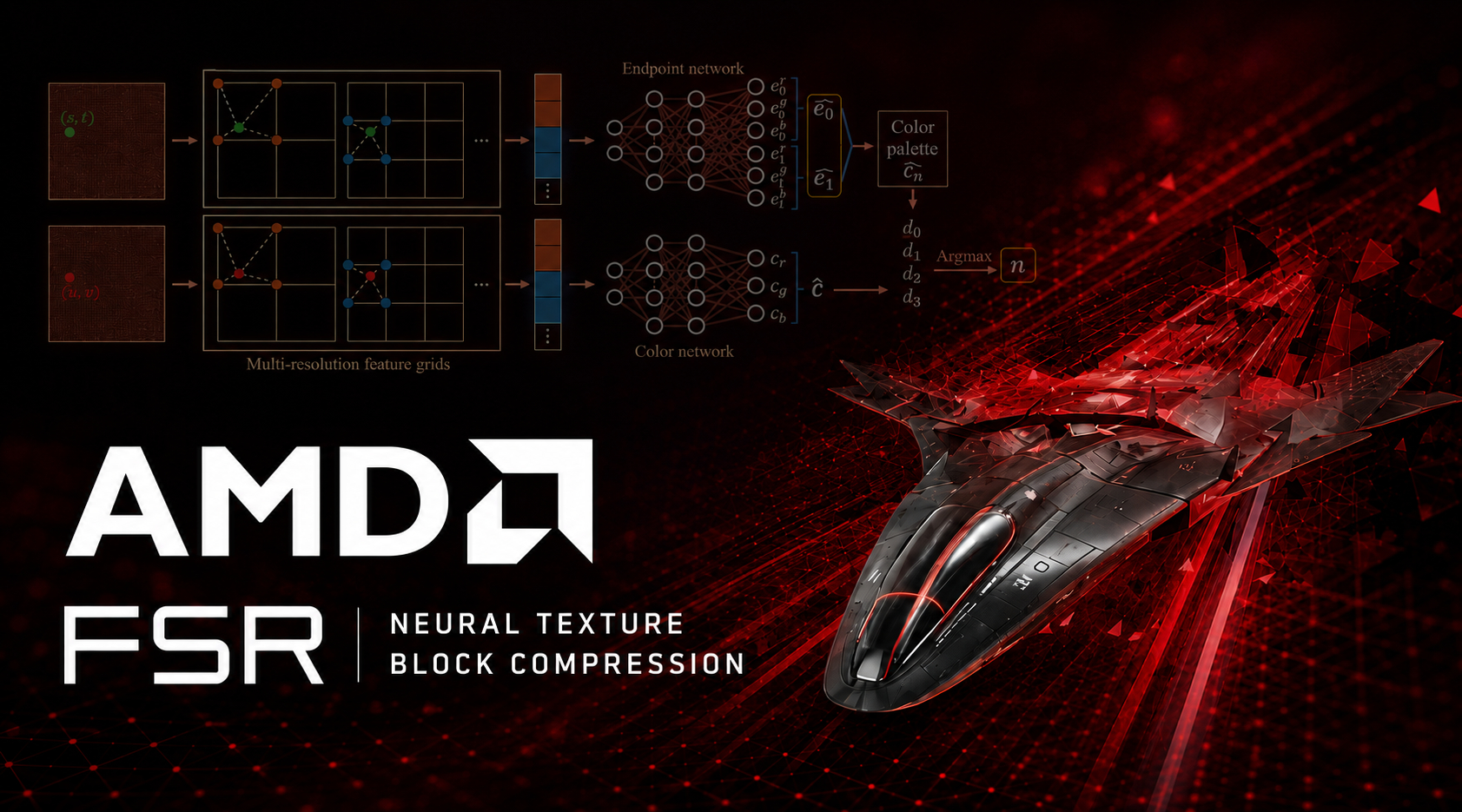
AMD has presented new graphics research at the I3D 2026 Symposium that could make neural texture compression and other implicit neural representation workloads more memory efficient. The research, titled PEPS: Positional Encoding Projected Sampling, introduces a new approach to positional encoding that can require 25% fewer model parameters while delivering comparable reconstruction quality or rendering accuracy. The work was developed by AMD researchers Guillaume Perez, Janarbek Matai, and Takahiro Harada, with additional information shared through AMD GPUOpen.
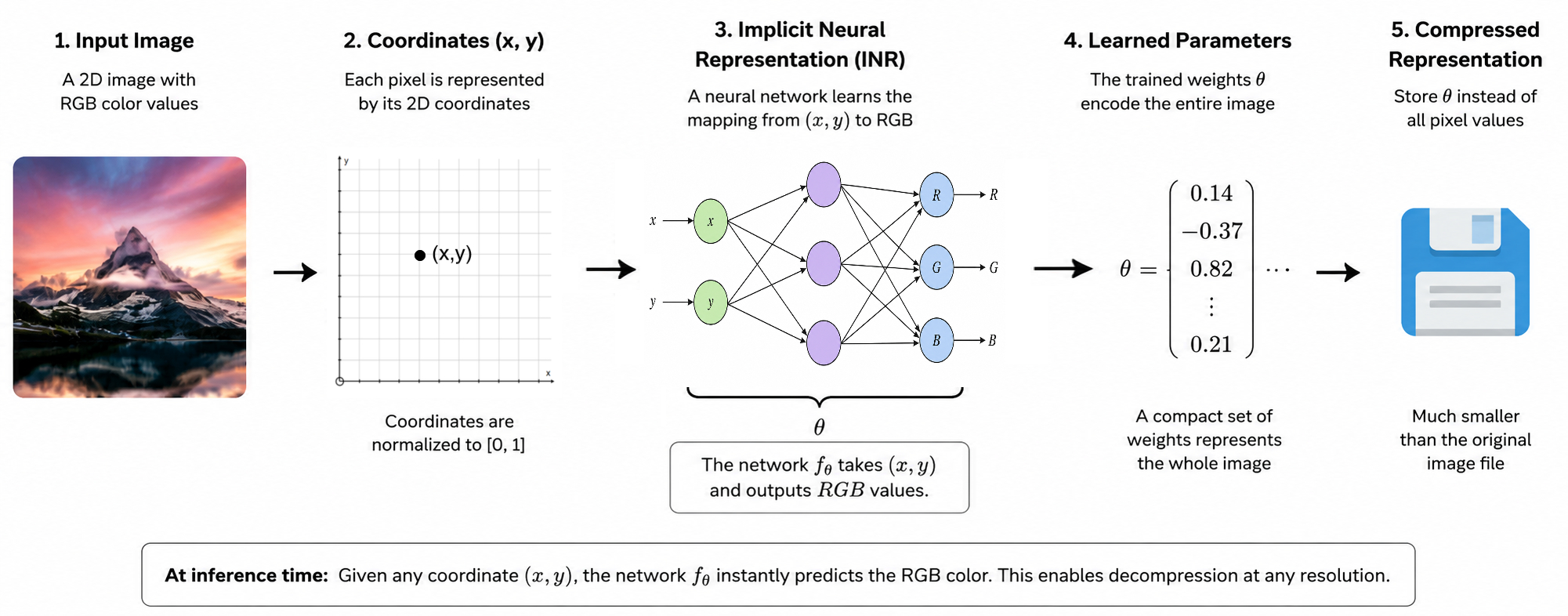
Neural texture compression uses implicit neural representations, commonly known as INRs, to learn coordinate to signal functions. Instead of storing every texture value conventionally, an INR receives texture coordinates and predicts the corresponding color, material, or surface information through a compact neural network. These systems commonly project low dimensional coordinates into a higher dimensional representation before passing the resulting data into a multilayer perceptron. This allows detailed textures and multidimensional signals to be represented with fewer stored parameters, although traditional positional encoding can struggle with complex, high frequency information unless larger grids or more advanced encoders are used.
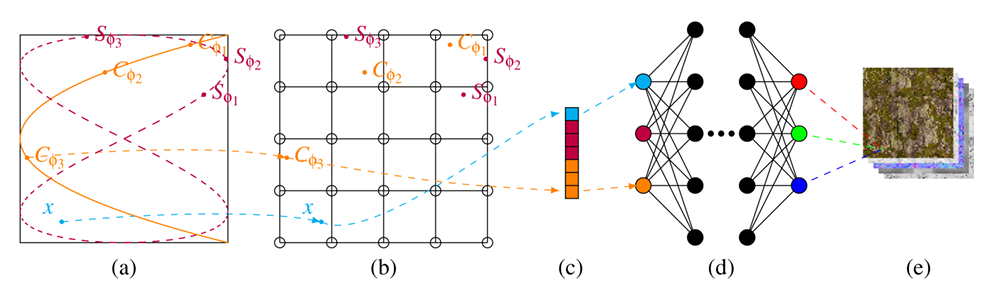
PEPS changes this process by treating each sine and cosine projection produced through positional encoding as a meaningful sampling point rather than only combining the projections into a single higher dimensional vector. As positional frequencies change, these projected points move along distinctive Lissajous curves. AMD uses these trajectories to sample learned grid encoders at several projected locations, giving the neural representation access to more useful information without requiring the same grid resolution or parameter count as conventional methods.
AMD also developed PinkPEPS, an optimized aggregation method that allocates latent dimensions according to the power spectral density of natural signals. Lower frequency information generally contains more signal energy, so PinkPEPS assigns representation capacity based on frequency rather than distributing resources equally across every sampled point. According to the research, this approach improves efficiency while preserving the stronger learning capability introduced by the main PEPS framework.
Testing across an 18 set neural texture compression dataset showed that PEPS based configurations generally delivered stronger image quality metrics than conventional bilinear grids, Local Positional Encoding, and the tested neural texture compression architecture. The highest overall results came from NTC PinkPEPS, which achieved an average PSNR of 41.89 and an SSIM score of 0.95. Configurations using 25% fewer parameters also remained competitive, supporting AMD’s claim that the method can reduce model size while retaining comparable reconstruction quality.
This reduction introduces additional computational overhead. AMD implemented neural texture decompression through HIP and tested it on a Radeon RX 9070 XT. Generating a single 1024 by 1024 three channel texture required 4.32 ms using the standard bilinear grid, compared with 5.47 ms using Grid PEPS. Grid PinkPEPS reduced the result to 4.86 ms, representing a 12.5% increase over the bilinear grid baseline and a meaningful improvement over the original Grid PEPS implementation. AMD attributed the performance difference to the additional arithmetic operations and memory accesses required by the expanded grid sampling process.
PEPS may also offer benefits beyond texture compression. AMD evaluated the technology with signed distance functions, which represent three dimensional shapes by storing the distance between a spatial point and the nearest surface. These representations can require dense, high resolution grids that consume significant memory, making them another potential target for lightweight neural compression.
During testing with the Pitted Stonefish signed distance function, Grid PEPS achieved an Intersection over Union score of 0.453 using the smaller encoder configuration. A larger Grid PEPS model using 8 times more encoder parameters reached 0.466, but several competing methods required the larger parameter configuration merely to approach the smaller Grid PEPS result. This indicates that PEPS could improve the representation of complex geometry while reducing the encoder memory footprint.
Consumer adoption, however, remains uncertain. AMD presented PEPS as research rather than a confirmed Radeon gaming feature, and the paper does not announce integration with FidelityFX Super Resolution, HYPR RX, Radeon drivers, or a commercial game development toolkit. The method also carries a measurable performance cost, meaning future implementations would need to balance memory savings against decompression latency and available GPU compute resources.
PEPS represents an important research direction for an industry increasingly constrained by texture size, geometry complexity, memory bandwidth, and graphics memory capacity. Neural compression is unlikely to replace established texture compression formats immediately, but it could eventually allow developers to deliver richer assets within tighter memory budgets.
The most significant result is not simply the 25% parameter reduction. It is that AMD demonstrated stronger representation efficiency using comparatively simple grid encoders. This could become valuable as game engines adopt neural rendering techniques across textures, materials, geometry, animation, and lighting.
However, PEPS should not currently be interpreted as an upcoming FSR feature or an immediate solution for graphics cards with limited VRAM. It remains an experimental technique with additional computational requirements, no announced consumer implementation, and no confirmed game integration. Its long term value will depend on whether AMD can convert the research into practical developer tools, optimized hardware paths, and real time rendering workflows.
Would you accept a small performance cost if neural texture compression could substantially reduce VRAM usage and allow games to use higher quality assets?
