
ASUS ProArt GR1X Claims 1440p 100+ FPS Gaming With RTX Spark at 140W
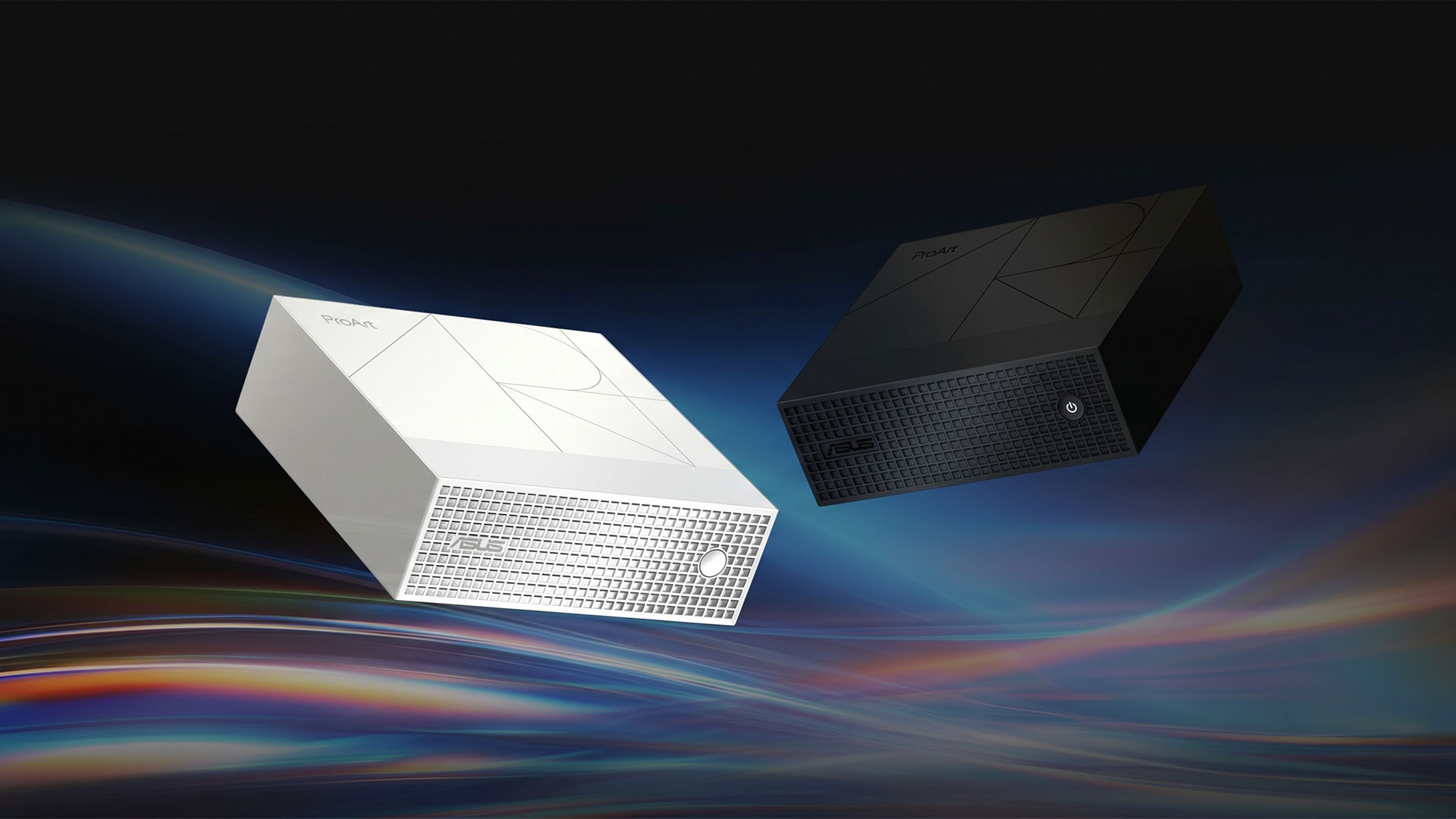
ASUS is expanding the positioning of its ProArt GR1X Mini PC beyond AI development and professional creation, promoting the compact NVIDIA RTX Spark system as capable of AAA gaming at 1440p with more than 100 FPS. The claim is particularly interesting because the RTX Spark platform operates at a 140W TDP while combining a 20 core NVIDIA Grace CPU and Blackwell RTX GPU inside a chassis measuring just 150 x 150 x 51 mm.
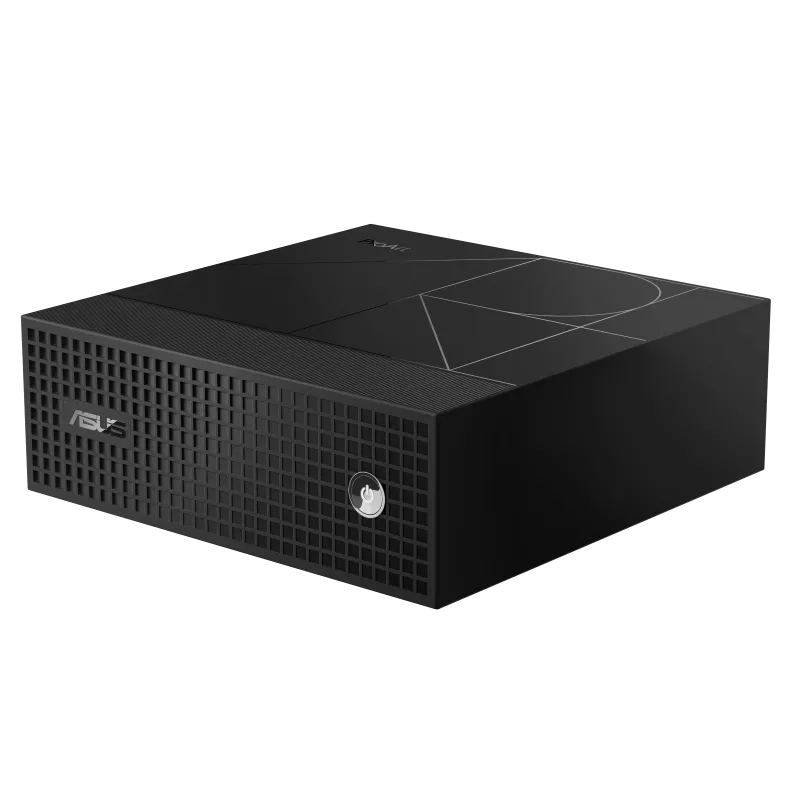
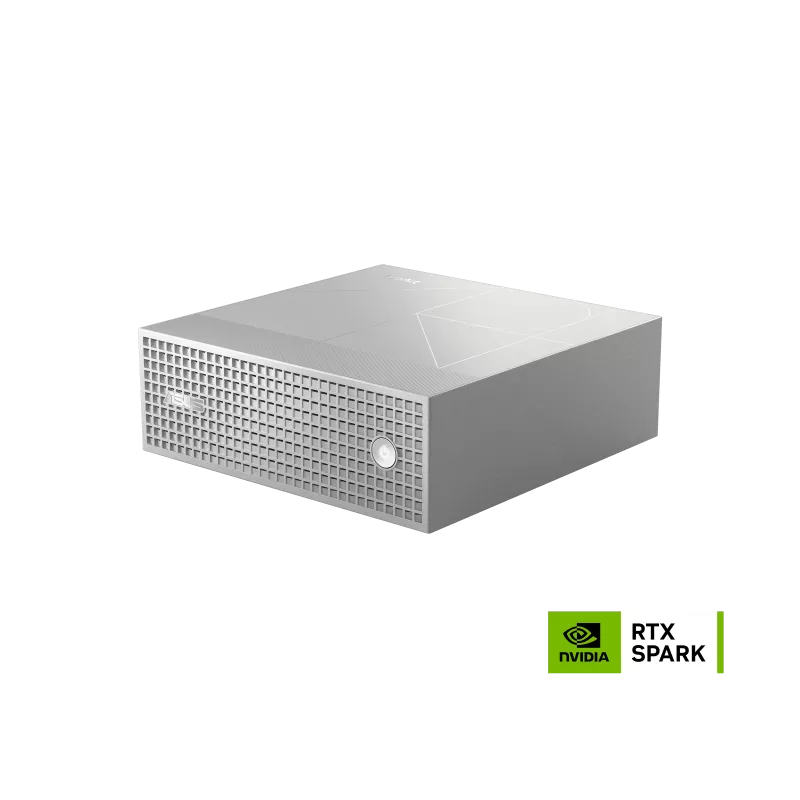
According to the official ASUS ProArt GR1X product page, the highest configuration uses the NVIDIA RTX Spark N1X Superchip with a 6,144 core Blackwell RTX GPU, 20 core Grace CPU, up to 128 GB of unified LPDDR5X memory, and up to 1 petaFLOP of FP4 AI performance. CPU and GPU resources are connected through NVIDIA NVLink C2C and access the same unified memory pool, allowing workloads to use considerably more memory than would typically be available to a conventional consumer GPU.
| Specification | ASUS ProArt GR1X |
|---|---|
| Processor | NVIDIA RTX Spark N1X |
| CPU | 20 core NVIDIA Grace |
| GPU | 6,144 core NVIDIA Blackwell RTX |
| Unified Memory | Up to 128 GB LPDDR5X |
| AI Performance | Up to 1 petaFLOP FP4 |
| Platform TDP | 140 W |
| Power Supply | 240 W |
| Storage | PCIe 5.0 and PCIe 4.0 NVMe |
| Networking | WiFi 7, Bluetooth 5.4, 10G LAN |
| Dimensions | 150 × 150 × 51 mm |
| Volume | Approximately 1.1 liters |
| Weight | 1.48 kg |
ASUS now lists the GR1X as capable of AAA gaming at 1440p and more than 100 FPS, alongside support for NVIDIA DLSS, Reflex, 4th generation Ray Tracing Cores, and Dynamic Multi Frame Generation. However, ASUS does not currently identify which games were used for the 100+ FPS claim, what graphics settings were selected, the internal rendering resolution, or how aggressively DLSS and Multi Frame Generation were configured. The number should therefore be treated as an ASUS performance claim rather than a directly comparable native 1440p benchmark.
The 140W specification also deserves context. ASUS lists 140W as the platform TDP while the complete GR1X uses a 240W power supply, meaning 140W should not be interpreted as the total power consumed by the entire Mini PC from the wall during gaming. Even so, integrating a 20 core CPU, Blackwell graphics, and up to 128 GB of unified memory within that thermal envelope makes the platform considerably different from a traditional desktop built around a discrete graphics card.
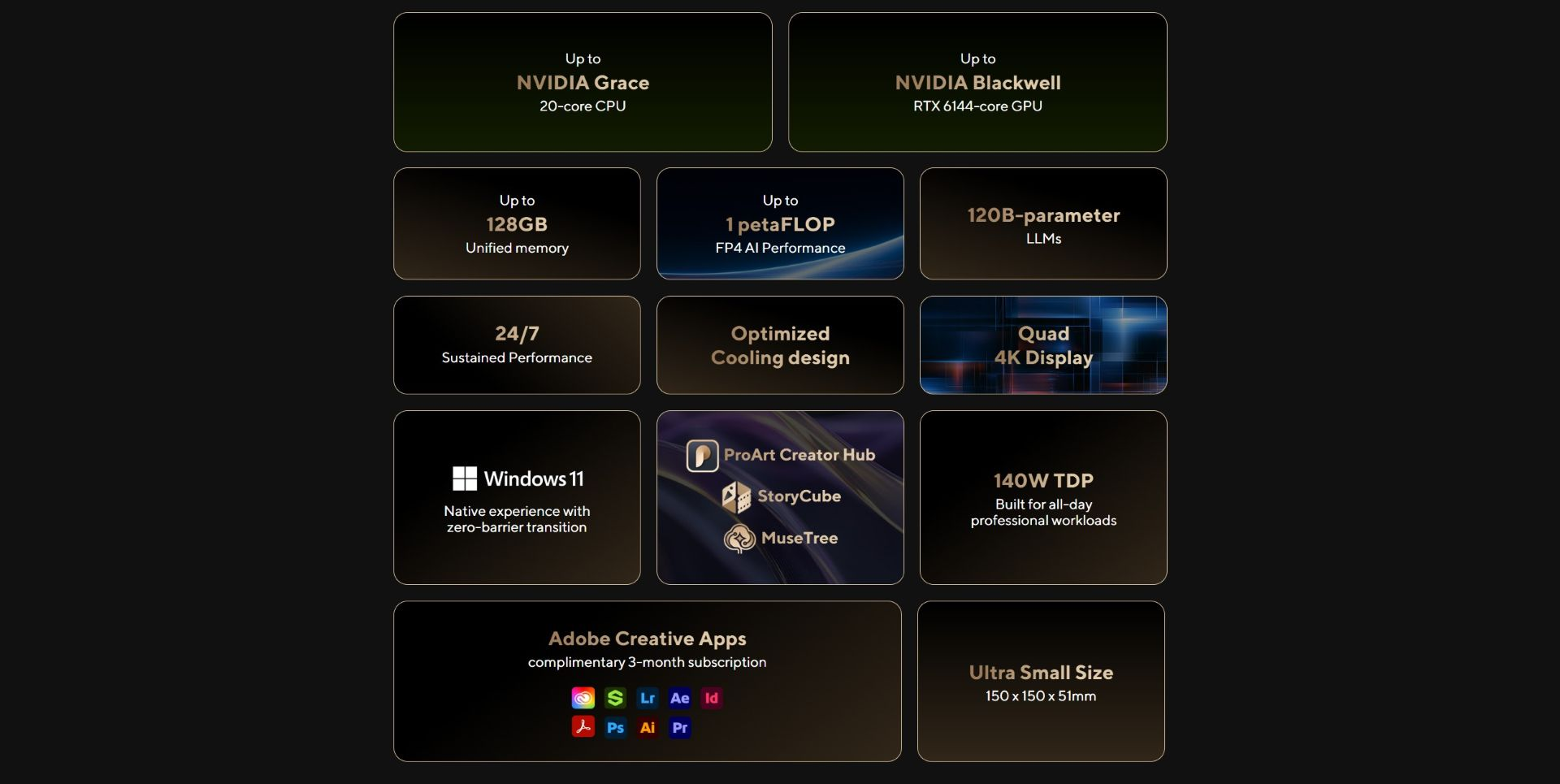
Cooling is handled by 2 fans with 109 blades each, 57 wide cooling fins, and 4 heat pipes. ASUS says the cooling design is intended for sustained workloads including continuous AI processing, rendering, and professional applications, with the company positioning the GR1X for 24/7 operation.
Gaming is only one part of the system's intended workload. ASUS says the 128 GB configuration can handle local large language models containing up to 120 billion parameters with context windows reaching 1 million tokens, while the unified memory architecture can accommodate 3D scenes reaching around 90 GB. Creative features include hardware accelerated 4:2:2 video processing, NVIDIA Studio technologies, CUDA, OptiX, RTX rendering, and AI assisted workflows.
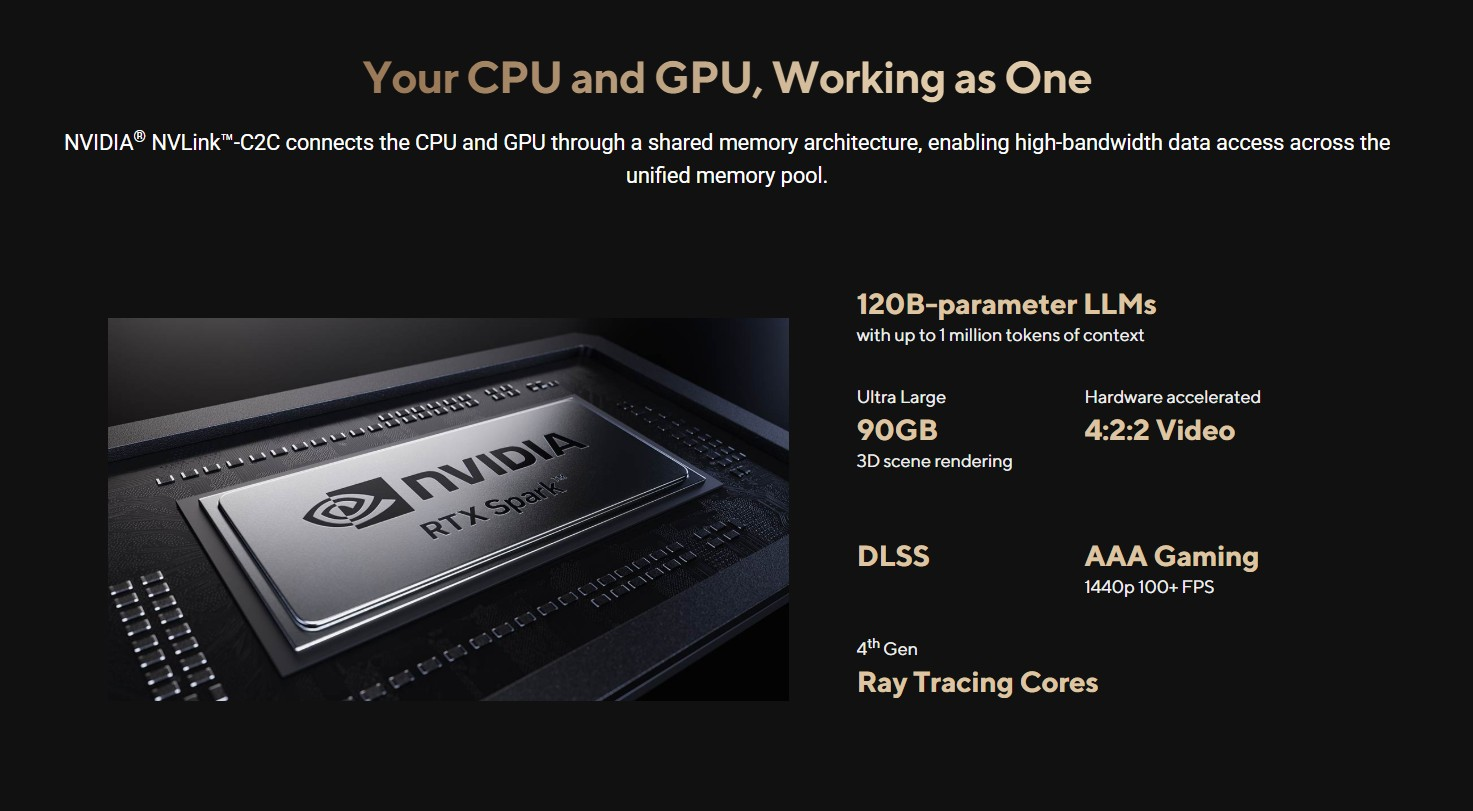
The unified memory configuration is arguably one of the GR1X's biggest advantages over conventional compact gaming PCs. Rather than separating system memory and dedicated VRAM, the Grace CPU and Blackwell GPU access the same memory pool. ASUS will offer both 64 GB and 128 GB configurations, making the system particularly interesting for AI models, large 3D projects, and professional workloads where GPU memory capacity can become a more significant limitation than raw compute performance.
Connectivity is similarly workstation focused. The GR1X includes 3 USB 3.2 Gen 2x2 Type C ports with DisplayPort support, another USB Type C connection for EPR PD 3.1 power input, HDMI 2.1, 10G Ethernet, WiFi 7, and Bluetooth 5.4. ASUS says the system can drive up to 4 displays, with HDMI supporting output up to 8K.
The system also represents another important step for NVIDIA's Windows on Arm strategy. RTX Spark combines the Grace Arm CPU with Blackwell graphics rather than using the x86 architecture found in most gaming PCs. NVIDIA has already introduced native Windows on Arm RTX Spark drivers and CUDA support, while game developers have been preparing selected titles and anti cheat systems for the platform.
ASUS has already reported strong early interest in RTX Spark hardware, with its initial allocation reportedly fully booked by channel customers. The GR1X now shows ASUS attempting to broaden that audience beyond AI developers and creators by positioning the same hardware as a compact gaming system.
The ProArt GR1X is far more interesting than the 100 FPS headline alone suggests.
ASUS' 1440p performance claim needs independent testing before meaningful comparisons can be made with conventional GeForce desktops because DLSS settings, Multi Frame Generation, game selection, and graphics presets remain unspecified. Generated frames can dramatically change displayed frame rates, so 100+ FPS does not necessarily describe the underlying native rendering performance.
What makes the GR1X compelling is the combination of capabilities inside roughly 1.1 liters. A 20 core Grace CPU, 6,144 core Blackwell GPU, up to 128 GB of unified memory, CUDA support, local AI acceleration, and modern RTX gaming technologies create a machine that sits somewhere between a Mini PC, compact workstation, AI development system, and gaming computer.
The bigger test for RTX Spark will be Windows on Arm software compatibility. If NVIDIA and Microsoft can make existing gaming libraries behave consistently while developers continue expanding native support, machines such as the GR1X could become a genuinely new category rather than simply specialized AI hardware with gaming functionality added on top.
Would you consider an RTX Spark Mini PC like the ProArt GR1X for gaming and AI workloads, or would you prefer a traditional x86 desktop with a dedicated GeForce GPU?
