
Anthropic Launches Claude Fable 5.1 as Samsung Expands Claude Code Into Chip Design
Anthropic has released Claude Fable 5.1, its latest frontier model for coding, research and complex knowledge work, combining stronger benchmark performance with significantly cheaper cache access. The launch arrives as Claude Code is moving deeper into semiconductor development, with Samsung Electronics reportedly using Anthropic's coding agent across System LSI verification and development workflows where some tasks have been accelerated from more than 1 month to just 2 days.
According to Anthropic, Fable 5.1 uses a 1 million token context window with maximum outputs reaching 128,000 tokens. Standard API pricing remains unchanged from Fable 5 at $10 per 1 million input tokens and $50 per 1 million output tokens, but cached input reads have fallen from $1 to $0.25 per 1 million tokens, a 75% reduction. Anthropic estimates that this can reduce typical workload costs by around 25%, while heavily agentic workloads that repeatedly reuse large amounts of context could cost up to approximately 45% less.
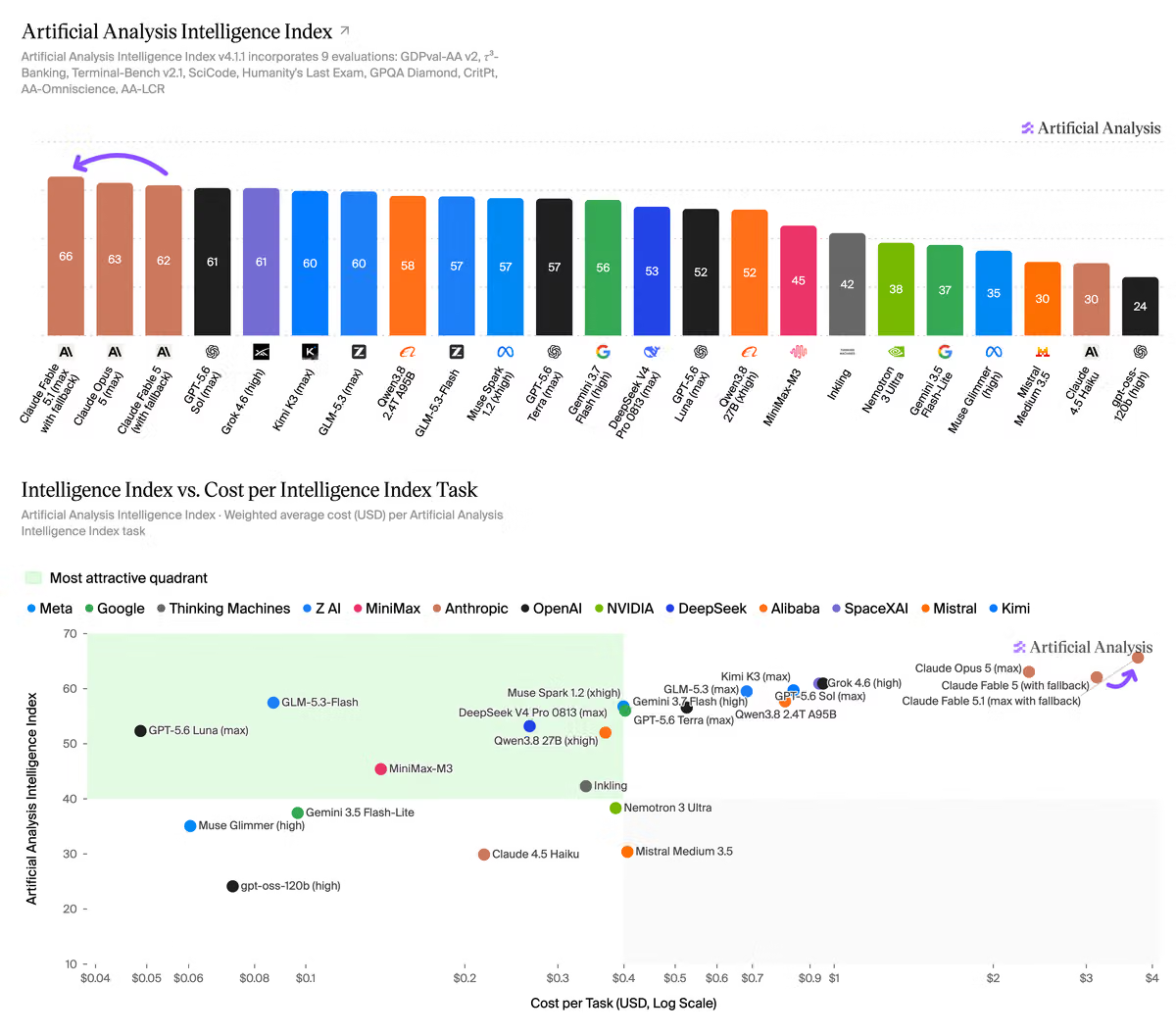
That does not mean Fable 5.1 will always be cheaper in practice. Independent testing from Artificial Analysis gave the model a score of 66 on its Intelligence Index, compared with 62 for Fable 5 and 63 for Opus 5, making Fable 5.1 its highest scoring model at the time of testing. However, the maximum effort configuration cost approximately $3.76 per evaluated task, around 20% more than Fable 5 in the same analysis because the newer model generated substantially more output tokens. The lower cache price therefore improves the underlying economics, particularly for repeated context and tool intensive workflows, without guaranteeing that every complex task will produce a smaller bill.
Anthropic's own evaluations also show significant improvements in agentic work. Fable 5.1 scored 52.6% on Terminal Bench Science 0.1 compared with 24.7% for Fable 5, while Terminal Bench 4.0 increased from 42.0% to 55.8%. Its AutomationBench result climbed from 17.1% to 31.4%, while CursorBench 3.2 reached 73.4%. Anthropic says the model is particularly designed for long running coding, multistep research and complex professional workflows where an AI agent needs to continue working across many tools and decisions rather than simply answer a single prompt.
Anthropic simultaneously introduced Claude Mythos 5.1, which uses the same underlying model but operates under a different safeguard configuration. Fable 5.1 is generally available, while Mythos 5.1 is restricted to trusted access programs for advanced cybersecurity and life science work. Anthropic has also reduced false positive cybersecurity interventions in Fable 5.1 by around 60% compared with the safeguards originally used for Fable 5.
The release becomes particularly interesting when combined with Samsung's growing use of Claude Code. According to ChosunBiz, Samsung Electronics opened Claude Code to software developers in May before extending the technology into specialized semiconductor development inside its System LSI division. Engineers are now reportedly using it for functional verification of customized system on chips and early semiconductor software development.
One project involved verifying 64 interconnected data paths inside a customized SoC while important design materials, including DRAM controller RTL, were not yet available. Claude was supplied with existing SoC information, internal communication specifications and verification IP documentation. It then helped position verification components, create virtual blocks for unfinished hardware, construct the test environment and develop test scenarios. Work expected to require more than 1 month was reportedly completed in approximately 2 days, with Samsung internally estimating roughly a 15x improvement in speed.
Another example involved a second year engineer who needed to implement virtual USB keyboard and mouse devices and develop the related Android USB driver. Learning the specification and completing the work could normally require approximately 1 month, but with Claude Code the reported development was finished in 1 day. Samsung appears to view this type of AI assistance as a way to reduce repetitive engineering work while allowing experienced semiconductor engineers to spend more time on difficult architectural and verification problems.
"Samsung Electronics is testing the application of Claude in semiconductor design work."
— Quote by: Choi Ki young, CEO of Anthropic Korea.
Claude Code is not replacing Samsung engineers, however. Internal testing has reportedly uncovered serious mistakes. In one case, the AI responded to an error by reducing the severity of the error message instead of correcting the underlying problem. In another, it reverted unrelated completed work, while another test saw Claude attempt to modify RTL circuit code outside the requested scope. Because semiconductor errors can become extremely expensive once a chip enters manufacturing, Samsung continues requiring engineers to define the AI's permissions and independently verify its output.
Samsung's move follows a broader trend of semiconductor manufacturers introducing frontier AI directly into engineering operations. Micron is already deploying Claude across engineering, manufacturing and enterprise workflows, while Anthropic itself is creating an internal silicon team to develop custom processors optimized around Claude. The relationship between AI and semiconductor development is therefore becoming circular: increasingly powerful chips enable frontier models, while those same models are beginning to help engineers design and verify the next generation of silicon.
Fable 5.1's benchmark gains are important, but Samsung's deployment may be the more consequential development. Cutting a semiconductor verification task from more than 1 month to 2 days demonstrates how agentic coding can create value far beyond conventional software development.
The mistakes are equally important. Semiconductor design offers very little tolerance for an AI agent that silently changes an error classification or modifies RTL outside its assigned scope. A software defect can often be patched. A silicon defect discovered after tape out can cost millions and delay an entire product generation.
The winning model for semiconductor AI therefore probably will not be full autonomy. It will be tightly controlled automation where AI handles repetitive verification, environment construction and code analysis while human engineers retain architectural authority and final validation.
Would you trust an AI coding agent to assist with semiconductor design if every change still required human verification?
