
AMD’s $5.4 Billion ATI Gamble Still Defines the Company 20 Years Later
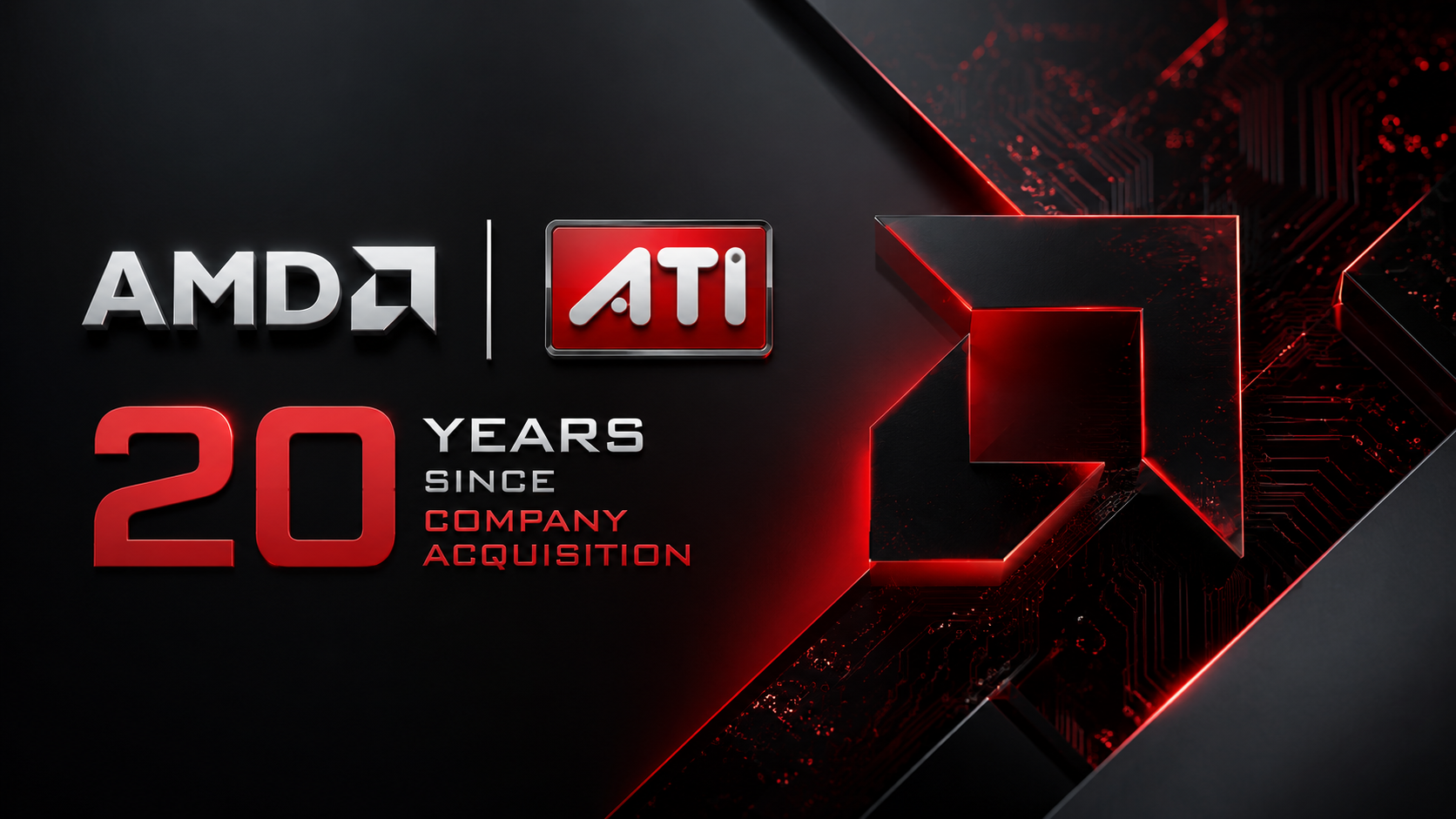
On July 24, 2006, AMD announced an agreement to acquire ATI Technologies for approximately $5.4 billion, creating one of the most consequential combinations in semiconductor history. The transaction was completed on October 25, bringing ATI’s graphics processors, chipsets, consumer electronics expertise, and Radeon portfolio into a company previously recognized primarily for competing with Intel in the CPU market.
The acquisition was considered a major financial and strategic gamble. AMD committed approximately $4.3 billion in cash and 58 million shares when the transaction closed, taking on significant financial pressure to purchase a company operating in a highly competitive graphics market. However, AMD’s original ATI acquisition presentation already outlined the long term opportunity clearly. The company wanted to combine CPU and GPU development, improve platform integration, expand into notebooks and consumer electronics, and build more capable products for gaming consoles.
AMD retired the ATI product name in 2010, but Radeon remained central to its graphics strategy. The branding disappeared, not the engineering foundation. ATI’s technology, intellectual property, and graphics teams continued shaping Radeon products as AMD developed new architectures for gaming, professional visualization, embedded systems, and accelerated computing.
The acquisition also made AMD’s Fusion strategy possible. In 2011, the company introduced its first generation of Accelerated Processing Units, combining x86 CPU cores with Radeon graphics inside a more tightly integrated processor design. These chips did not eliminate the need for discrete graphics cards, particularly in demanding gaming and professional workloads, but they made capable graphics available in affordable notebooks, desktops, compact computers, and entertainment systems without requiring separate graphics hardware.
That CPU and GPU integration eventually became one of AMD’s strongest commercial advantages. PlayStation 5 uses a custom AMD Zen 2 processor with Radeon RDNA 2 graphics, while Xbox Series X combines a custom Zen 2 CPU with an RDNA 2 GPU. Valve’s Steam Deck follows the same broader concept through a compact AMD processor integrating Zen 2 CPU cores and RDNA 2 graphics. AMD technology now extends across desktop computers, notebooks, PlayStation and Xbox consoles, gaming handhelds, and other integrated platforms.
Radeon also preserved AMD’s position in discrete gaming graphics. NVIDIA remains the strongest competitor in the premium GPU market, but Radeon has continued providing an alternative across multiple generations through competitive rasterization performance, larger memory configurations on selected products, open graphics technologies, and integration with AMD processor platforms. The current Radeon business remains directly connected to the graphics capability AMD gained through ATI, even as modern RDNA architectures have evolved far beyond the designs available in 2006.
The impact extends into artificial intelligence and high performance computing. AMD introduced Radeon Instinct in 2016 as a collection of GPU accelerators and open software designed for machine intelligence. The company later separated its gaming and compute architecture strategies, creating CDNA specifically for AMD Instinct accelerators. Today, Instinct forms the foundation of AMD’s attempt to challenge NVIDIA in artificial intelligence training, inference, and supercomputing.
That roadmap continues to expand, AMD is preparing its Instinct MI500 generation for 2027 with CDNA 6, advanced 2nm manufacturing, and HBM4E memory. These products are technologically distant from ATI’s original Radeon chips, but they remain part of the wider graphics and parallel computing foundation that the acquisition helped AMD establish.
The anniversary was also recognized through a commemorative post from Sasa Marinkovic, reflecting how the ATI transaction remains closely connected to AMD’s identity 20 years later.
20 years ago today, @AMD announced its acquisition of ATI Technologies, bringing together world-class processor and graphics innovation under one roof.
— Saša Marinković (@SasaMarinkovic) July 24, 2026
That combination gave AMD the enduring and unique ability to deliver high-performance CPUs and GPUs across PCs, gaming, data… pic.twitter.com/JOV6CkB5Fe
The ATI acquisition did not instantly transform AMD into the company it is today. The transaction created financial pressure, integration challenges, and years of difficult competition. However, it gave AMD something that would have been extraordinarily difficult to recreate internally: a mature graphics organization, established intellectual property, the Radeon brand, and the ability to design complete computing platforms around both CPU and GPU technology.
Without ATI, AMD might still have rebuilt its CPU business, but it would not hold the same strategic position across gaming consoles, handheld systems, integrated processors, discrete graphics, and artificial intelligence accelerators. The acquisition was expensive and risky, but 20 years later, it remains the decision that expanded AMD from a CPU competitor into a complete computing company.
Was acquiring ATI the most important decision in AMD’s history, or does the development of Zen deserve that title?
