
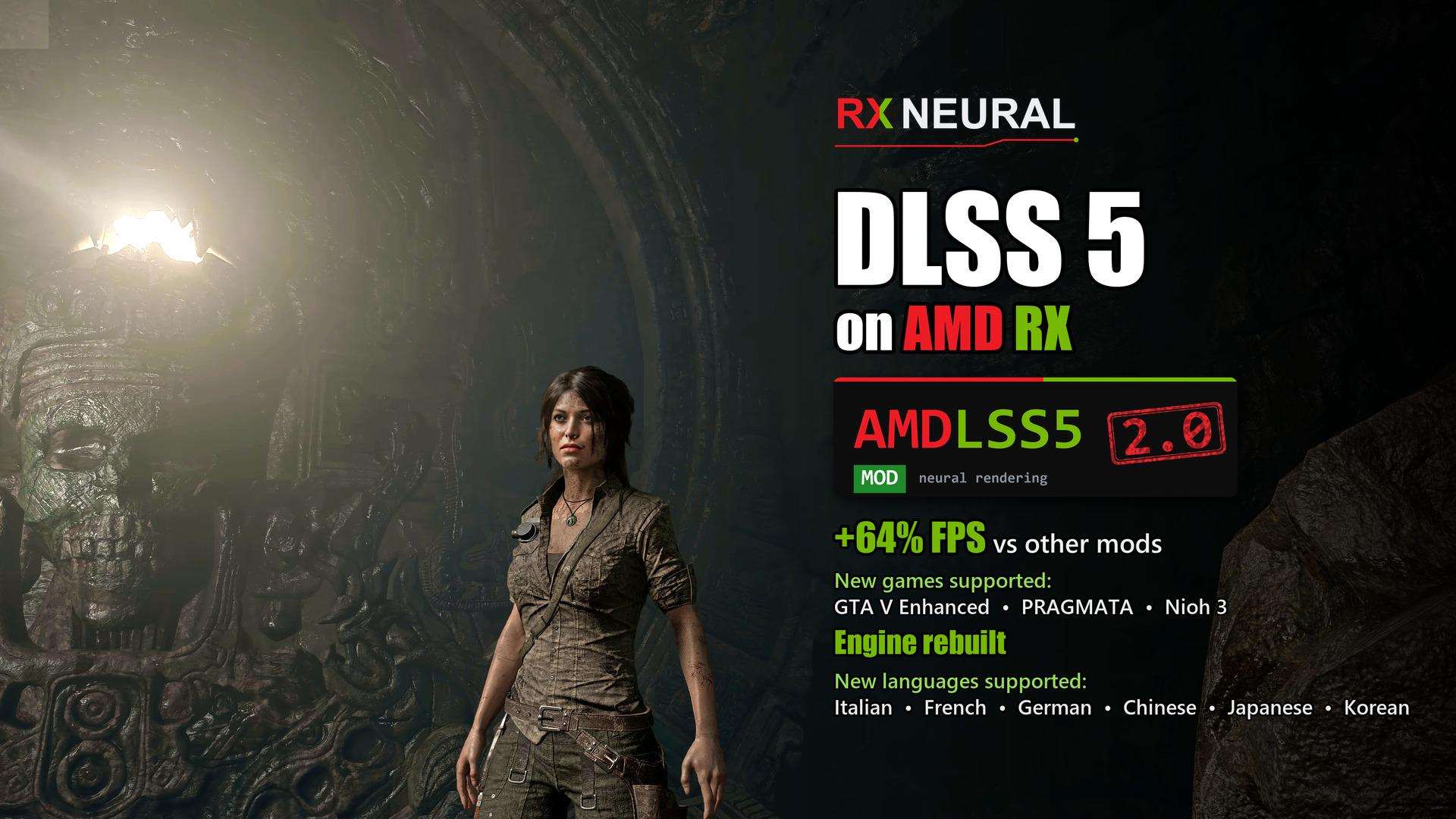
The PC modding community continues expanding access to NVIDIA's proprietary rendering technologies, with developer Wehaveall releasing AMDLSS5 2.0, an experimental modification designed to bring DLSS 5 Neural Rendering to AMD Radeon graphics cards. The latest update introduces a completely redesigned rendering engine, expanded game compatibility, and substantial performance improvements, with the developer reporting up to 64% higher average FPS compared with competing neural rendering mods.
According to the official AMDLSS5 GitHub repository, version 2.0 replaces its previous dependency on external modification files with a dedicated engine developed specifically for the project. The new implementation integrates neural rendering into existing DirectX 12 upscaling pipelines, using technologies such as AMD FSR 2, FSR 3.1, and Intel XeSS. Unlike NVIDIA's official DLSS 5 implementation, AMDLSS5 is an unofficial community project without official support from either AMD or NVIDIA.
The performance improvements were demonstrated in Resident Evil Requiem, using a Radeon RX 9070 XT at 4K with FSR enabled. According to the developer's Reddit benchmark results, AMDLSS5 2.0 reached an average of 101.2 FPS, compared with 91.3 FPS using version 1.6.1 and 61.6 FPS through competing modifications.
AMDLSS5 Performance Comparison
| Implementation | Average FPS | 1% Low FPS |
|---|---|---|
| Competing Mods | 61.6 | 55.5 |
| AMDLSS5 1.6.1 | 91.3 | 66.0 |
| AMDLSS5 2.0 | 101.2 | 78.5 |
| Improvement vs. Older Version | +11% | +19% |
| Improvement vs. Competing Mods | +64% | +41% |
Developer benchmarks recorded over 60 seconds using PresentMon, Radeon RX 9070 XT, 4K resolution, and FSR. Results have not been independently verified. The 64% improvement does not represent a gain over unmodified gameplay.
Beyond performance, the update introduces support for PRAGMATA, Nioh 3, and Grand Theft Auto V Enhanced, joining existing compatible games such as Cyberpunk 2077, The Witcher 3, Red Dead Redemption 2, Monster Hunter Wilds, and Resident Evil Requiem. GTA V Enhanced compatibility is restricted to offline Story Mode with BattlEye disabled. Additional features include 39 color grading presets, improved ambient occlusion, indirect lighting adjustments, local tone mapping, and updated 2x frame generation support for selected games.
Hardware compatibility primarily targets AMD Radeon RX 9070 and RX 9070 XT graphics cards. The developer expects the RX 9060 series to function, while RX 7000 GPUs have received experimental alpha support. However, these additional configurations have not been validated on actual hardware. The latest implementation also requires Windows 10 or Windows 11, an AVX2 compatible processor, and a supported DirectX 12 game.
The developer has published a video demonstration comparing AMDLSS5 2.0 with alternative implementations, showcasing the reported performance improvements and visual enhancements. The mod is available free through its official GitHub release page, although the source code for version 2.0 has not yet been published, limiting independent review of its implementation.
The project follows earlier experiments that successfully demonstrated NVIDIA DLSS 5 Neural Rendering on AMD Radeon hardware, highlighting growing community interest in making advanced rendering technologies available across competing GPU architectures.
AMDLSS5 2.0 demonstrates how PC modders continue challenging the hardware restrictions surrounding proprietary graphics technologies. While NVIDIA has made significant progress with DLSS 5 performance optimization, the technology remains officially restricted to supported GeForce hardware.
The reported 64% improvement is impressive, but it primarily demonstrates more efficient implementation compared with competing mods rather than a universal improvement in gaming performance. Independent testing will be necessary to evaluate image quality, GPU overhead, latency, and stability.
More importantly, projects like AMDLSS5 reinforce the value of an open and flexible PC gaming ecosystem. Players should have greater freedom to use advanced rendering technologies on capable hardware without unnecessary vendor restrictions. Broader compatibility encourages competition, extends GPU longevity, and provides more options for consumers who prefer upgrading software rather than replacing perfectly functional graphics cards.
Should NVIDIA make DLSS 5 Neural Rendering available to AMD Radeon GPUs, or do you believe exclusive graphics technologies are necessary to maintain competition between GPU manufacturers?
