
AM4 Is Still Getting Fresh BIOS Updates Nearly 9 Years After A320 Arrived
AMD’s AM4 platform continues receiving firmware support nearly 9 years after the first A320 motherboards appeared, with ASUS and GIGABYTE releasing new BIOS versions incorporating AMD AGESA ComboV2 PI 1.2.0.12. The updates are not introducing a new generation of processors to A320, but they do provide current security fixes and platform firmware for some of the oldest Ryzen motherboards still in active use. The timing is particularly relevant as high memory costs continue making complete platform upgrades more expensive, giving existing DDR4 systems another reason to remain operational rather than moving immediately to AM5.
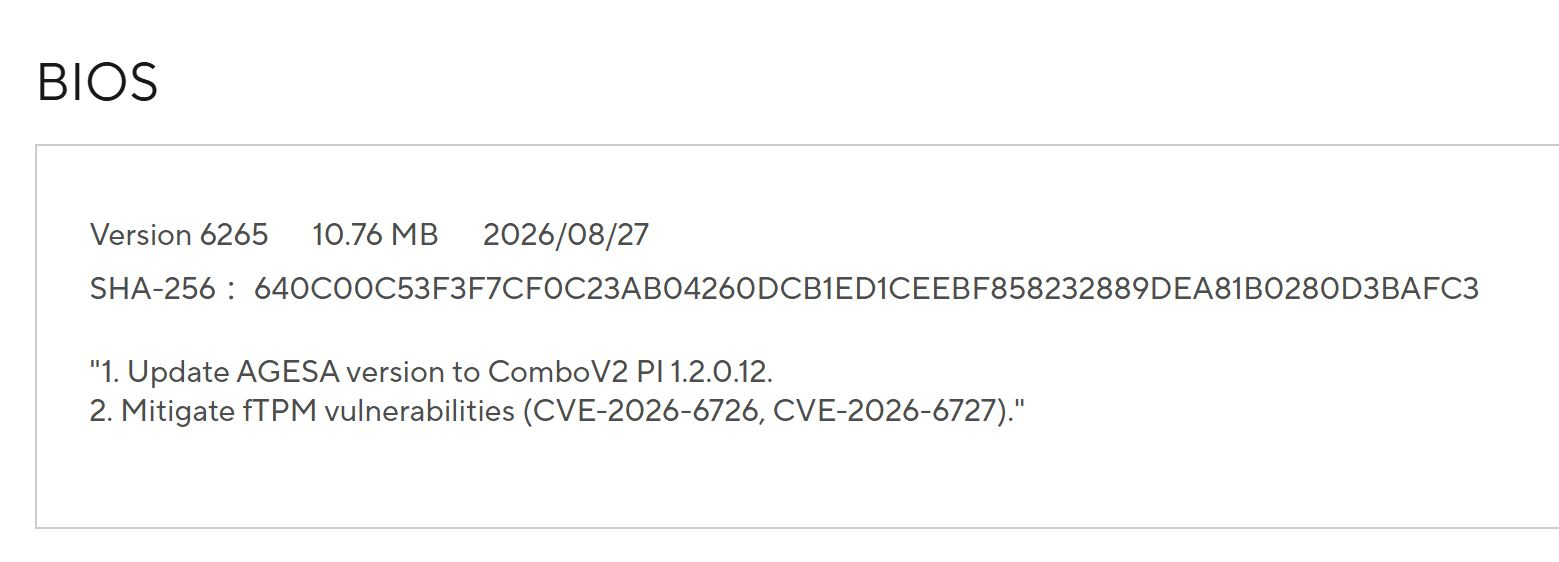
The latest example was highlighted by TechEpiphany, who pointed to fresh firmware for the ASUS PRIME A320M A. ASUS released BIOS version 6265 on August 27, updating the board to AGESA ComboV2 PI 1.2.0.12 while addressing AMD fTPM vulnerabilities identified as CVE 2026 6726 and CVE 2026 6727. The significance is less about the individual security update and more about the age of the hardware receiving it. AMD introduced A320 as its affordable AM4 chipset in 2017 alongside the first generation of Ryzen processors, meaning some boards from that period are still receiving current platform firmware in 2026. ASUS lists the new BIOS directly on its support page, following additional compatibility and security updates released throughout 2025 and 2026.
ASUS is not alone. GIGABYTE has also released AGESA ComboV2 1.2.0.12 firmware for older A320 models including the GA A320M H, GA A320M D2P, and A320M HD3, with BIOS updates dated September 3. These releases contain the same AMD TPM reference code fixes, showing that the continued support is broader than a single motherboard receiving an unusually late update. The process itself is collaborative: AMD supplies the underlying AGESA firmware and platform code, while motherboard manufacturers integrate, validate, and distribute individual BIOS releases for their boards. That distinction matters because BIOS availability and processor compatibility can still vary significantly between models even when they share the same chipset.

AM4 also remains commercially relevant beyond firmware maintenance. AMD launched the Ryzen 5 5500F on September 10, 2026, adding another 6 core Zen 3 processor to the socket years after AM5 became the company’s primary desktop platform. We recently covered the Ryzen 5 5500F launch alongside the Ryzen 5 7500, while ASRock has gone even further by releasing a new B550M Pro A WiFi 6E motherboard for AM4. The 5500F should not be assumed to work with every A320 board, however, since AMD’s own compatibility list currently names X570, X470, X370, B550, B450, B350, and A520 while omitting A320. Users still need to check the CPU support list for their exact motherboard before upgrading.
The longevity becomes even more relevant under current memory market conditions. Moving from an older AM4 system to AM5 normally means replacing the motherboard and moving from DDR4 to DDR5 alongside the processor, making memory pricing part of the total upgrade cost. Although supply conditions are changing, DDR5 pricing remains under pressure from strong server and AI demand, Acer expects PC pricing pressure to remain elevated into 2027, while other parts of the memory industry are warning that allocation could remain tight. For someone already using a functional AM4 system, continued BIOS security and compatibility updates can therefore extend the practical lifespan of hardware that has already been paid for.
AM4’s longevity is increasingly unusual in the modern desktop market. A320 was designed as the entry level member of AMD’s original Ryzen chipset family, yet motherboard vendors are still integrating new AMD firmware and security fixes almost a decade later. That does not suddenly make a 2017 A320 board equivalent to a modern B850 or X870 platform, nor does it guarantee support for every newer AM4 processor, but it does mean users are not automatically being abandoned simply because their motherboard belongs to the first Ryzen era.
The current component market makes that support more valuable. A complete platform replacement can require a new CPU, motherboard, and memory at a time when DRAM pricing remains unusually volatile. For users whose existing Ryzen system still delivers enough performance, keeping AM4 secure and functional can be considerably more practical than upgrading for the sake of moving to a newer socket. AMD may have shifted its development focus to AM5, but AM4 is proving remarkably difficult to retire.
Are you still running an AM4 gaming PC, and if so, do these continued BIOS updates make you more likely to keep it for another upgrade cycle?
