
AMD Linux Driver Adds GDDR7 Support as Next Radeon Architecture Takes Shape
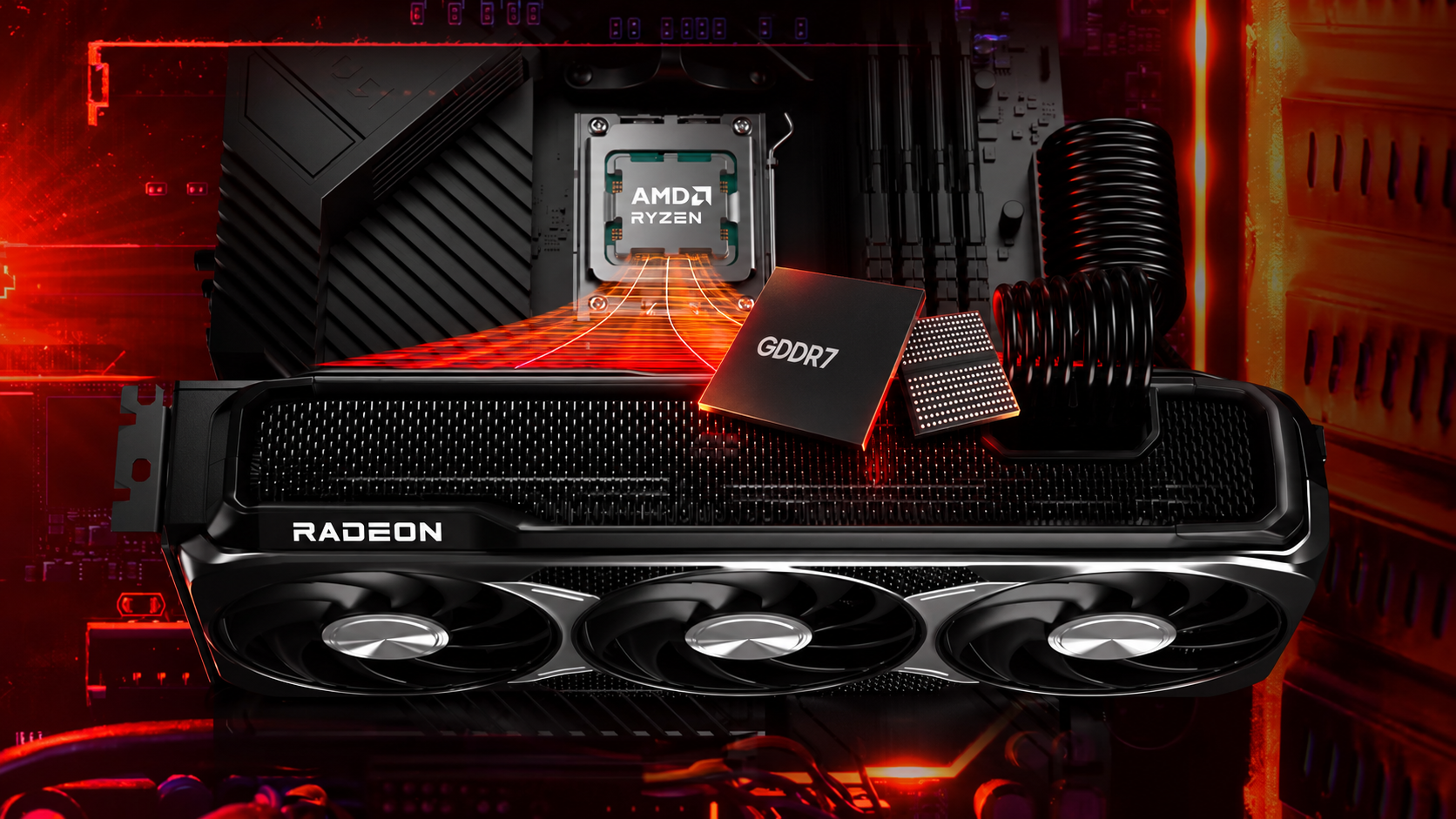
AMD has started preparing its open source Linux graphics stack for GDDR7 memory, adding the new memory type to the AMDGPU driver alongside another wave of hardware enablement patches. The change is small at the code level, but its timing is notable as AMD continues introducing new graphics IP blocks believed to be associated with its next Radeon architecture. Current Radeon RX 9000 graphics cards based on RDNA 4 still use GDDR6, while AMD has not officially confirmed what memory technology its next generation gaming GPUs will adopt.
The latest AMDGPU Linux development adds "GDDR7" to the list of video memory types recognized by the driver. The actual modification is essentially a new identifier allowing AMDGPU to correctly report GDDR7 when hardware using it appears, so this should not be interpreted as a complete memory controller implementation suddenly arriving in Linux. What makes the patch more interesting is the surrounding work. AMD also submitted support for IH 8.0, a new revision of its interrupt handling hardware, and NBIF 7.10, the latest version of the New Bus Interface connecting the GPU with the rest of the system. These additions follow earlier work around Display Core Next 6 and GFX 13.0.x, creating a growing collection of Linux changes associated with unreleased AMD graphics hardware.
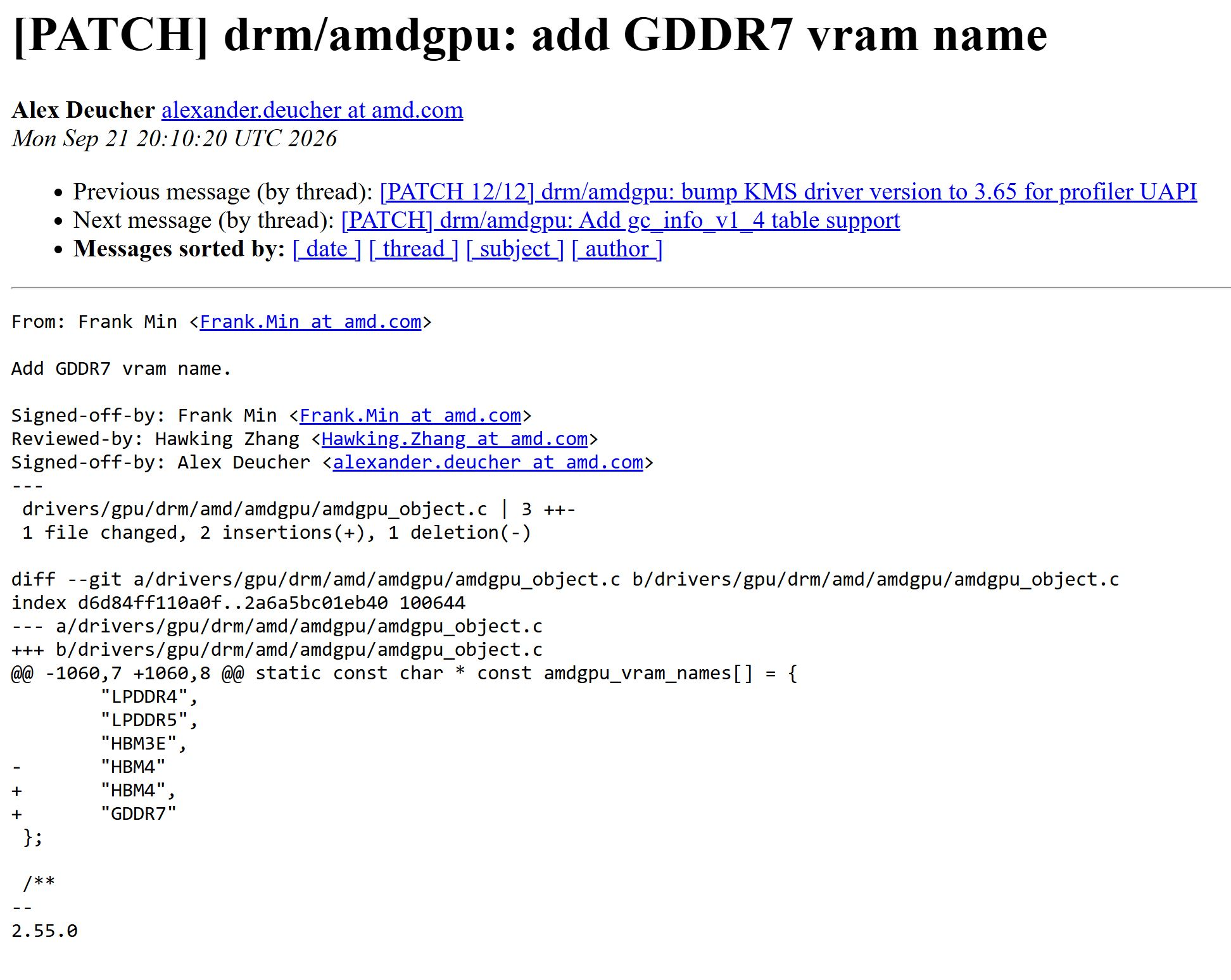
None of these patches officially confirms that the hardware is RDNA 5. AMD has not formally announced RDNA 5 as the commercial name of its next Radeon gaming architecture, nor has it confirmed that future Radeon cards will use GDDR7. Linux development frequently exposes hardware support well before products are announced, however, because AMD develops much of its graphics driver stack in the open. The addition therefore provides the clearest software evidence so far that AMD is preparing to support GDDR7 somewhere within its future graphics portfolio, even if the exact GPU family and product configuration remain unknown.
Moving to GDDR7 would be a logical progression for future Radeon hardware. NVIDIA already uses the technology across its GeForce RTX 50 generation, while memory manufacturers are expanding both speed and density. Recently report that 4 GB and 6 GB GDDR7 memory chips could arrive between 2027 and 2028, potentially allowing future GPUs to offer significantly larger VRAM capacities without widening their memory buses. Higher density devices could be especially useful for mainstream Radeon products, where AMD would have more flexibility to balance memory capacity, PCB complexity, bandwidth, and cost.
The new Linux work also arrives as other pieces of AMD's future graphics strategy begin appearing. Recent reports suggest the company is exploring more advanced neural rendering technologies for its next architecture, AMD was rumored to be developing Neural Lighting for future Radeon hardware. GDDR7 would complement that direction by providing additional memory bandwidth for increasingly complex rendering, ray tracing, and machine learning workloads, although there is still no confirmed connection between the Linux memory patch and those reported features.
AMD's early Linux enablement is also useful for users beyond the hardware speculation. Preparing kernel support before a GPU reaches the market gives distributions, Mesa developers, and application maintainers more time to integrate and test the required infrastructure. AMD has followed this approach for several generations, allowing portions of future graphics hardware to become visible through kernel patches long before the company provides final product names or specifications.
The GDDR7 addition itself is only one line in the driver, so it should not be treated as confirmation of an RDNA 5 specification sheet. The more meaningful story is the pattern forming around it. GFX 13, DCN 6, IH 8.0, NBIF 7.10, and now GDDR7 support show AMD steadily preparing Linux for hardware that has not yet been officially introduced.
GDDR7 would also make sense for AMD's next major Radeon generation, particularly if the company plans to increase ray tracing and neural rendering performance. More bandwidth and higher density memory packages could give AMD considerably more flexibility when designing future GPUs, but until the company names the architecture and confirms its memory subsystem, the Linux patch remains preparation rather than a product announcement.
Would GDDR7 and larger VRAM configurations make AMD's next Radeon generation more attractive to you, or do you think ray tracing and neural rendering performance need to improve first?
