
Windows 11 Prepares Intel APX Support for Nova Lake, With Future AMD CPUs Also Expected to Benefit
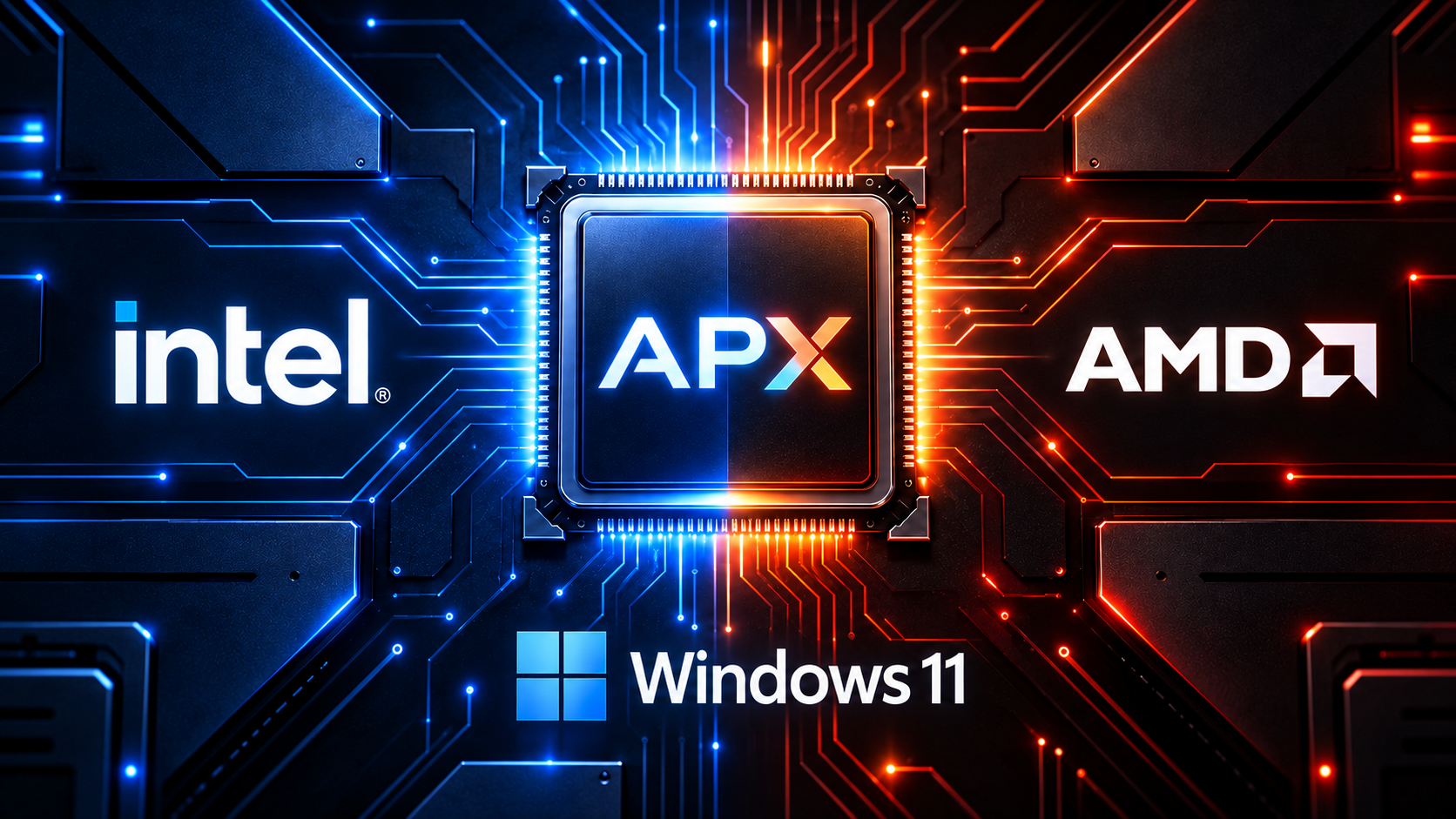
Microsoft is preparing Windows 11 to support Intel's Advanced Performance Extensions (APX), a major expansion of the x86 instruction set designed to improve CPU performance and efficiency. The technology is expected to debut on Intel's upcoming Nova Lake desktop processors and Diamond Rapids Xeon CPUs, while future AMD architectures could eventually adopt the same capabilities.
The feature was discovered by Windows enthusiast Xeno in Windows 11 Insider Preview Build 29695.1001, released October 23, 2026, through Microsoft's Experimental Future Platforms channel. A new setting labeled Advanced Performance Extensions includes the description "Let Windows use APX for better performance" and requires a system restart when enabled. However, the feature remains experimental, and Microsoft has not confirmed when it will become available in a public Windows release.
Here is how the new "Advanced Performance Extensions (APX)" setting would appear on compatible hardware on 29695 https://t.co/o5wrhnruJH
— Xeno (@XenoPanther) October 23, 2026
According to Intel's technical documentation, APX represents one of the most significant upgrades to the x86 architecture in decades. Its primary improvement is doubling the number of general purpose registers from 16 to 32, allowing processors to retain more information internally rather than repeatedly transferring data between registers and memory. The extension also introduces three operand instructions, improved conditional operations and additional mechanisms for reducing unnecessary instruction execution.
These improvements could benefit workloads involving complex calculations, software compilation, data processing and gaming engines, particularly when applications are optimized for the new instruction set.
Intel APX vs Conventional x86 Architecture
| Feature | Conventional x86 | Intel APX |
|---|---|---|
| General Purpose Registers | 16 | 32 |
| Register Capacity | Standard | 2X |
| Memory Load Operations | Baseline | Approximately 10% fewer |
| Memory Store Operations | Baseline | More than 20% fewer |
| Instruction Count | Baseline | Approximately 10% fewer |
| Three Operand Instructions | Limited | Expanded |
| Conditional Execution | Traditional instruction set | Additional conditional operations |
Performance estimates are based on Intel's prototype simulations using SPEC CPU 2017 Integer workloads. Reductions in instruction counts and memory operations do not represent equivalent increases in gaming FPS or application performance.
Microsoft has already begun preparing its software ecosystem for the transition. Its Windows SDK includes development infrastructure for future processor capabilities, while WinDbg has received improvements for handling and inspecting APX registers. The new Windows 11 setting represents another step toward ensuring the operating system can properly manage the additional processor state.
On the hardware side, Intel's Nova Lake and Diamond Rapids architectures are expected to introduce APX support. Software developers have also begun preparing their applications, with AIDA64 introducing an APX optimized SHA3 benchmark for both processor families.
AMD could eventually benefit from the same instruction set improvements as Intel and AMD continue collaborating through their x86 Ecosystem Advisory Group. However, AMD's upcoming Zen 6 architecture does not currently list APX support in GCC 16's processor documentation. This has led to speculation that Zen 7 could become AMD's first compatible architecture, although no official confirmation is available.
Importantly, existing processors cannot gain APX capabilities through a Windows update alone. The technology requires compatible hardware, operating system support and applications compiled to use the new instructions. Intel expects many native applications to benefit through recompilation without significant source code modifications, while software using managed runtimes could receive improvements once those environments adopt APX.
Microsoft's official Windows Insider release notes also clarify that Experimental channel features are not tied to specific retail Windows versions. Consequently, APX support has not been confirmed for Windows 11 27H2 or any particular public release.
Intel APX could become an important architectural improvement because it targets CPU execution efficiency rather than depending exclusively on higher clock speeds or additional cores. Expanding the register pool and reducing unnecessary memory operations could benefit demanding software, particularly applications that spend substantial time executing general purpose integer instructions.
For PC gaming, however, the benefits will depend heavily on how game engines, compilers and operating systems adopt the technology. CPU intensive workloads such as game simulation, physics calculations and asset processing could potentially benefit, but APX alone does not guarantee higher frame rates or improved gaming performance.
The broader significance is the potential for both Intel and AMD to adopt a common architectural improvement. If APX becomes widely supported across future processors, software developers could optimize their applications without creating entirely separate execution paths for competing CPU manufacturers.
Do you think Intel APX could bring meaningful performance improvements to next generation gaming CPUs, or will higher clock speeds, larger caches and additional cores remain more important?
