
Valve Adds FSR 4.1 to Steam Machine as Reservation Queue Advances
Valve has added AMD FSR 4.1 support to Steam Machine through Proton Experimental, giving the compact SteamOS gaming PC access to AMD’s latest machine learning upscaling technology in compatible games. According to the official Steam Machine update, the feature is available for titles that support the FSR Upgrade path, allowing players to test the newer image reconstruction model before it reaches a stable Proton release.
FSR 4.1 is particularly relevant to Steam Machine because the system uses a semi custom AMD RDNA 3 GPU with 28 compute units and 8 GB of GDDR6 memory. AMD expanded FSR 4.1 support to RDNA 3 hardware through its latest FSR SDK, bringing the machine learning upscaler to Radeon RX 7000 class graphics. The technology is designed to improve image stability, fine detail, and overall reconstruction quality compared with older FSR versions, although results will continue to depend on the game, internal resolution, and selected quality mode.
The arrival of official support follows the earlier discovery of FSR 4.1 inside Proton Experimental, which suggested that Valve was preparing to upgrade supported FSR games across Linux and SteamOS. Steam Machine owners must currently select Proton Experimental to access the feature, meaning occasional compatibility issues or regressions remain possible while Valve continues testing the implementation.
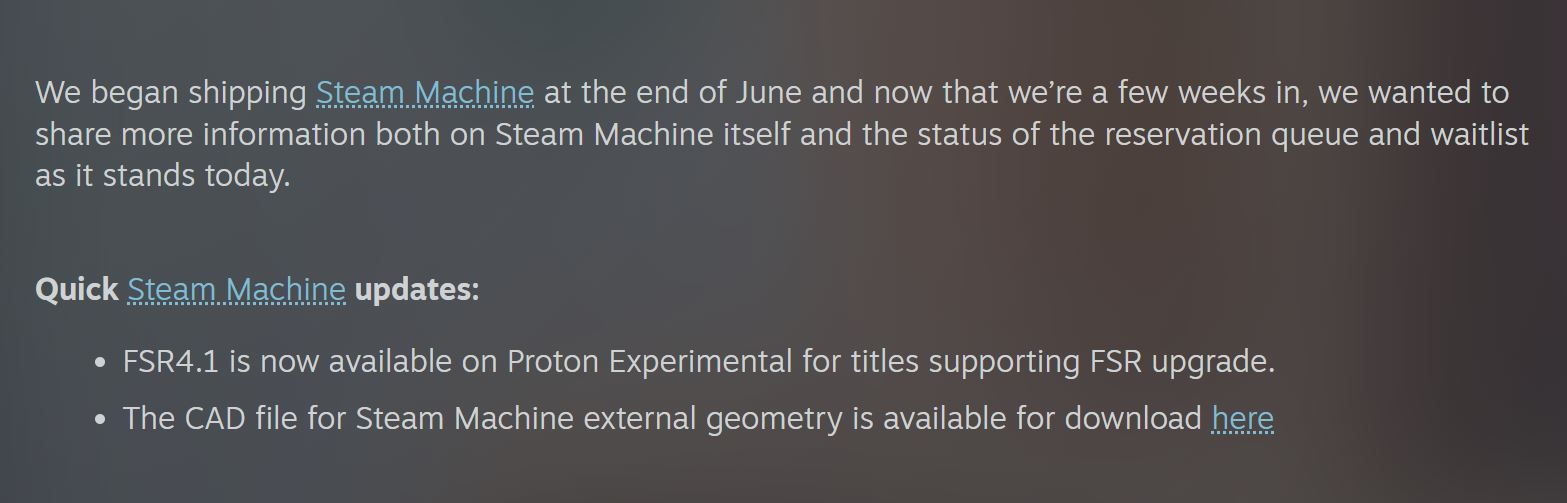
Valve also provided an update on Steam Machine availability after beginning shipments at the end of June. Purchase invitations are being distributed daily according to the randomized reservation order, and Valve expects everyone currently holding a reservation to receive an opportunity to purchase before the end of 2026. Customers have 72 hours to complete an order after receiving their purchase invitation.
Reservation and waitlist progress varies by model and region. Valve says some product queues have already reached their final reservation holders, allowing the company to begin moving customers from the corresponding waitlists. Customers entering the reservation queue from a waitlist will now receive a status confirmation before Valve sends the separate purchase invitation. Valve also emphasized that waitlisted customers are not moving ahead of existing reservation holders.
The reservation system covers the 512 GB Steam Machine priced at US$1,049, the 2 TB version priced at US$1,349, and bundles containing the Steam Controller. Rising RAM and storage costs substantially increased the final retail price, making visual quality and performance improvements especially important to the system’s value proposition. Former PlayStation executive Shuhei Yoshida previously criticized Steam Machine performance and pricing, although he praised its quiet operation, compact design, and living room experience.
Valve has also released the external CAD geometry files for Steam Machine. The files provide precise physical measurements that can help enthusiasts and accessory manufacturers create stands, mounts, skins, enclosures, and replacement designs compatible with the compact system.
FSR 4.1 is an important upgrade for Steam Machine because its hardware needs advanced reconstruction technology to deliver convincing results at 1440p and 4K. The system does not have enough raw graphics performance to treat native 4K as a realistic target in every modern game, making image quality improvements through FSR central to Valve’s living room strategy.
The reservation update also shows that demand remains stronger than Valve’s initial production capacity. Valve’s randomized system is more controlled than a traditional launch and provides better protection against automated purchases and resellers, but customers on waitlists may still face a lengthy delay.
Steam Machine’s long term success will depend on whether Valve can combine SteamOS convenience, broad game compatibility, consistent FSR support, and future price reductions into a product that feels easier to justify against consoles and compact gaming PCs.
Does FSR 4.1 make Steam Machine more attractive at US$1,049, or is the price still too high for its performance level?
