
Unreal Engine 5.8 Lands With Lumen Lite To Push 60 FPS On Nintendo Switch 2

Epic Games has officially launched Unreal Engine 5.8, and this update may become one of the most important releases of the UE5 generation. The new version arrives during Unreal Fest Chicago with advanced worldbuilding tools, improved animation workflows, stronger virtual production features, production ready MegaLights, and a new Lumen Lite mode designed to make global illumination far more practical on lower power hardware, including Nintendo Switch 2.
The timing matters because Epic says UE 5.8 is the last planned major Unreal Engine 5 release as the company ramps up work on Unreal Engine 6. UE5 will still receive bug fixes and regression support, and Epic is leaving the door open for a possible UE 5.9 if needed, but the message is clear. Unreal Engine 5.8 is the final big technology package meant to carry many upcoming PC, PlayStation 5, Xbox Series X|S, and Nintendo Switch 2 projects while UE6 moves toward its next development phase.
The headline feature for Nintendo players is Lumen Lite. Epic says the new mode preserves much of Lumen’s visual impact at a much lower GPU cost by using irradiance fields with probe occlusion. It runs twice as fast as Lumen High Quality and is designed to let games that rely on global illumination run at 60 FPS on Nintendo Switch 2, while also supporting PC. This directly addresses one of the biggest technical problems facing modern handheld and hybrid ports: keeping advanced lighting without cutting performance too aggressively.
For Nintendo Switch 2, this could be a major turning point. UE5 games have often struggled on lower power hardware because Lumen, Nanite, high density worlds, and modern post processing systems can be expensive. Lumen Lite gives developers a cleaner middle path, allowing them to keep the artistic identity of dynamic global illumination without forcing every port into heavy visual compromise. Epic’s own State of Unreal 2026 recap specifically highlights lightweight dynamic global illumination for 60 FPS support on Nintendo Switch 2 and PC, which suggests the feature is not a small experiment but a core platform answer.
Unreal Engine 5.8 also brings Mesh Terrain as an experimental 3D mesh based system for larger and more complex landscapes. Unlike traditional heightfield terrain, Mesh Terrain can create structures such as tunnels, overhangs, floating islands, and more unusual geography directly inside the editor or from imported assets. It works with Unreal’s Procedural Content Generation framework, allowing developers to manually art direct procedural results without breaking the underlying system. That could be very useful for open world games where artists need both scale and control.
The Procedural Vegetation Editor is another major addition for environment teams. Epic says developers can now grow high quality, biologically correct, Nanite ready vegetation directly from scratch, with trees that compete for light, form clusters, react to nearby meshes, and can still be edited with basic sculpting tools. Developers can also use sketches and photos as input, which could reduce the gap between concept art, natural reference, and production ready assets.
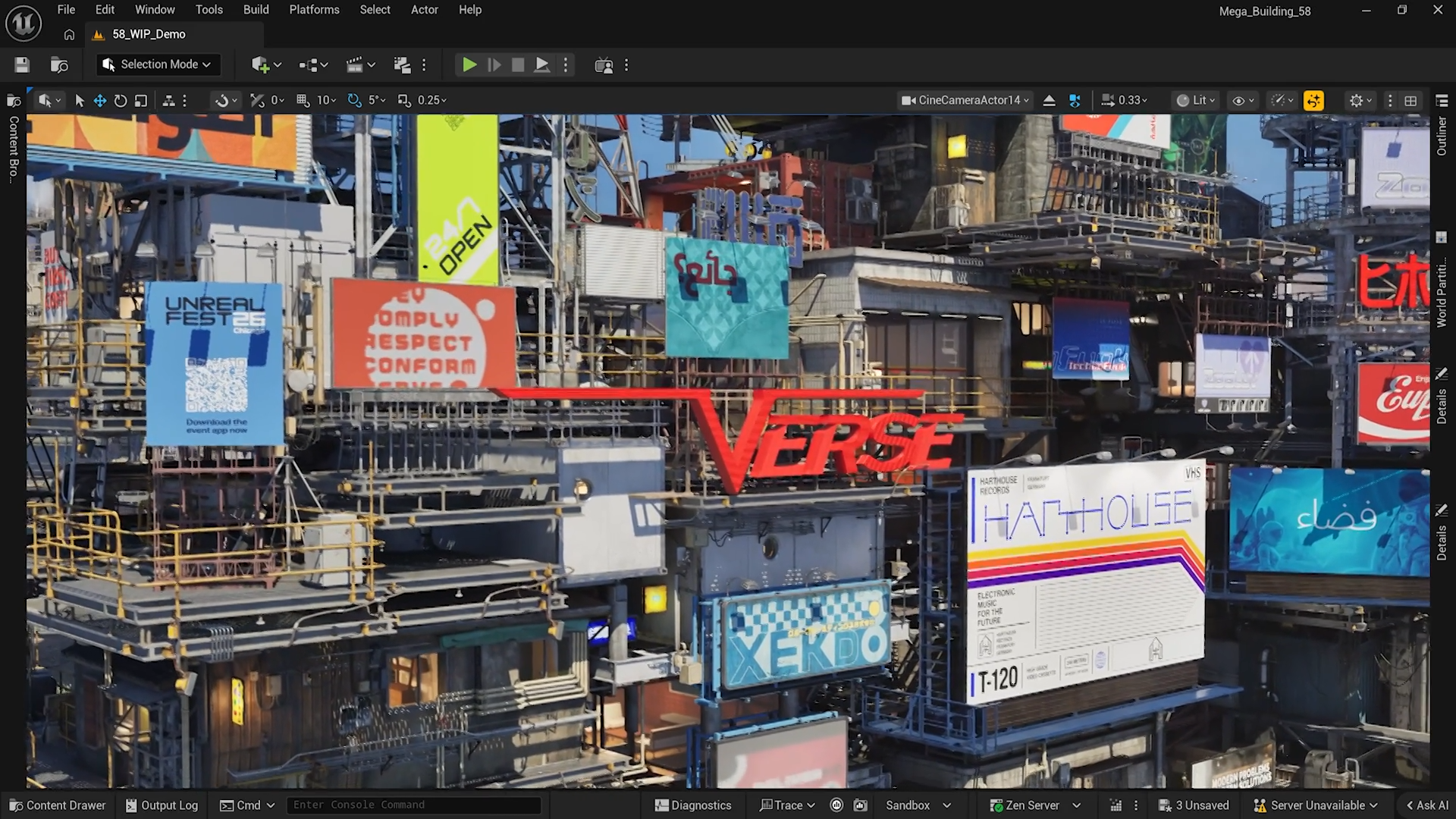
MegaLights is now production ready in UE 5.8, giving developers the ability to place a vast number of dynamic and shadowed area lights while reducing noise and improving performance. Epic says MegaLights now targets 60 FPS on current generation consoles, which is important for teams building visually dense scenes on PlayStation 5 and Xbox Series X|S. The update also improves character and animation workflows. Control Rig Physics has moved to beta, Control Rig Dynamics brings a faster runtime solver, Direct Mesh Controls give animators more direct interaction with character surfaces, and automated baking makes iteration faster. MetaHuman Collections are also introduced as an experimental asset type that can help developers populate real time worlds with crowds, scaling to hundreds of characters on mobile and thousands on higher end platforms. For studios working on larger cities, RPG hubs, sports crowds, or cinematic environments, this could reduce production pressure while keeping scenes visually populated.
Epic is also pushing deeper into model assisted creation. UE 5.8 includes an experimental Model Context Protocol plugin that lets developers connect models such as Claude directly to Unreal Engine projects. These models can understand assets, levels, Blueprints, materials, meshes, and other project systems, with the goal of helping developers build assets, extend functionality, test content, and optimize workflows. This does not mean AI replaces creative direction, but it does show where Epic thinks production pipelines are heading.
That direction becomes even clearer in The Road to Unreal Engine 6. Epic says UE6 will unify Unreal Engine 5 and Unreal Editor for Fortnite into a single next generation engine, with a stronger focus on Verse, portable content, interoperable economies, and model assisted workflows. Epic is targeting Unreal Engine 6 Early Access at the end of 2027, with the full release expected 12 to 18 months later. "UE6 is UE5 and UEFN coming together into a single, unified engine for the next generation of gaming." Quote by: Epic Games.
Rocket League was confirmed as the first Unreal Engine 6 game, and Epic’s new roadmap gives that reveal more context. UE6 is not being positioned as a simple rendering upgrade. It is being built as a broader development ecosystem where traditional premium games, live service platforms, creator economies, and Fortnite connected tools can share more technology.
For developers, this is both exciting and complicated. The performance work in UE 5.8 is exactly what many studios have been asking for, especially as UE5 games have faced criticism around optimization, shader compilation, traversal stutter, and CPU side limitations. Lumen Lite, MegaLights performance work, improved PSO handling, and better mobile workflows all point toward Epic understanding that visual ambition alone is not enough. The next phase of Unreal needs to make games easier to ship smoothly, not just prettier in trailers.
The AI direction will be more divisive. Epic is framing model assisted tools as a way to reduce repetitive content authoring and give teams more time for creative polish, but many developers and players remain cautious about generative AI in games. The practical question will be how Epic balances productivity tools with transparency, authorship, and creative control. If these tools help technical artists automate routine work while human teams keep direction and taste, they could become valuable. If they are used as a shortcut to replace craft, the backlash will be immediate.
Unreal Engine 5.8 looks like a strong closing chapter for UE5. It gives developers more tools for large worlds, better lighting scalability, improved production workflows, and a clearer path toward handheld performance. More importantly, Lumen Lite could make Nintendo Switch 2 a much healthier platform for future Unreal Engine projects, especially if developers can keep 60 FPS targets without stripping away too much of the visual identity that made UE5 games stand out.
UE6 is now the bigger strategic horizon, but UE 5.8 is the release that many studios will actually build with right now. If Epic can use this version to improve real world performance while preparing UE6 as a cleaner, more unified development platform, the transition from UE5 to UE6 could be much smoother than many developers feared.
Do you think Lumen Lite will finally make Unreal Engine 5 games feel strong on Nintendo Switch 2, or does Epic still need deeper CPU and shader performance improvements?
