

Taiwanese manufacturer King Slide Works, originally known for producing kitchen drawer mechanisms and furniture hardware, has become one of the biggest beneficiaries of the artificial intelligence boom. The company now controls an estimated 70% to 90% of the high end AI server rail market, supplying precision mechanical components used in NVIDIA GPU servers and major cloud computing infrastructure. While much of the industry's attention remains focused on semiconductors, memory, and advanced cooling, King Slide has demonstrated how specialized mechanical engineering can become equally valuable in modern data centers.
Founded in Kaohsiung in 1986, King Slide initially specialized in furniture slides and hinges before expanding into server hardware around 2000. Its expertise in precision manufacturing allowed the company to develop increasingly sophisticated rail systems capable of supporting heavy computing equipment. Unlike conventional drawer mechanisms, AI server rails must safely support server modules weighing dozens of kilograms while maintaining extremely tight manufacturing tolerances. Some advanced designs reportedly measure just 6.1 mm thick and support equipment exceeding 40 kg, with manufacturing tolerances reaching approximately 0.02 mm.
These requirements have become increasingly demanding with NVIDIA's Blackwell and Rubin architectures, as modern AI servers incorporate heavier GPU assemblies, liquid cooling equipment, and complex power distribution systems. King Slide is an official NVIDIA MGX ecosystem partner, supplying mechanical solutions for multiple generations of AI infrastructure. As NVIDIA expands its Vera Rubin rack and compute tray designs, the importance of reliable mechanical components continues growing.
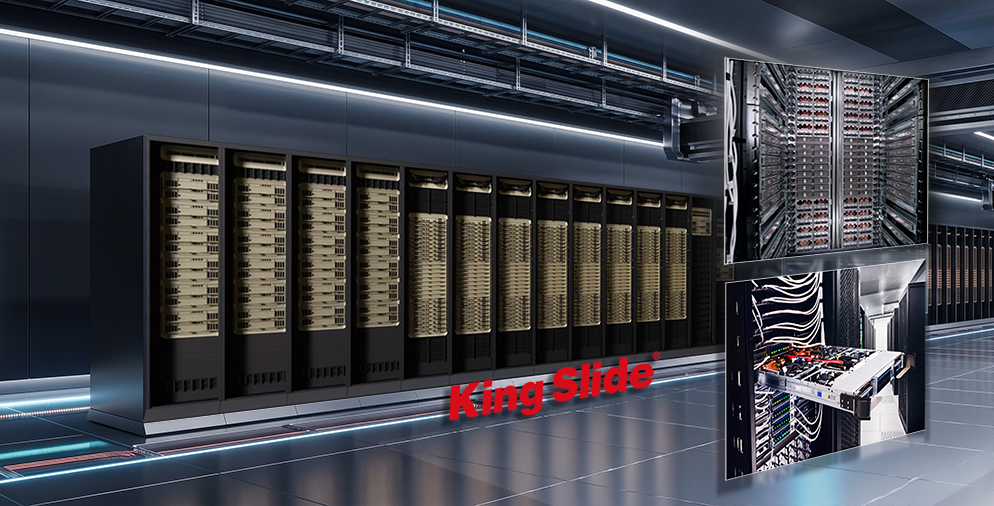
King Slide's dominance has translated into exceptional financial performance. The company reported an 87.4% gross profit margin during Q2 2026, exceeding the gross margins commonly associated with major semiconductor manufacturers. Its Q3 revenue reached approximately NT$17.34 billion ($530 million), increasing around 60% compared with the previous quarter. Revenue during the first 9 months of 2026 totaled NT$33.62 billion ($1.03 billion), representing 167.8% annual growth.
| Financial Metric | Reported Result |
|---|---|
| Estimated AI Server Rail Market Share | 70% to 90% |
| Q2 2026 Gross Profit Margin | 87.4% |
| Q3 2026 Revenue | NT$17.34 billion |
| Q3 Quarterly Revenue Growth | Approximately 60% |
| First 9 Months of 2026 Revenue | NT$33.62 billion |
| Annual Revenue Growth for First 9 Months | 167.8% |
| Patent Portfolio | More than 3,750 patents |
The company's competitive advantage extends beyond manufacturing capacity. Its extensive patent portfolio covers mechanical designs, production techniques, tooling, and specialized locking mechanisms. These technologies make it difficult for competitors to reproduce the same reliability and precision, particularly when a mechanical failure could damage hundreds of thousands of dollars in computing equipment.
King Slide is expanding production in Taiwan and the United States, including its manufacturing operations in Houston, Texas, to support increasing demand. However, its market share remains an industry estimate rather than an independently audited figure, and competitors are developing alternative rail solutions as NVIDIA and other infrastructure providers diversify their supply chains.
King Slide's success demonstrates that the AI industry depends on much more than GPUs and advanced semiconductor manufacturing. Even relatively inexpensive mechanical components can become critical when they support computing systems worth millions of dollars.
An 87.4% gross margin is particularly impressive for a company specializing in physical hardware, illustrating the value of engineering expertise, manufacturing precision, and years of research and development.
However, the growing profitability of AI infrastructure suppliers also highlights how investment is increasingly concentrated around data centers. While this creates valuable opportunities for specialized manufacturers, the broader technology industry must ensure that consumer computing and gaming hardware continue receiving sufficient attention and production capacity.
Did you expect a company specializing in kitchen drawer mechanisms to become a major AI infrastructure supplier, and do you believe specialized hardware manufacturers could become the next big winners of the AI boom?
