
Sony Project Canis Leak Points to 540p Rendering With PSSR 3 Targeting 1080p
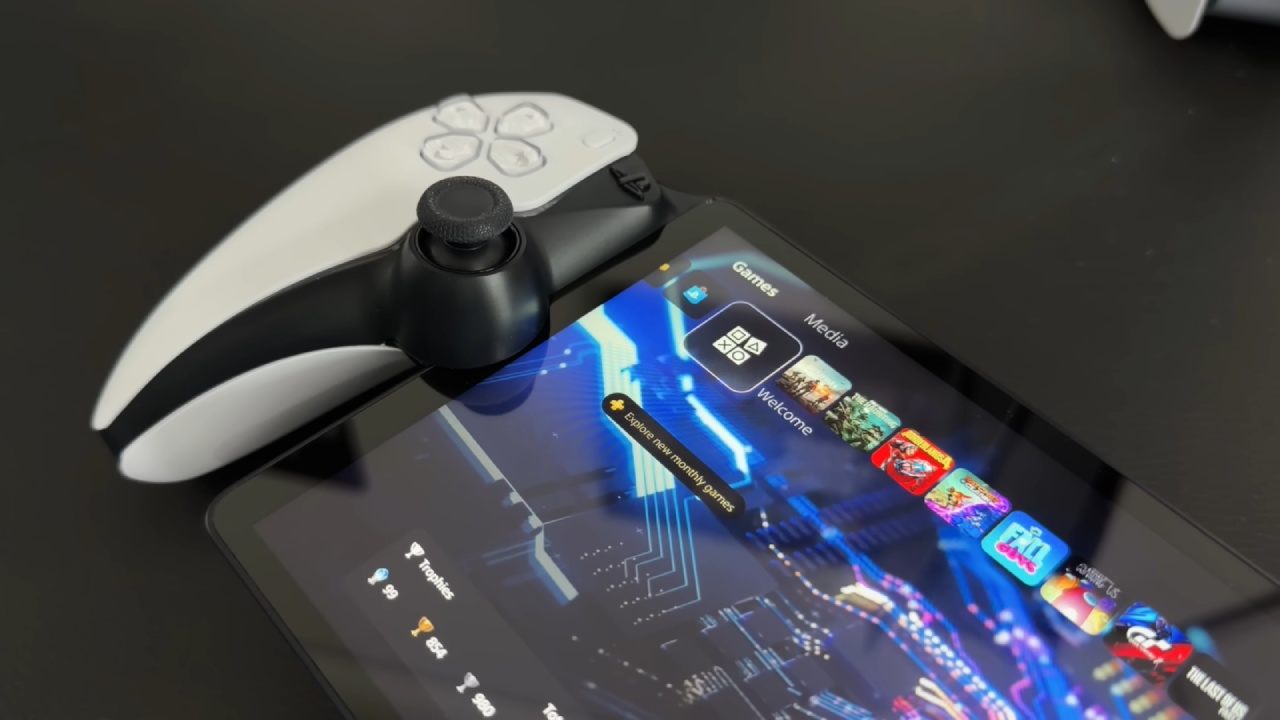
Sony’s rumored next generation PlayStation handheld, codenamed Project Canis, could rely heavily on AI reconstruction rather than brute force GPU performance, with a new leak claiming demanding games may render internally at just 540p before being reconstructed to the handheld’s 1080p display.
The latest information comes from GameGPU, which claims Canis is targeting a late 2027 release and will use a custom AMD processor manufactured on a 3 nm process. The rumored configuration combines 4 Zen 6c CPU cores with 2 lower power Zen 6 cores, 24 GB of shared LPDDR5X memory across a 192 bit interface, and 16 RDNA 5 Compute Units.
Portable power reportedly sits between 15 W and 25 W. The GPU is claimed to operate around 1.2 GHz in handheld mode for approximately 4.91 TFLOPS of FP32 throughput, rising to 1.65 GHz and approximately 6.75 TFLOPS when docked. These specifications remain unofficial, and Sony has not announced Project Canis publicly.
| Specification | PlayStation 5 Pro | Project Canis (PSP 3 Handheld) |
|---|---|---|
| Custom AMD APU | Zen 2 cores, 16.7 TFLOPs | Zen 6 cores (4c Zen 6c, 2c LP) |
| GPU | 60 CUs (30 WGPs), custom RDNA 2/3 hybrid architecture at approximately 2.18 GHz | 16 RDNA 5 CUs at 1.2 to 1.65 GHz |
| System Memory | 16 GB GDDR6 + 2 GB DDR5 | 24 GB LPDDR5X, 192 bit bus |
| Power | Approximately 215 to 240 W under load | 15 W to 25 W |
| Upscaling | PSSR 2.0 (Standard) | PSSR 3.0 (Upscaling and Frame Gen Enabled) |
| Target | Native 1080p/1440p to 4K via PSSR 2.0 | Native 540p to 1080p via PSSR 3.0 |
| TFLOPs (Mobile/Docked) | 16.7 TFLOPs (fixed, no mobile/docked split) | 4.91 TFLOPs / 6.75 TFLOPs |
| Effective PSSR 3.0 TFLOPs | N/A | 10 to 11 TFLOPs (Mobile) / approximately 14 TFLOPs (Docked) |
The most interesting part of the report is how Sony may compensate for that relatively modest raw GPU budget. GameGPU claims demanding titles could render internally at 540p before being reconstructed to 1080p using a future technology it calls PSSR 3.0. The same report says this version would combine machine learning upscaling with frame generation, potentially allowing games to target perceived output between 30 FPS and 60 FPS while keeping power consumption suitable for portable hardware.
Sony has not officially announced anything called PSSR 3.0. What is confirmed is that the company already introduced a substantially upgraded version of PlayStation Spectral Super Resolution on PS5 Pro during 2026. Lead architect Mark Cerny said the new neural network and algorithm were developed through Sony and AMD’s Project Amethyst collaboration, with Resident Evil Requiem becoming the first game to use the new model.
There is also growing evidence that Sony is researching frame generation for future PlayStation hardware. A Sony Interactive Entertainment researcher publicly referenced work on a frame interpolation pipeline for a next generation PlayStation platform, something we previously examined. That research does not confirm that the feature will ship with Canis, but it makes the direction technically plausible.
One part of the new leak deserves particular caution. GameGPU describes the handheld as delivering an equivalent of 10 to 11 TFLOPS in portable mode and approximately 14 TFLOPS while docked after accounting for PSSR, placing it relatively close to PS5 Pro’s 16.7 TFLOPS figure.
PSSR cannot actually increase the GPU’s physical FP32 throughput. Upscaling and frame generation can substantially improve perceived resolution and frame rate, but an AI reconstructed 14 TFLOPS equivalent is not directly comparable with 14 TFLOPS of native GPU compute. Canis would still reportedly provide around 4.91 to 6.75 TFLOPS of raw FP32 performance under these specifications.
That makes the 540p target more interesting than the theoretical comparison. At handheld screen sizes, a strong temporal reconstruction model could allow Sony to spend considerably more of its limited power budget on geometry, lighting, ray tracing, and simulation while reconstructing the final image at 1080p.
Previous leaks have also suggested Canis will support local PS4 and PS5 games rather than operating like the streaming focused PlayStation Portal, with USB C video output, expandable storage, and docked operation.
540p sounds extremely low until reconstruction becomes part of the hardware design from the beginning.
Sony does not necessarily need a handheld GPU capable of rendering PS5 quality games natively at 1080p. It needs enough performance to produce a clean base frame, then a reconstruction system capable of turning that limited input into something convincing on a portable display.
That is where Project Canis could become much more interesting than simply building a smaller PS5.
The rumored specifications still need substantial verification, and the term PSSR 3.0 remains unofficial. But Sony’s confirmed investment in Project Amethyst, upgraded PSSR, and next generation frame interpolation research makes an AI heavy handheld architecture increasingly believable.
Would you accept games rendering internally at 540p on a PlayStation handheld if PSSR could reconstruct a convincing 1080p image?
