
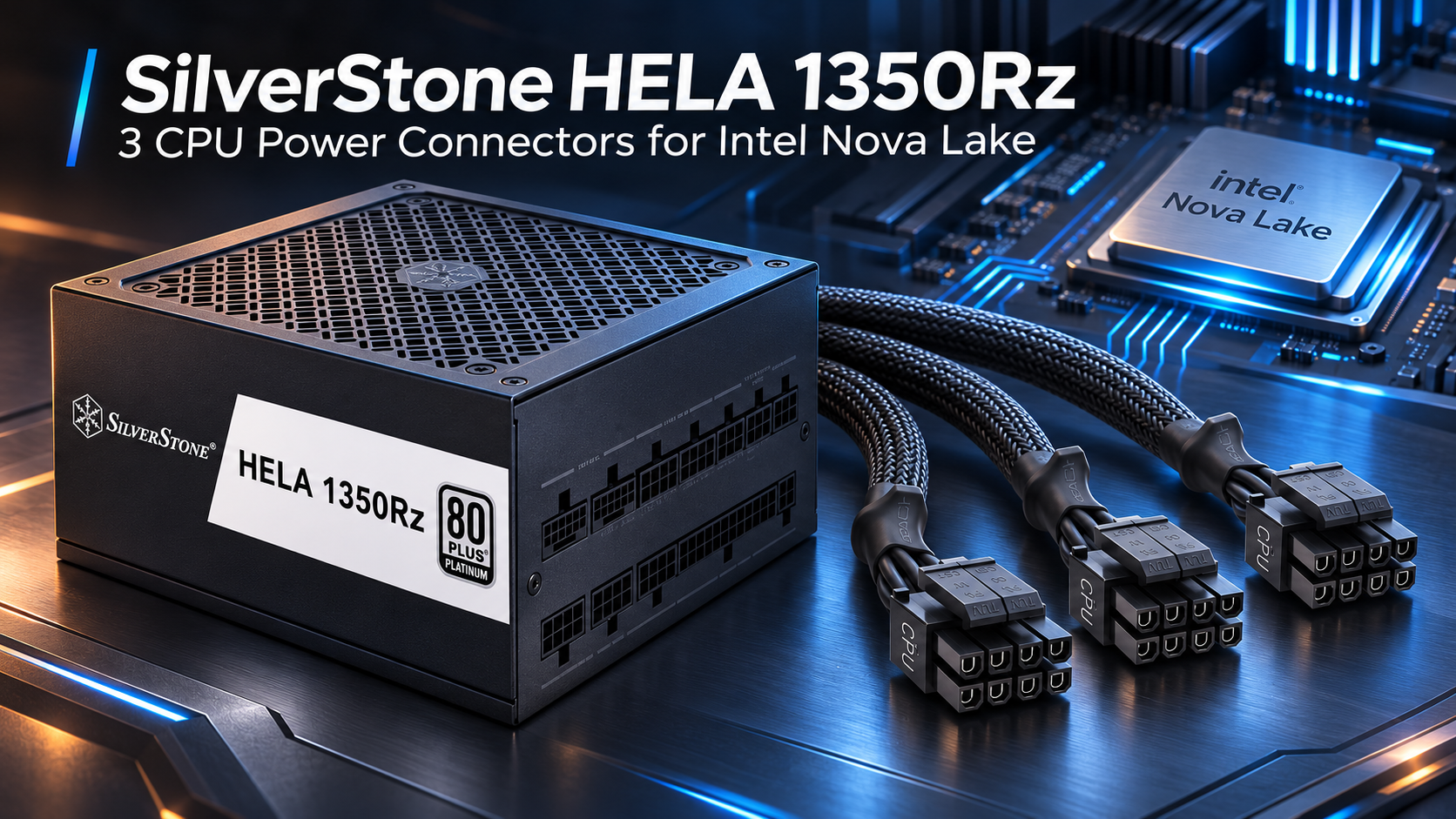
SilverStone has introduced the HELA 1350Rz, a 1350W power supply designed to support Intel's upcoming Nova Lake S desktop processors and their potentially demanding power requirements. The new unit features 3 dedicated 4+4 pin EPS CPU power cables, an unusual configuration for consumer power supplies that typically include 1 or 2 CPU power connections. SilverStone specifically references the high power demands of Intel's next generation platform, suggesting that motherboard manufacturers are preparing for significantly higher electrical requirements on enthusiast desktop systems.
According to SilverStone's official product specifications, the HELA 1350Rz features an ATX 3.1 compliant design, 80 PLUS Platinum efficiency certification, and 2 native 12V 2×6 connectors for modern graphics cards. The fully modular power supply uses Japanese capacitors, a 135 mm fluid dynamic bearing fan with automatic semi fanless operation, and protection against overcurrent, overpower, overvoltage, short circuits, and overheating. Measuring 150 × 86 × 160 mm, the unit also features flat modular cables and angled SATA connectors for easier installation.
SilverStone HELA 1350Rz Specifications
| Specification | Details |
|---|---|
| Rated Power | 1350W |
| Efficiency | 80 PLUS Platinum |
| Standard | ATX 3.1, PCIe 5 |
| CPU Power | 3 × 4+4 pin EPS cables |
| GPU Power | 2 × 12V 2×6 connectors |
| Design | Fully modular |
| Capacitors | Japanese capacitors |
| Cooling | 135 mm FDB fan, semi fanless mode |
| Dimensions | 150 × 86 × 160 mm |
| Maximum Rated Operating Temperature | 50°C |
| Pricing | Not announced |
The additional CPU power connection is particularly interesting because earlier reports suggested that Intel's flagship Nova Lake S processors could feature up to 52 cores with a reported PL2 power limit reaching 474W. These figures remain unconfirmed, but they align with expectations of substantially increased power delivery requirements for high performance desktop processors. Previous information surrounding Intel's upcoming Z990 motherboards has also pointed toward configurations supporting 3 EPS CPU connectors, particularly on premium models designed for demanding workloads and overclocking.
However, the inclusion of 3 EPS cables does not confirm that every Nova Lake S processor will require them. Motherboard manufacturers are reportedly free to implement 2 or 3 connectors depending on their power delivery designs, and the additional connection may primarily benefit extreme overclocking or systems operating beyond standard power limits. Intel has not officially confirmed the rumored 474W PL2 figure, and the 1350W rating represents the power supply's total output capacity rather than the CPU's expected consumption.
The upcoming processors will also introduce Intel's LGA 1954 socket, requiring a new motherboard platform. Early Nova Lake S motherboard designs have already appeared, indicating that hardware manufacturers are preparing the surrounding ecosystem ahead of the next desktop generation. SilverStone has not announced the HELA 1350Rz's retail pricing or confirmed international availability.
SilverStone's decision to include 3 EPS CPU cables raises important questions about Intel's approach to next generation desktop performance. While additional power delivery capacity can improve stability under demanding workloads, consumers should not need increasingly expensive cooling systems and oversized power supplies simply to achieve competitive processor performance.
Efficiency should remain as important as absolute performance, particularly as electricity consumption and hardware costs continue affecting PC enthusiasts. A processor capable of consuming nearly 500W under heavy workloads could offer impressive multicore performance, but its practical value will depend on cooling requirements, power efficiency, and real gaming results.
The HELA 1350Rz provides additional flexibility for high performance builds, but consumers should evaluate their actual hardware requirements before purchasing a premium power supply. More power connections do not automatically translate into better performance, and most gaming systems will not require this level of electrical capacity.
Would you consider an Intel Nova Lake processor with a potential 474W power limit if it delivered significantly higher performance, or would you prioritize a more efficient CPU with lower cooling and power requirements?
