
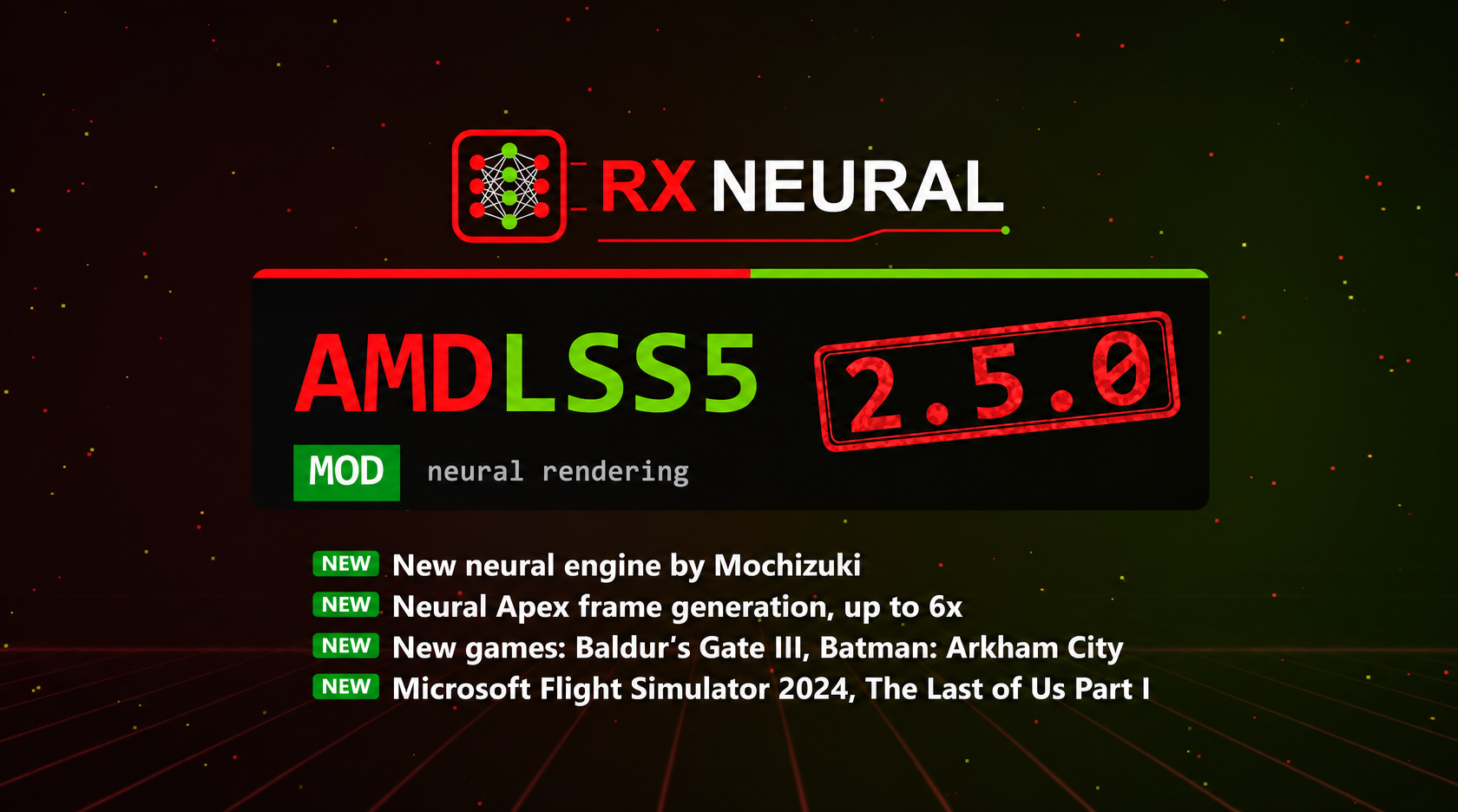
The PC modding community continues pushing the boundaries of GPU compatibility, with developer Wehaveall releasing AMDLSS5 2.5, an experimental modification that brings NVIDIA DLSS 5 Neural Rendering to AMD Radeon graphics cards. Released on November 20, 2026, the update introduces a redesigned Vulkan neural engine delivering up to 60% faster neural network processing, approximately 10% higher gaming performance, and reduced VRAM consumption compared with the previous version. It also expands game compatibility and introduces frame generation multipliers reaching 6x, providing Radeon users with additional graphical capabilities not officially supported by AMD or NVIDIA.
According to the developer's official GitHub release, the latest version replaces the previous HIP processing engine with a Vulkan implementation based on Mochizuki's DLSSNR AMD runtime. Combined with additional optimizations, this architecture significantly reduces the computational overhead associated with executing NVIDIA's neural rendering network on Radeon hardware. Testing conducted in Resident Evil Requiem using a Radeon RX 9070 XT demonstrated approximately 10% higher frame rates and 500 MB lower VRAM consumption compared with AMDLSS5 2.0. However, the advertised 60% improvement specifically concerns neural network processing speed rather than a comparable increase in overall gaming performance.
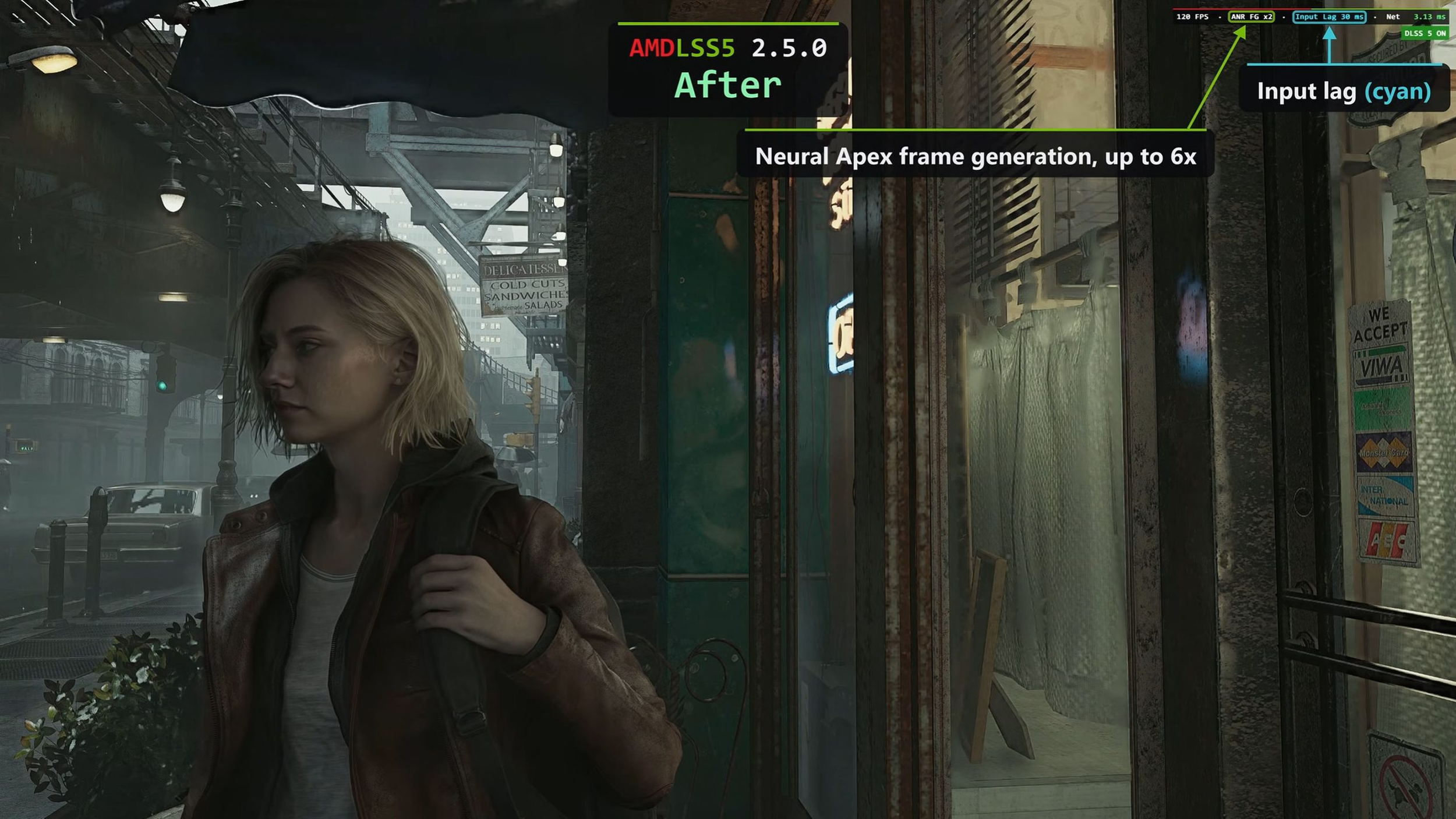
The update also integrates Neural Apex Frame Generation, developed by Apex Compute, allowing users to select multipliers between 2x and 6x. Unlike conventional frame generation implementations that typically generate additional frames through features integrated into the game, Neural Apex can operate alongside the neural rendering modification in supported titles without native frame generation support. The technology includes frame pacing management, input latency monitoring, and the ability to enable or disable frame generation without restarting the game. Nevertheless, generated frames do not increase the game's underlying simulation rate or input responsiveness, meaning smoother displayed motion does not necessarily translate into improved gameplay latency.
Compatibility has also expanded considerably, with AMDLSS5 2.5 introducing support for Baldur's Gate 3, Microsoft Flight Simulator 2024, The Last of Us Part I, and Batman: Arkham City. Experimental support has also been added for the Black Myth: Wukong Benchmark Tool. The inclusion of Baldur's Gate 3 and the 32 bit version of Batman: Arkham City is particularly interesting because the modification now extends beyond conventional DirectX 12 applications through additional compatibility mechanisms. Existing support includes titles such as Resident Evil Requiem, Cyberpunk 2077, Red Dead Redemption 2, and The Witcher 3.
Players can examine the visual differences and performance improvements through the developer's AMDLSS5 2.5 gameplay demonstration on YouTube. The project continues the community's earlier progress in bringing DLSS 5 Neural Rendering to AMD Radeon RX 9070 XT graphics cards, demonstrating how software optimization can gradually overcome some of the performance limitations encountered by unofficial implementations.
Hardware compatibility currently focuses on AMD's RDNA 4 architecture, including the Radeon RX 9070 XT, RX 9070, RX 9070 GRE, and RX 9060 XT 16 GB. The developer has also confirmed successful operation on the Radeon RX 7800 XT, while additional RDNA 3 models remain experimental. Radeon RX 6000 graphics cards and older architectures are not supported. The modification requires Windows 10 or Windows 11, a compatible processor supporting AVX2 instructions, and appropriate graphics drivers.
Despite the improvements, AMDLSS5 remains an experimental community project. Certain games can exhibit visual artifacts, ghosting, or compatibility problems, while shader compilation may introduce additional loading time during the first launch or following driver updates. The project also incorporates proprietary NVIDIA neural network data and third party components with separate licensing conditions. It is not officially affiliated with either GPU manufacturer.
Players interested in experimenting with the technology can access the free AMDLSS5 2.5 download and installation instructions on GitHub. The latest installer supports automatic game detection across several PC gaming platforms, while existing installations can be updated without losing their configuration settings.
AMDLSS5 2.5 demonstrates why PC modding remains an essential part of the gaming ecosystem. NVIDIA's DLSS technologies have traditionally been closely associated with GeForce hardware, but independent developers continue proving that some advanced graphical features can operate across competing GPU architectures when the software is adapted appropriately.
The most impressive achievement is not simply the 60% improvement in neural processing performance, but the continued optimization of technology that initially imposed enormous performance penalties on Radeon graphics cards. These developments highlight the importance of software efficiency and demonstrate how community driven engineering can extend the practical capabilities of existing hardware.
However, frame generation multipliers reaching 6x should not be confused with equivalent improvements in native gaming performance. Image quality, frame pacing, input latency, and GPU utilization remain essential considerations when evaluating the actual experience.
More importantly, technologies such as neural rendering should become increasingly accessible across different hardware platforms. PC gamers should not be forced into unnecessary GPU upgrades simply because advanced software features remain exclusive to specific manufacturers. The continued development of AMDLSS5 represents an encouraging example of hardware flexibility, user choice, and the benefits of an active PC modding community.
Would you install AMDLSS5 2.5 to experience NVIDIA Neural Rendering on your AMD Radeon GPU, or would you prefer AMD to develop an official alternative with better performance and compatibility?
