
Reddit User Says Ryzen 7 9800X3D Failed After Updating ASRock X870 Pro RS WiFi to BIOS 4.10
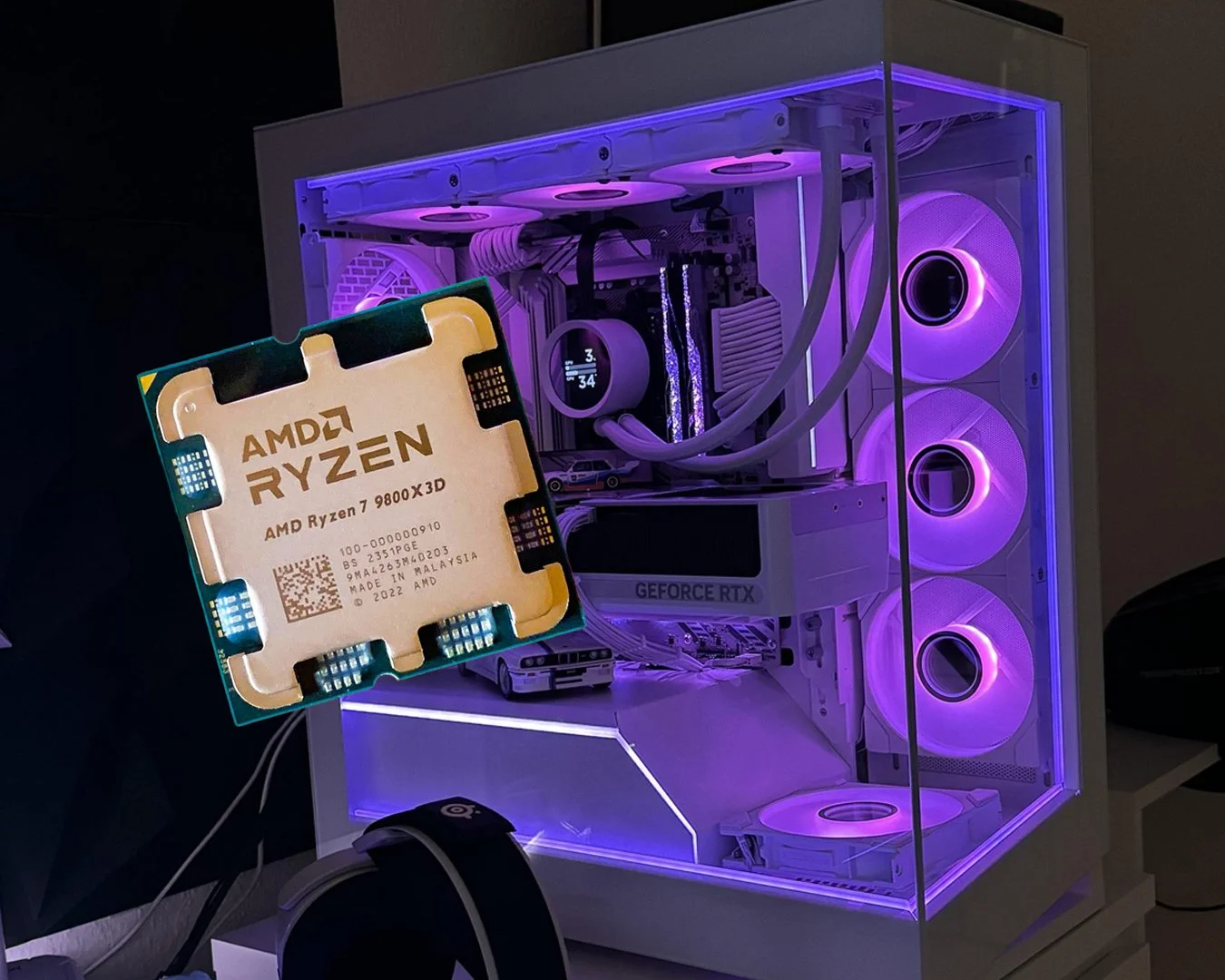
A new AM5 failure report is making the rounds after a Reddit user claimed their Ryzen 7 9800X3D stopped working shortly after updating an ASRock X870 Pro RS WiFi motherboard to BIOS 4.10. The original post, shared by u/Less-Wealth-1945 on Reddit, says the system had been stable for about a year before the update, and that after flashing to BIOS 4.10 and loading defaults, the user only re enabled EXPO for memory before the machine froze and eventually refused to boot. The post describes CPU and DRAM diagnostic LEDs staying lit, the CPU fan spinning at full speed, and the system failing to recover despite multiple troubleshooting attempts.
The timing is what makes this case stand out. ASRock’s official BIOS 4.10 rollout for AM5 boards specifically lists “Resolve a boot failure occurring on certain CPUs” as one of the key changes, alongside an AGESA update to ComboAM5 PI 1.3.0.0a and memory compatibility improvements. In other words, this was supposed to be part of the mitigation path for the wider AM5 boot failure discussion, not a trigger for a fresh incident. ASRock’s BIOS support pages show version 4.10 broadly deployed across multiple 600 and 800 series boards, including X870 lineup models.
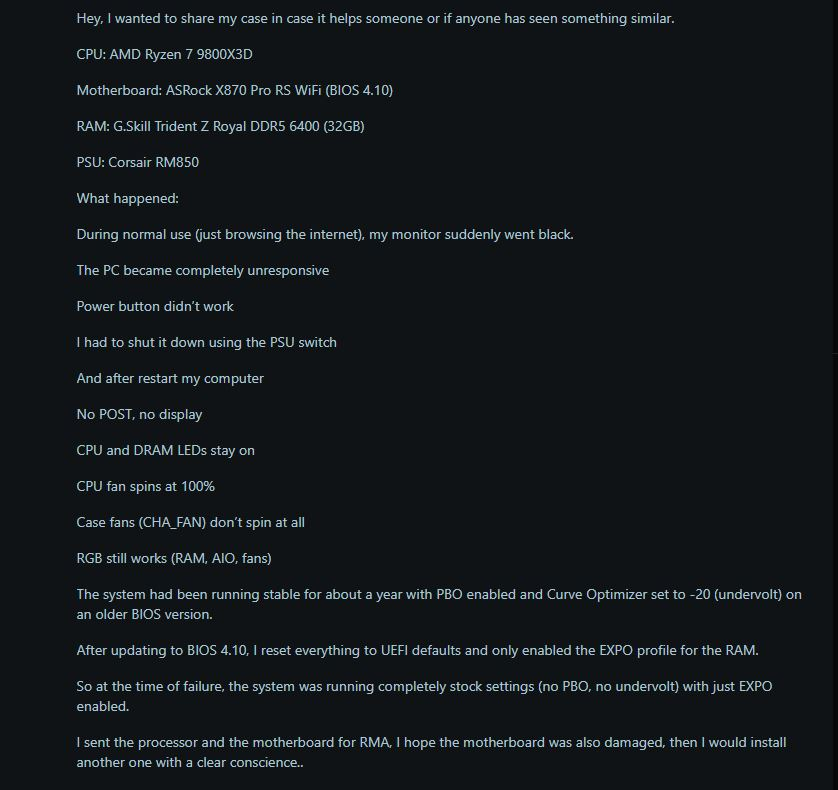
That said, the most important detail here is also the easiest to miss: this is still only a user report, not a confirmed root cause. The Reddit post strongly suggests a serious failure, but it does not prove that BIOS 4.10 itself killed the CPU. There are no socket photos, no board level inspection results, no RMA findings, and no official statement tying the failure directly to the update. It is entirely possible the CPU died coincidentally, that the board failed first, or that the system is stuck in a non recoverable boot condition rather than a physically dead processor. Based on the currently available evidence, all 3 remain possible.
There is also a nuance around the “no overclocking” framing. The user says manual overclocking was disabled and only EXPO was enabled after resetting the BIOS, which is accurate in the sense that Precision Boost Overdrive and Curve Optimizer were no longer active at the time of failure. However, EXPO is still a memory overclocking profile rather than strict JEDEC baseline operation, so this was not a completely stock platform configuration in the purest sense. That does not make EXPO the culprit, but it is worth stating clearly because these distinctions matter in AM5 troubleshooting.
The broader background is that ASRock and AMD have already acknowledged recent concerns around Ryzen 9000 behavior on AM5 systems. ASRock issued an official statement last month saying it had been conducting internal reviews and working with AMD on validation and BIOS improvements, while a company news post in Taiwan said the updated AGESA was intended to improve compatibility and address no boot problems seen on certain CPUs, including systems that may fail to start after a period of normal use.
That context is why this case will likely get more attention than a normal Reddit troubleshooting thread. If BIOS 4.10 was meant to reduce AM5 no boot incidents, then even a single fresh report after the update naturally raises questions about whether the underlying issue has really been solved or only partially mitigated. At the same time, one anecdote is not enough to conclude the fix failed across the board. Without a pattern of additional verified 4.10 incidents, this should be treated as a warning sign to watch, not a proven indictment of the new BIOS.
For users currently on ASRock AM5 platforms, the practical takeaway is caution rather than panic. BIOS 4.10 is an official stability oriented release, but this report shows that the wider Ryzen 9000 and AM5 reliability conversation is not fully over yet. Until there is clearer evidence from RMA results, motherboard inspection, or a broader cluster of similar cases, the smartest reading is that a user experienced a serious failure after updating, not that ASRock’s latest BIOS has been proven to cause CPU deaths.
Do you think this is just an isolated AM5 failure case, or is the Ryzen 9000 reliability story still not fully under control even after the latest BIOS mitigation efforts?
