
NVIDIA Vera Delivers 2x AI Throughput in Modal Tests Against Intel Xeon
NVIDIA's Vera CPU has demonstrated up to 2x higher task throughput than Intel Xeon processors in early tests conducted by AI cloud provider Modal, highlighting the growing importance of Arm based CPUs for agentic AI infrastructure. The results show that Vera can maintain stronger performance under heavy workloads, potentially challenging Intel and AMD in a server market increasingly driven by AI agents and parallel computing.
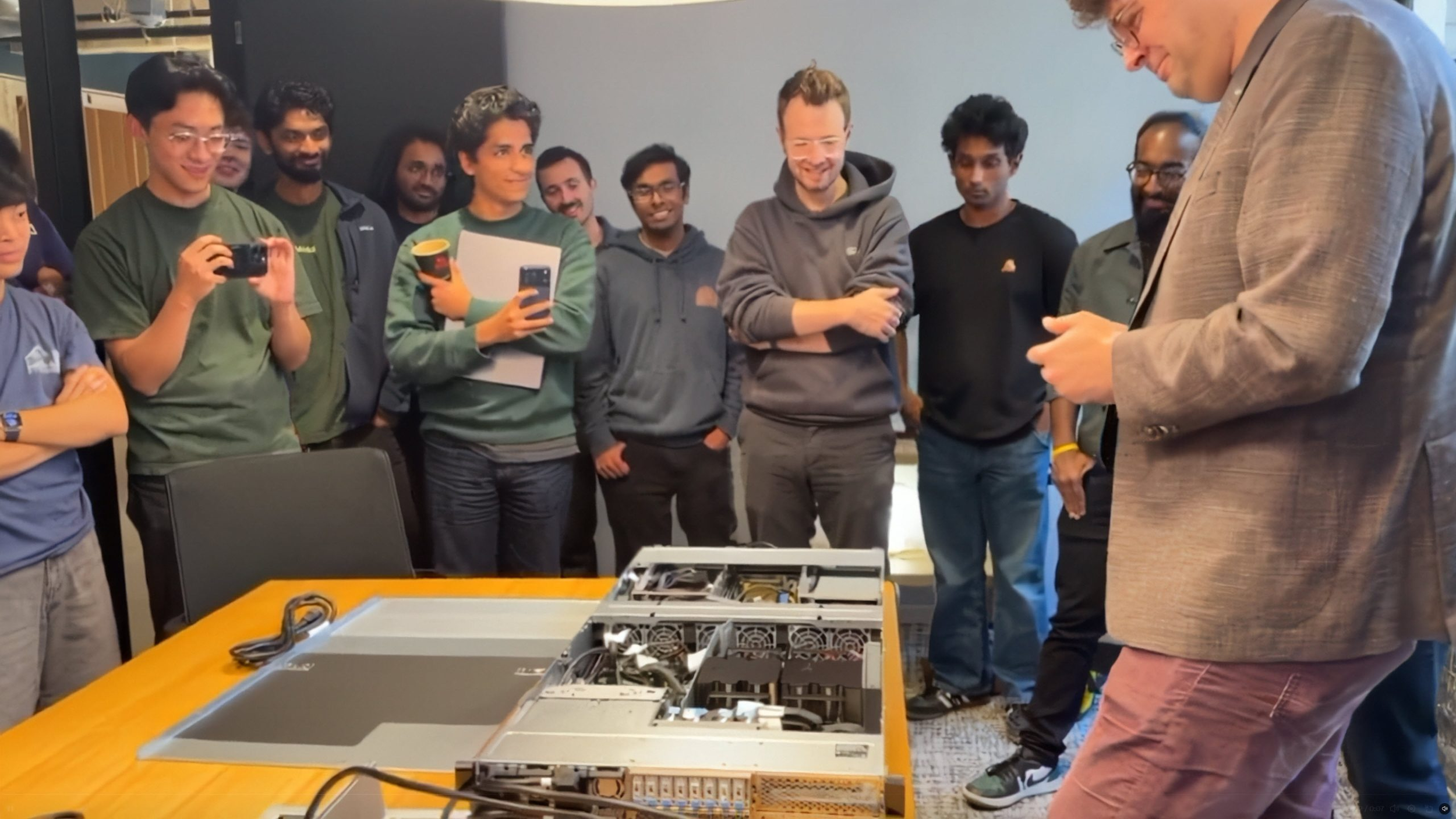
According to an October 19 technical report published by Modal, the company recently received its first NVIDIA Vera CPU server for evaluation at its San Francisco office. Modal currently operates infrastructure built around Intel and AMD x86 processors, making the transition to NVIDIA's Arm architecture a substantial undertaking that requires modifications to its infrastructure and container image building systems. However, early benchmarks suggest the investment could provide significant performance improvements for its AI sandbox services.
To evaluate the processor, Modal developed Agentless Agent Bench, a custom benchmark containing 50 tasks adapted from Terminal Bench. These workloads simulate activities commonly performed by autonomous AI agents, including compiling code, searching files, executing Git operations, and running development tools. Network operations were removed to isolate CPU performance, while the tests measured both individual task completion times and throughput under increasing numbers of concurrent containers.
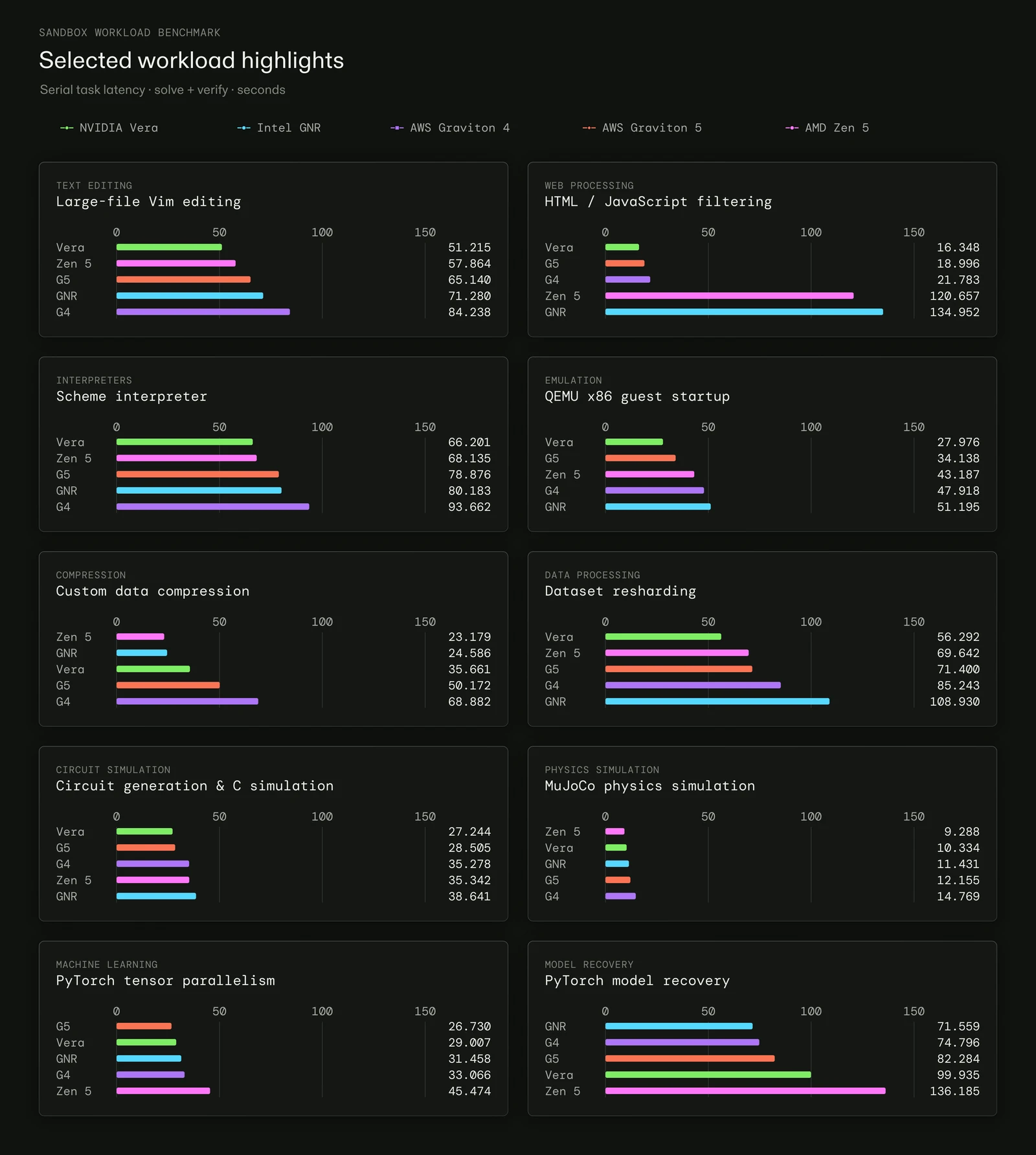
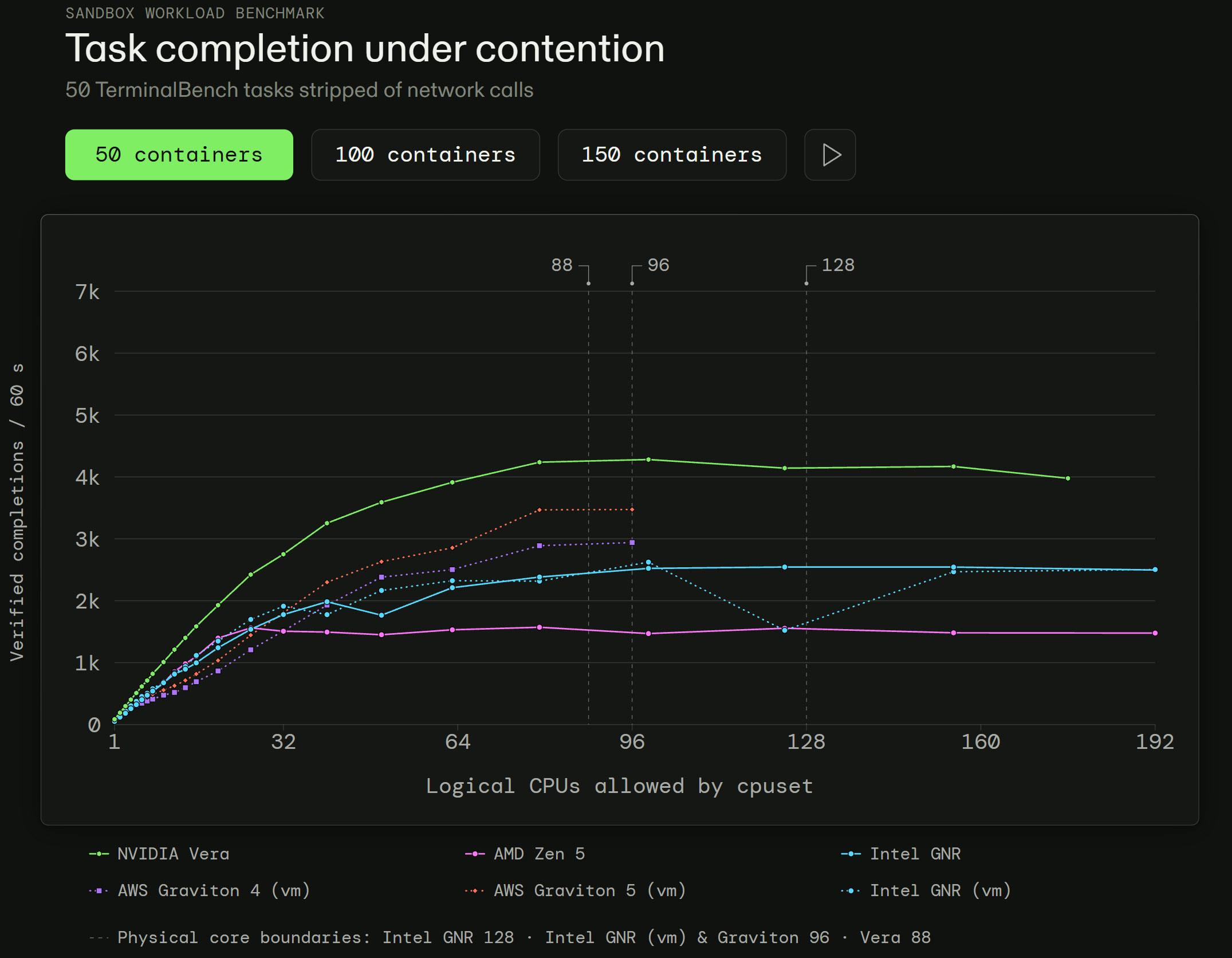
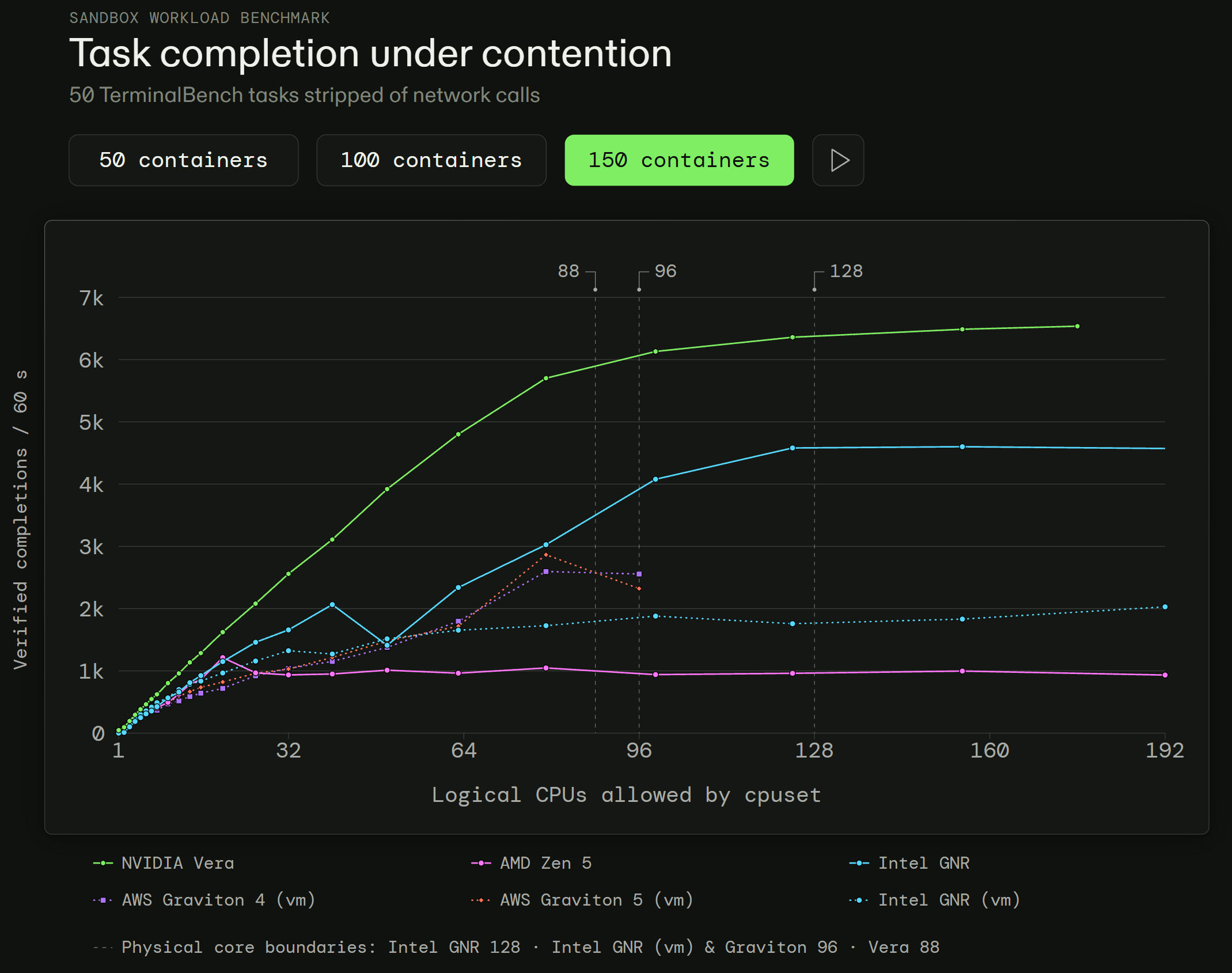
Initial results showed relatively modest performance differences between NVIDIA Vera and competing processors from Intel, AMD, and AWS when running individual tasks. The advantage became considerably more pronounced under sustained parallel workloads. Modal reported up to 2x higher throughput compared with a comparable Intel Xeon Granite Rapids system, with Vera continuing to scale as additional containers were introduced while competing systems reached their throughput limits earlier.
NVIDIA Vera Performance in Modal's Tests
| Benchmark Area | Reported Result |
|---|---|
| Test Suite | 50 AI agent workloads |
| Intel Comparison | Up to 2x higher throughput versus Xeon Granite Rapids |
| AMD Comparison | Vera demonstrated stronger scaling under contention |
| Individual Task Latency | Generally comparable, with mixed results |
| Concurrent Workloads | Higher throughput with less performance degradation |
| Primary Advantage | Memory bandwidth and efficient workload scheduling |
Results are based on Modal's internal benchmarks. The 2x figure applies to its tested Intel Granite Rapids configuration and should not be interpreted as a universal performance advantage over all Intel and AMD CPUs.
Modal attributes the improvement primarily to Vera's ability to handle memory intensive workloads without the severe contention experienced by some competing systems. According to NVIDIA's official technical specifications, Vera features 88 custom Olympus CPU cores, supporting 176 simultaneous threads through Spatial Multithreading. Its LPDDR5X memory subsystem delivers up to 1.2 TB/s of bandwidth, allowing multiple processes to access data efficiently while reducing bottlenecks.
These capabilities are particularly relevant for agentic AI services, where hundreds of isolated environments may run unpredictable workloads simultaneously. Tasks such as software installation, code compilation, and repository analysis can generate sudden CPU usage spikes. Improving processor throughput allows cloud providers to accommodate more concurrent agents without significantly increasing response times. For reinforcement learning, faster CPU execution can also reduce periods when expensive GPUs remain idle waiting for simulations or validation tasks to finish.
The development builds on NVIDIA Vera's early server CPU performance results against Intel Xeon and AMD EPYC, strengthening the company's ambitions beyond graphics processors. Vera was developed as part of the NVIDIA Vera Rubin platform but can also operate independently in CPU focused servers.
Despite the encouraging results, Modal is not abandoning Intel or AMD. As confirmed in a Reuters interview, CEO Erik Bernhardsson intends to maintain a mixed infrastructure fleet, deploying workloads on whichever architecture delivers the best results. Both Intel and AMD are also developing newer server processors that could narrow the performance gap.
Modal has not announced when Vera powered sandboxes will become generally available, and its results have not yet been independently reproduced across a broad range of production environments.
Modal's testing highlights an important shift in AI infrastructure, where CPU performance is becoming increasingly relevant alongside GPU acceleration. Autonomous agents depend heavily on code execution, data processing, and orchestration, making efficient server CPUs essential for maintaining overall system performance.
Vera's strongest advantage appears to be its ability to maintain throughput under heavy contention rather than simply outperforming competitors in individual tasks. Its high memory bandwidth and custom Arm architecture could allow cloud providers to run more simultaneous workloads while improving infrastructure utilization.
However, the 2x result is specific to Modal's testing methodology. It does not establish that Vera is universally twice as fast as AMD EPYC or Intel Xeon across conventional server applications.
For NVIDIA, the strategic opportunity is significant. By expanding into standalone CPUs, the company can compete for infrastructure spending beyond its established GPU business while strengthening its broader AI computing ecosystem.
Could NVIDIA Vera become a serious competitor to AMD EPYC and Intel Xeon in AI data centers, or will x86 processors continue dominating the server market?
