
NVIDIA Synthetic Video Detector Flags AI Generated Footage With Up to 92% Accuracy

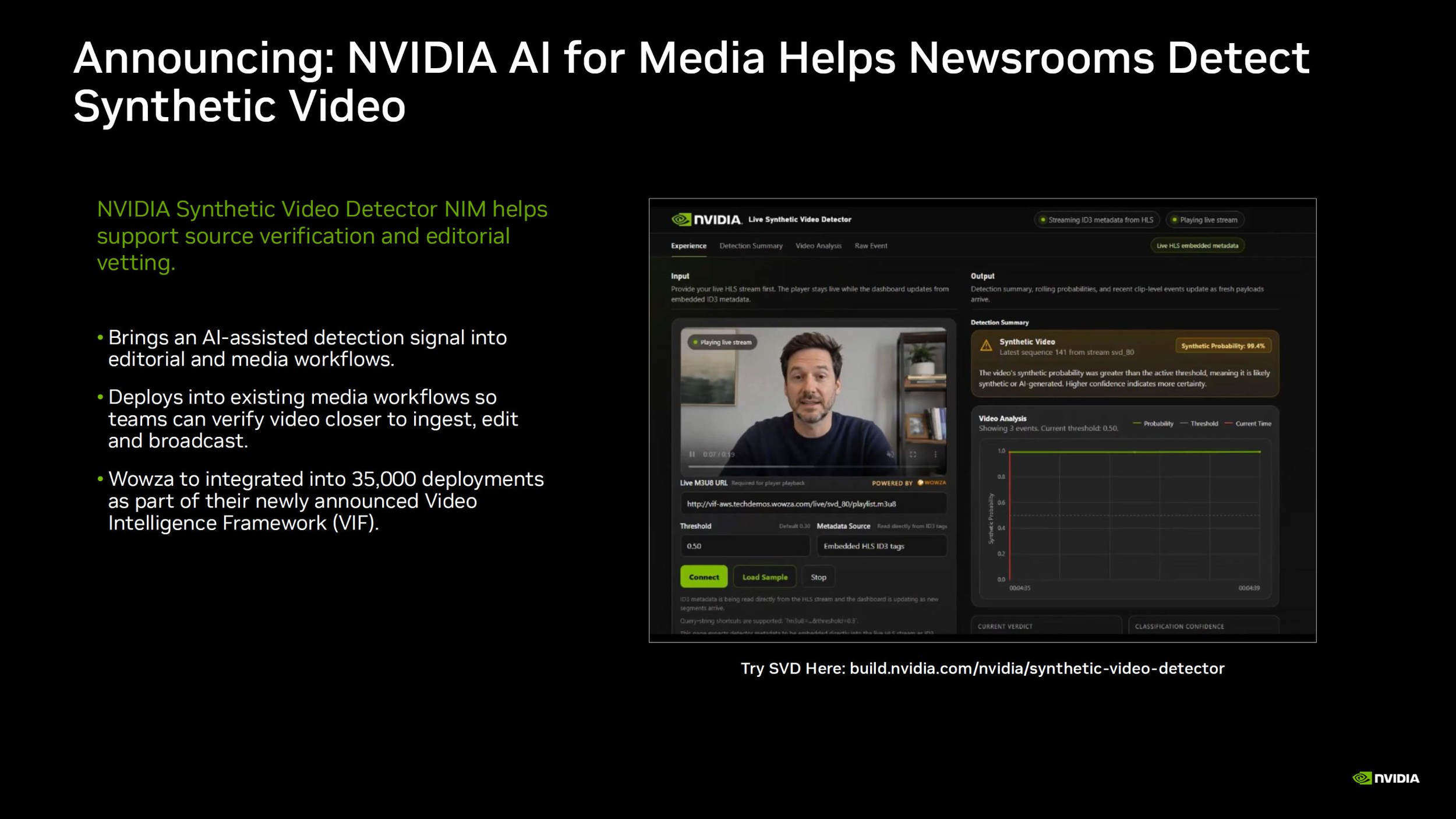
NVIDIA has introduced a Synthetic Video Detector designed to help newsrooms, broadcasters, government agencies, and media organizations identify footage created through artificial intelligence. The detector arrives as generative video models produce increasingly convincing content that can spread rapidly through news feeds and live streaming platforms before editorial teams have enough time to verify its origin.
The new Synthetic Video Detector is distributed as an NVIDIA NIM microservice within the company’s AI for Media platform. It examines video frame by frame and produces a probability score between 0 and 1, with higher values indicating that the footage is more likely to be synthetic. Editorial teams can use the score to prioritize manual reviews, isolate suspicious clips, or escalate content for deeper forensic analysis.
The system does not determine whether the events shown in a video are truthful, misleading, or taken out of context. It is specifically designed to detect visual patterns associated with videos created by AI diffusion models. NVIDIA therefore presents the detector as an additional verification signal rather than a replacement for source checks, metadata analysis, reverse searches, eyewitness confirmation, and established newsroom procedures.
NVIDIA reports accuracy of up to 92% when examining uncompressed footage. Accuracy falls to 87% at 15% compression and 82% at 50% compression, demonstrating how social media processing, transcoding, and repeated uploads can make synthetic content more difficult to identify. The company’s public model card separately lists an accuracy result of 85.64% across an internal evaluation benchmark containing 4,000 videos, showing that performance can vary according to the dataset and testing conditions.
The microservice can process 1080p frames in as little as 22 ms on supported NVIDIA RTX systems and approximately 30 ms on NVIDIA L40 GPUs. This level of performance could allow synthetic video screening to operate close to live ingest pipelines rather than requiring every clip to be uploaded to a remote service before analysis.
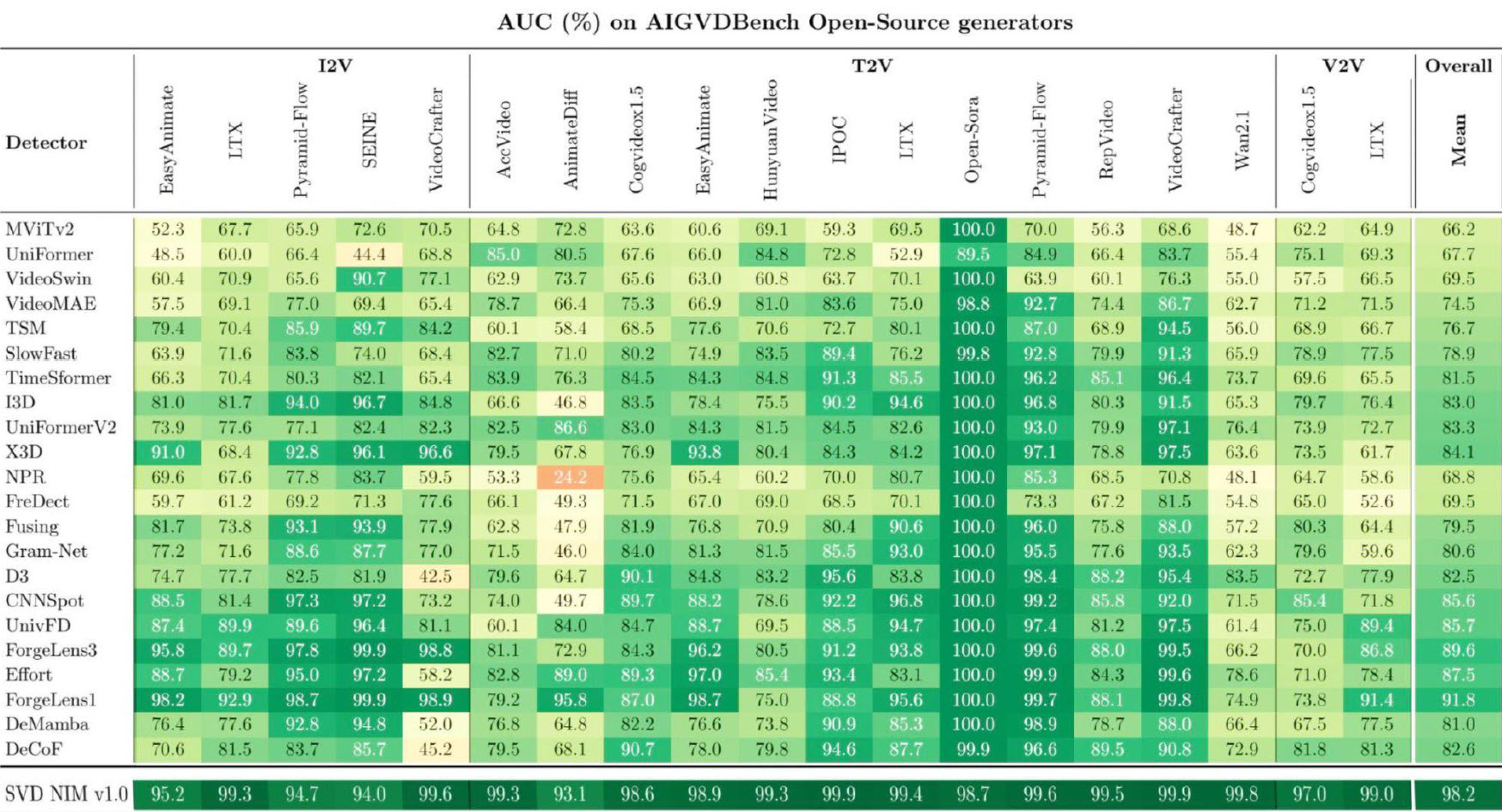
The model is built from an ensemble of DINOv2 and DINOv3 vision transformer architectures and contains approximately 172 million parameters. NVIDIA says it was developed using real footage alongside synthetic videos created through generators including Pyramid Flow, Open Sora Plan, Allegro, and Cosmos Predict 1. The model is also based on technology connected to the winning entry from the ICCV 2025 SAFE Challenge.
NVIDIA intentionally configures the system to prioritize reducing false negatives, meaning it is more willing to flag authentic footage than risk allowing synthetic content to pass undetected. This approach may be useful during breaking news events, but it also makes human review essential because a high probability score should not automatically be treated as proof that a clip is fake.
The current microservice accepts MP4 video using the H.264 codec and can return an overall synthetic probability alongside optional intermediate results. Variable frame rate footage is not currently supported, while NVIDIA warns that repeated compression and transcoding may reduce detection performance. The service can operate through local, edge, hybrid, and approved isolated environments, helping organizations retain control over sensitive footage.
Streaming technology company Wowza plans to integrate the detector into its Video Intelligence Framework. Wowza technology currently supports more than 35,000 video deployments across more than 170 countries, potentially bringing automated synthetic content analysis into existing live broadcast and streaming infrastructure.
The Synthetic Video Detector is currently available through NVIDIA’s AI for Media access program and can also be tested through the company’s online NIM environment. Supported hardware includes selected Blackwell, Ada, Ampere, and Turing GPUs with Tensor Cores and compatible video encoding and decoding hardware.
NVIDIA is expanding its AI PC ecosystem through local inference tools, creator applications, and real time AI processing. Synthetic Video Detector extends that strategy into media verification, giving RTX hardware a potential role in protecting editorial workflows as well as generating and processing content.
Synthetic video detection is becoming necessary infrastructure, but a 92% result still leaves meaningful room for mistakes. The technology could help journalists identify suspicious footage faster during breaking events, yet it cannot determine whether a video has been edited deceptively, presented with a false description, or removed from its original context.
The strongest implementation will combine automated detection with provenance records, metadata, trusted sources, and experienced editorial review. NVIDIA’s speed advantage makes the detector useful as an initial filter, but treating any automated score as a final verdict could create a new misinformation problem rather than solving the existing one.
Would you trust an AI detector to flag suspicious news footage, or should every result require confirmation from a human verification team?
