
NVIDIA Expands RTX Remix With Advanced Particle VFX as Quake III RTX Enters Early Access
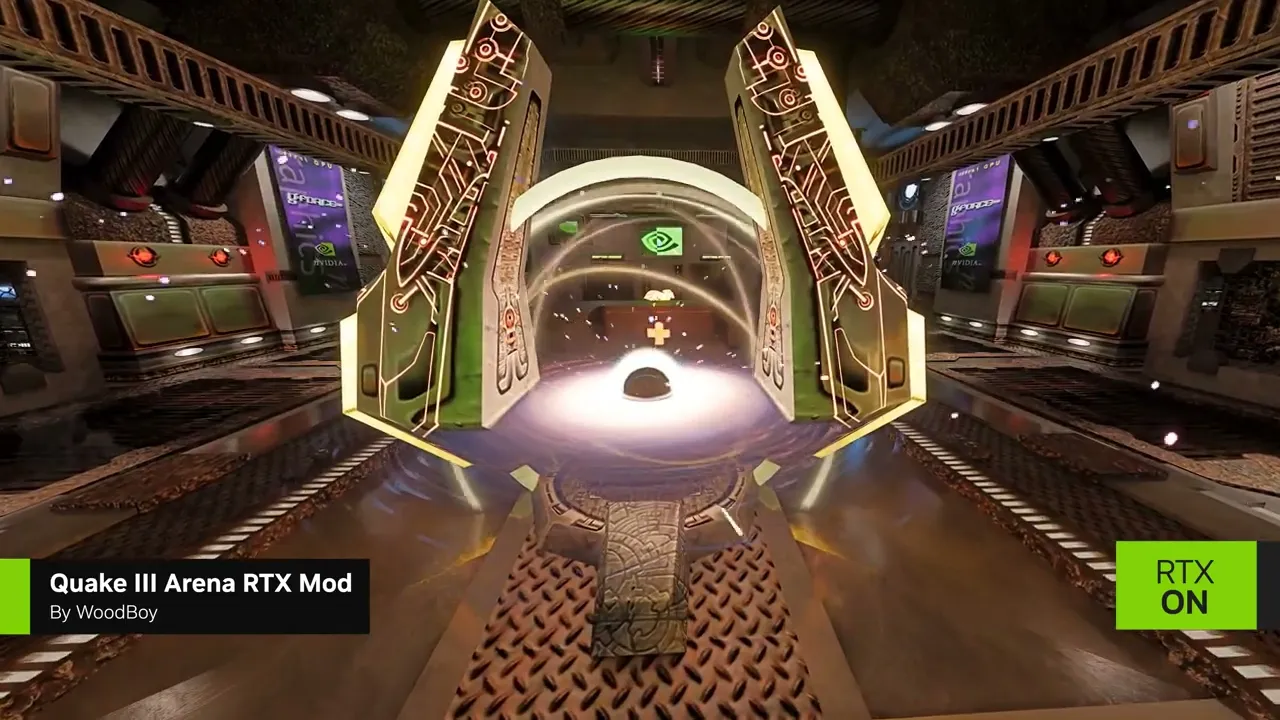
NVIDIA used its GDC 2026 announcements to push RTX Remix further as a serious remastering platform for classic PC games, with one of the biggest updates centered on a major overhaul to its particle system. The company confirmed that its new Advanced Particle VFX feature will arrive next month, answering what it says has been the top request from the RTX Remix open source community.
The new Advanced Particle VFX system is designed to give modders far more control and flexibility when rebuilding effects for older titles. At the core of this update is a new curve editor that allows creators to precisely define how a particle behaves throughout its entire lifespan. This includes control over color, size, velocity, and transparency over time. Instead of relying on simple fade outs or uniform scaling, modders can now craft more nuanced animation sequences that evolve in visually dramatic ways. NVIDIA demonstrated this with Quake III’s black hole effect, where particles expand outward, shift in color, and gradually fade as they move away from the center. The result is a much more layered and expressive effect that would have been difficult to achieve with the older toolset.
Another major focus of the update is reducing the repetitive look that often affects particle systems in classic games. The new system introduces randomized elements such as random animations, random flipping, and random rotation on a per particle basis. This means repeated effects no longer look mechanically identical, helping scenes feel more organic and less scripted. NVIDIA highlighted Quake III’s lightning gun during the showcase, where each discharge appears with different orientations and directional patterns. Impact effects also gain more visual variety, with debris and rock fragments scattering in different sizes and trajectories, adding a stronger sense of chaos and physical response.
The third major improvement comes from deeper physical simulation. Advanced Particle VFX adds support for attraction, magnetic repulsion, wind, air resistance, updated collision behavior, and burst modes. These tools allow modders to build effects that respond more dynamically to the game world and to surrounding forces. NVIDIA once again used the Quake III black hole as the showcase, showing particles from machine gun fire being pulled inward while shotgun blasts caused particles to orbit the void before ultimately collapsing into it. This kind of layered behavior gives RTX Remix creators more room to reimagine older effects with modern presentation standards.
Alongside the platform update, NVIDIA also highlighted the release of Quake III RTX Early Access version 0.6. The project was created by modder Woodboy, who has taken on the task of remastering several levels from id Software’s original Quake III Arena. Available free for owners of the original game through ModDB, the early access version currently includes 15 levels, among them the custom “Area 15 – NVIDIA Bunker” map rebuilt with RTX technology.
This Quake III RTX project is also being positioned as a showcase for what RTX Remix is becoming. The release includes NVIDIA DLSS 4 with Multi Frame Generation, path tracing, DLSS Ray Reconstruction, remade PBR assets, RTX Remix Logic, Advanced Particle VFX, Neural Radiance Cache, and NVIDIA Reflex. For players and modders alike, it is a practical example of how classic shooters can be reintroduced with a much more ambitious visual standard while keeping their original gameplay identity intact.
NVIDIA also shared another RTX Remix related update involving Call of Duty 2 Remixed. That project now supports the Logic system, allowing players to trigger changes in weather conditions and time of day through hotkeys. While smaller in scope than the particle overhaul, it shows that RTX Remix is continuing to evolve not only as a graphics remastering platform but also as a more interactive modding framework.
From a broader PC gaming perspective, this is one of the more meaningful RTX Remix updates so far. Visual upgrades such as path tracing and PBR assets naturally attract attention, but particle effects are often what make worlds feel alive during actual gameplay. By giving modders better animation control, richer randomness, and more advanced physical behavior, NVIDIA is addressing a part of remastering that directly impacts immersion. Quake III RTX serves as a strong early proof point, especially for players who want to see iconic arena shooter combat rebuilt with modern lighting and effects technology.
What do you think about NVIDIA’s latest RTX Remix upgrades? Does Quake III RTX look like a compelling reason to revisit a classic shooter with modern visuals?
