
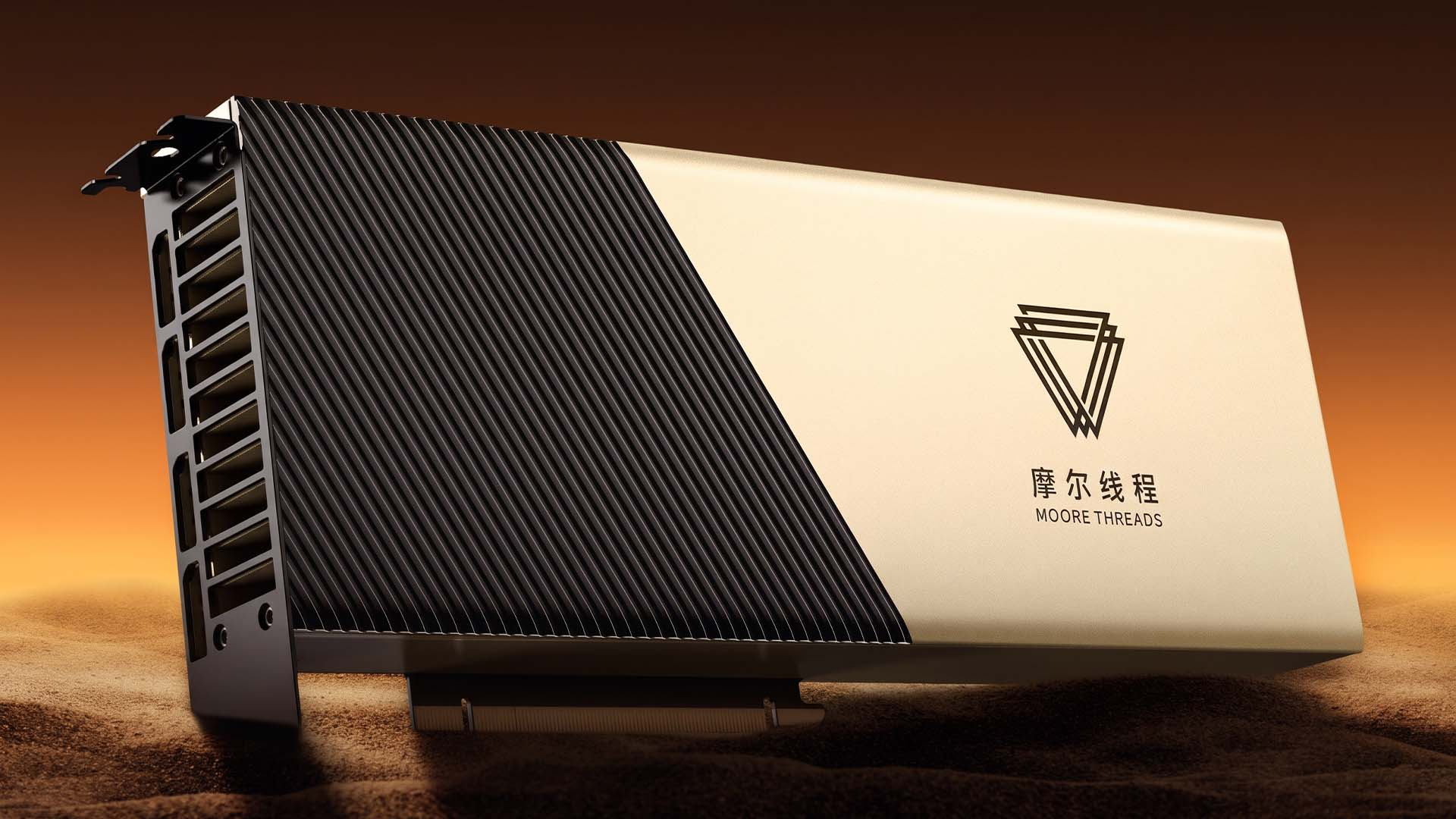
Chinese GPU manufacturer Moore Threads is preparing to introduce its next generation Lushan graphics card, promising what could become the largest VRAM capacity ever offered on a consumer GPU. The company is positioning its upcoming graphics architecture for both AAA gaming and local artificial intelligence, potentially challenging the memory limitations of conventional desktop graphics cards. The official unveiling is expected during the MUSA Developer Conference 2026 on December 29, with additional technical details scheduled throughout the event in Beijing.
The announcement follows a November 18 social media post from AIR_FORCE, product manager of the Moore Threads MTT S80, suggesting that Lushan could feature the highest memory capacity in consumer graphics card history. Although no exact specifications have been confirmed, the statement suggests the possibility of exceeding the 32 GB available on NVIDIA's GeForce RTX 5090. Previous architectural presentations indicated that Moore Threads was targeting up to 4 times the memory capacity of its earlier generation, potentially suggesting configurations reaching 64 GB. However, this remains an expectation rather than a confirmed product specification.
According to the company's official Lushan announcement, the new graphics architecture will focus on both advanced rendering and artificial intelligence. Moore Threads previously outlined substantial improvements over its existing MTT S80 and S90 graphics cards, including 16 times greater geometry processing performance, 50 times higher ray tracing performance, and 64 times greater AI computing capability. The company is also introducing its UNITE rendering architecture, a new generation of proprietary hardware ray tracing acceleration, and AI assisted rendering technologies. These figures represent manufacturer performance targets rather than independently verified gaming benchmarks.

For PC gaming, the larger memory capacity could provide additional flexibility for 4K textures, demanding graphics modifications, and increasingly complex environments. However, the GPU's actual competitiveness will depend on memory bandwidth, driver optimization, graphics API compatibility, and real gaming performance. Moore Threads has made considerable improvements to its existing GPU drivers, but its software ecosystem still faces substantial challenges compared with NVIDIA, AMD, and Intel.
The greater opportunity could emerge in local AI workloads, where VRAM capacity often determines whether large language models can operate entirely on a single graphics card. Higher memory configurations could support larger quantized models, extended context windows, and more complex image generation workflows without relying on multiple GPUs or slower system memory. This follows the growing industry interest in high memory computing systems designed for local AI, although Moore Threads will also need competitive memory bandwidth and broader software support to deliver practical performance advantages.
The company's proprietary MUSA computing platform remains another important consideration. Unlike NVIDIA's established CUDA ecosystem, Moore Threads must continue developing compatibility with popular machine learning frameworks, inference engines, and creative applications. Without reliable software support, even substantial VRAM capacity may provide limited practical benefits.
Moore Threads is expected to reveal additional specifications during its MUSA Developer Conference on December 29 and 30. Pricing, power consumption, memory configuration, gaming benchmarks, and international availability have not yet been confirmed.
Moore Threads' Lushan could represent an important development for the consumer GPU industry, particularly as NVIDIA and AMD continue separating gaming graphics cards from expensive professional AI accelerators. VRAM capacity has become one of the biggest limitations for enthusiasts interested in both modern gaming and local AI, making the possibility of a consumer graphics card with substantially more than 32 GB particularly interesting.
However, memory capacity alone will not make Lushan competitive. The GPU must demonstrate acceptable gaming performance, mature drivers, efficient AI processing, and compatibility with widely used development tools. More importantly, it needs accessible pricing that allows enthusiasts to benefit from the hardware rather than simply introducing another expensive workstation alternative.
The consumer market needs greater competition and practical access to high capacity graphics cards. If Moore Threads can deliver substantial VRAM at reasonable prices while improving its software ecosystem, Lushan could become an interesting alternative for PC enthusiasts who want to run AI locally while retaining full control over their hardware.
Would you consider a Moore Threads GPU with 48 GB or 64 GB of VRAM for local AI and gaming, even with a less mature software ecosystem, or would you prefer paying more for NVIDIA or AMD hardware?
