
Micron Taiwan Workers Move Closer to Strike as 80% Back Action Over Bonuses
Micron Technology is facing growing labor pressure at its critical Taiwan manufacturing operations, with more than 80% of surveyed union members supporting possible strike action unless the company changes its employee bonus system and shares more of its record profits with workers. The unions representing employees in Taoyuan and Taichung told Reuters that they have nearly 10,000 members among approximately 15,000 Micron employees across the 2 locations, making any potential labor action significant for one of the world's largest memory manufacturers.
The August survey does not mean that a strike has officially begun or even been formally approved. However, the more than 80% support among participating union members represents a major escalation from the discussions that emerged during July. We previously reported that Micron Taiwan union representatives were reviewing strike procedures and questioning the company's 200% performance bonus cap as employees compared their compensation with increasingly generous profit sharing programs at Samsung Electronics and SK hynix.
At the center of the dispute is Micron's existing Incentive Pay Plan, or IPP. The unions argue that the annual system does not adequately reflect the company's profitability and lacks transparency around how its company performance component is calculated. According to the unions, the existing performance bonus can reach a maximum of around 200% of the target payment, reportedly equivalent to approximately 5 months of salary, while recent actual payouts have been closer to 2.6 months.
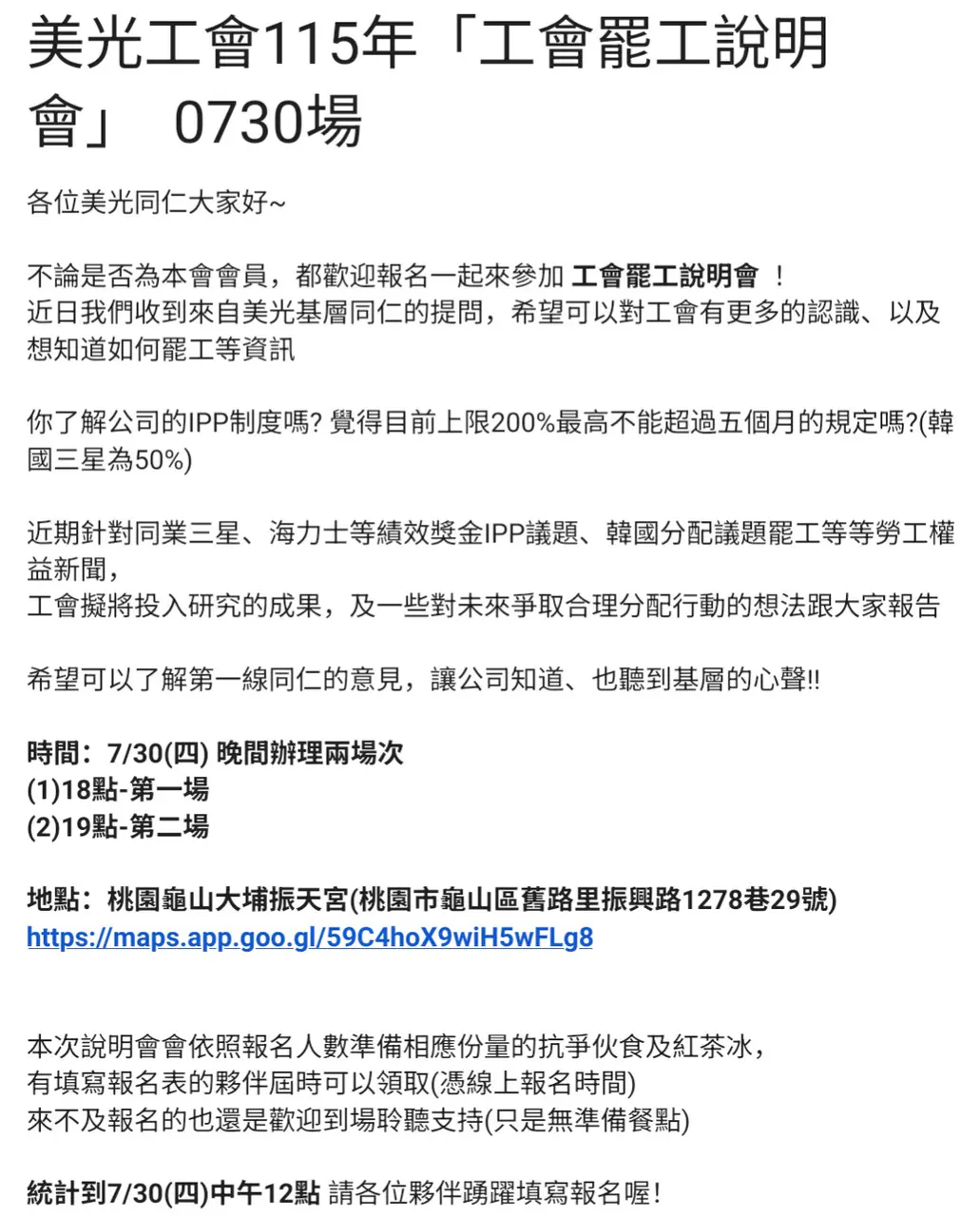
For fiscal 2026, the unions are asking Micron to provide an additional one time bonus that they say would amount to approximately 83 months of salary per Taiwan employee. Beginning in fiscal 2027, they want the existing IPP replaced by a profit sharing structure that allocates 15% of operating profit toward employee bonuses, with payments distributed quarterly instead of once per year. Micron has indicated that it intends to maintain the existing IPP for this year's bonus calculation.
The demands arrive during an extraordinary financial period for the memory industry. Micron reported record fiscal Q3 2026 revenue of $41.46 billion, compared with $23.86 billion during the previous quarter and $9.30 billion a year earlier. GAAP net income reached $28.24 billion, while operating income climbed to $33.32 billion. Micron CEO Sanjay Mehrotra attributed the results to the growing strategic value of memory during the AI era and rapidly increasing customer demand.
Micron Taiwan has responded by saying its 2026 performance bonus will be the largest in company history. The company plans to disclose details of the upcoming IPP payment during October and says it will continue communicating with employees while complying with Taiwan's labor regulations. Micron also argues that its total compensation package extends beyond the annual IPP and includes base salary, operational bonuses, employee stock programs and restricted stock arrangements.
"2026's performance bonus payout would be the highest in the company's history."
— Quote by: Micron Taiwan.
The comparison with South Korean competitors is driving much of the disagreement. Samsung recently avoided a planned 18 day strike involving as many as 48,000 union members after reaching an agreement that created a bonus pool equal to 10.5% of the semiconductor division's operating profit, subject to profitability conditions. SK hynix already allocates around 10% of annual operating profit toward employee bonuses. Micron's Taiwan unions argue that these arrangements have created an increasingly large compensation gap between workers performing similar roles across the world's 3 dominant DRAM manufacturers.
A strike could have consequences extending well beyond Micron's workforce. Taiwan is the company's largest manufacturing base and hosts major production for both conventional DRAM and High Bandwidth Memory. Taiwanese authorities say Micron has invested approximately NT$1.4 trillion, or $43.9 billion, in the country. The Central Taiwan Science Park administration is monitoring the negotiations and has assigned personnel to help communication between the company and its unions, warning that production disruption could affect Micron, workers and the wider semiconductor supply chain.
The timing could hardly be more sensitive for memory supply. AI infrastructure has pushed DRAM and HBM demand to unprecedented levels, while Micron recently began high volume HBM4 shipments and is expanding additional DRAM capacity in Taiwan. In March, the company completed its acquisition of PSMC's Tongluo P5 facility, adding approximately 300,000 square feet of existing 300 mm cleanroom space and preparing further construction to increase advanced DRAM and HBM output.
Any meaningful disruption would therefore arrive in a memory market that is already extremely tight. Korean DRAM export unit values surged 401% year over year during August as AI infrastructure absorbs increasing manufacturing capacity. Micron's own margins also illustrate how dramatically the cycle has changed, with its fiscal Q3 non GAAP gross margin reaching 84.9%.
Formal negotiations remain the immediate priority. Industry reports indicate that mediation is expected during September, with a formal strike vote possible if labor and management fail to reach an agreement. Until that process concludes, the 80% figure should be understood as support recorded through an internal survey rather than authorization for an immediate walkout.
The potential Micron strike demonstrates how the AI memory boom is reshaping more than semiconductor pricing. Workers can see the same extraordinary financial results investors and customers are seeing, and compensation structures that looked competitive during a normal DRAM cycle are now being compared against profit sharing programs worth billions of dollars at Samsung and SK hynix.
The unions' proposed 15% allocation is more aggressive than either Korean competitor, and the requested 83 months of salary for fiscal 2026 is an extraordinary demand. Whether those numbers survive negotiations is another question. What matters now is that Micron cannot easily dismiss the dispute when its Taiwan operations are strategically essential to both DRAM and HBM supply.
With memory availability already under severe pressure, neither Micron nor its customers want a prolonged production interruption. That gives both sides a strong incentive to reach an agreement before labor negotiations become a semiconductor supply problem.
With Micron reporting record profits from the AI memory boom, should employees receive a fixed percentage of company operating profit similar to Samsung and SK hynix?
