
Meta Expands NVIDIA Vera Rubin and Vera CPU Deployments With $3 Billion Investment Partnership

Meta is expanding its partnership with NVIDIA to accelerate the development and deployment of its Muse AI models, committing to additional Vera Rubin GPU systems, dedicated Vera CPU infrastructure and advanced networking technologies. The agreement, announced on October 26, 2026, also includes a planned $3 billion investment by NVIDIA in Meta's equity offering, strengthening the relationship between 2 of the largest companies driving the global AI infrastructure expansion.
According to NVIDIA's official announcement, the companies will collaborate on optimizing training and inference workloads across Meta's Muse family of models. The objective is to improve computational efficiency, maximize infrastructure utilization and reduce the total cost of operating increasingly complex AI agents.
The expansion builds upon Meta's existing deployment of NVIDIA Blackwell and Rubin accelerators, but places additional emphasis on dedicated Vera CPU systems. Unlike conventional AI workloads focused primarily on GPU computation, autonomous agents require substantial CPU resources to execute applications, manage virtual environments, access databases and coordinate multiple tasks simultaneously.
Meta's Muse personal AI agent demonstrates this shift. The platform operates through dedicated secure virtual machines capable of running browsers, interacting with applications and completing tasks on behalf of users. Supporting these operations at a scale potentially reaching billions of users requires both powerful AI accelerators and extensive general purpose processing capacity.
NVIDIA Infrastructure Supporting Meta's Muse AI Expansion
| Technology | Hardware Specifications | Primary Role |
|---|---|---|
| Vera Rubin NVL72 | 72 Rubin GPUs and 36 Vera CPUs | AI model training and inference |
| Rubin GPU | 288 GB HBM4 per GPU | High bandwidth AI processing |
| Vera CPU | 88 Arm based Olympus cores | Agent execution and data processing |
| Vera CPU Rack | Up to 256 liquid cooled CPUs | Large scale virtual environments |
| NVLink 6 | 216 TB/s aggregate bandwidth per NVL72 rack | GPU communication |
| Spectrum X Ethernet | High performance AI networking | Connecting distributed AI systems |
| BlueField 4 | Infrastructure processing and acceleration | Networking, storage and workload isolation |
Specifications reflect NVIDIA's published platform capabilities, not confirmed quantities or configurations purchased by Meta.
The Vera Rubin NVL72 architecture delivers 20.7TB of HBM4 memory across its 72 GPUs, with approximately 1.4PB/s of aggregate memory bandwidth. NVIDIA also rates the platform at 2.52 exaFLOPS of dense FP4 training compute, providing the computational capacity required for increasingly demanding reasoning and inference workloads.
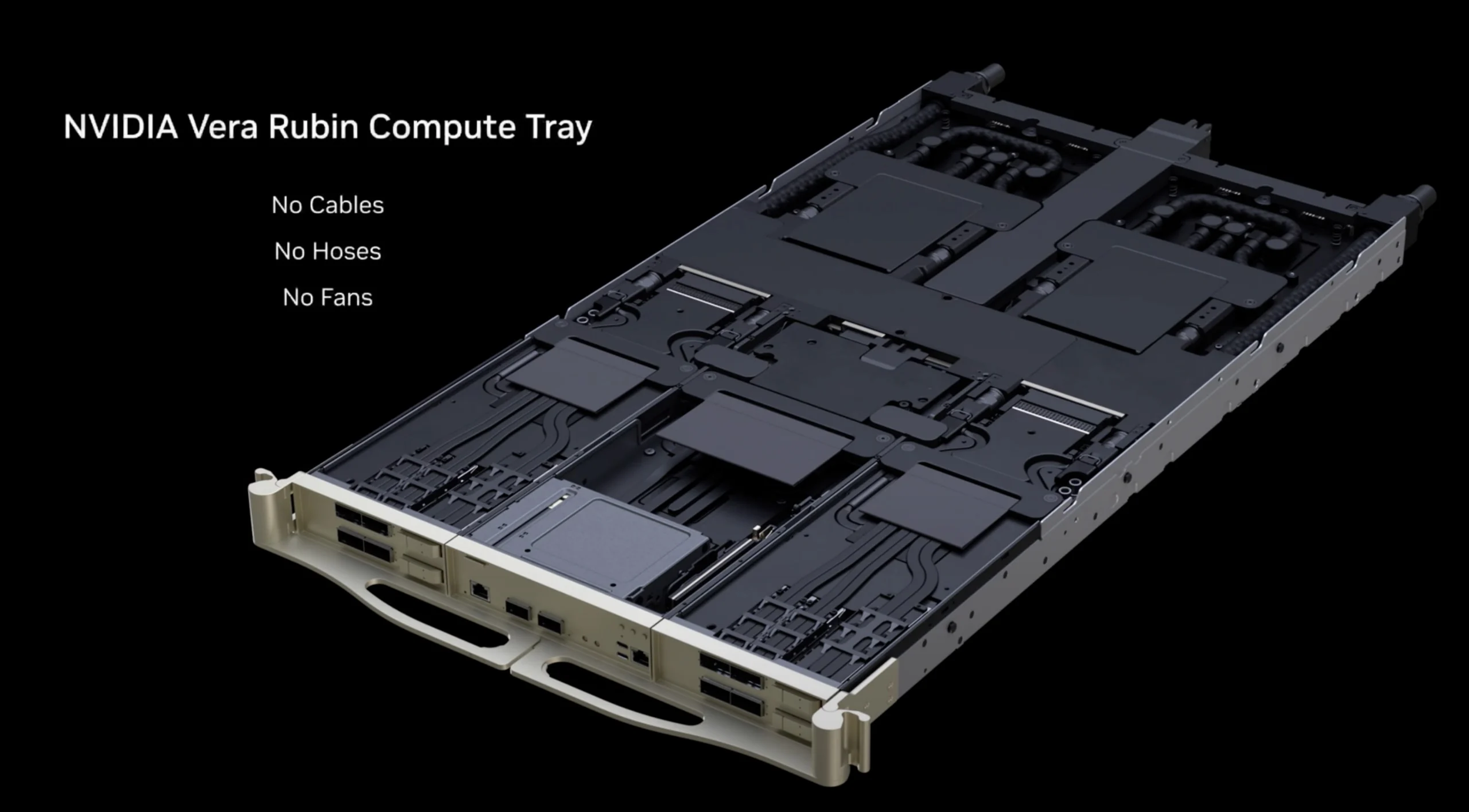
Meanwhile, standalone Vera CPU racks can integrate up to 256 processors, supporting more than 22,500 concurrent CPU environments under NVIDIA's reference architecture. These systems are designed to handle the software execution, data processing and orchestration tasks surrounding GPU accelerated AI models.
Meta has already demonstrated the scale of its infrastructure ambitions through its Prometheus AI supercluster in Ohio. The facility currently operates hundreds of thousands of GPUs, with plans to expand toward approximately 1 million GPUs across multiple generations of hardware. Meta confirmed that Vera Rubin NVL72 systems will join its existing Blackwell infrastructure, with projected improvements of 10% to 20% in performance per watt compared with GB300 NVL72.
Beyond hardware, NVIDIA and Meta are exploring additional collaboration involving NVIDIA OpenShell for secure AI agent deployment and NVIDIA Sentry for monitoring agent behavior. These initiatives remain under consideration rather than finalized deployment commitments.
The $3 billion equity investment adds a financial dimension to the partnership, although it should not be confused with the value of Meta's hardware purchases. Neither company has disclosed the additional number of Vera Rubin systems being ordered, the total deployment cost or a specific installation schedule.
Meta's expanded NVIDIA partnership highlights an important change in AI infrastructure design. GPUs remain essential for model training and inference, but increasingly capable AI agents create substantial demand for CPUs, networking and storage systems capable of executing thousands of simultaneous tasks.
This is particularly significant for NVIDIA because Vera represents an expansion beyond its traditional GPU business. By supplying dedicated CPU racks alongside Rubin accelerators, the company can compete more directly with AMD EPYC, Intel Xeon and custom server processors while offering an integrated AI computing platform.
The $3 billion investment also strengthens NVIDIA's commercial relationship with one of its largest infrastructure customers. However, Meta's continued investment in alternative processor architectures suggests that maintaining supplier flexibility remains strategically important.
Ultimately, the competitive advantage may depend less on individual GPU performance and more on how efficiently complete AI systems can execute complex tasks. With Muse targeting widespread consumer adoption, infrastructure operating costs and performance per watt could become just as important as raw computational capacity.
Do you think NVIDIA's expansion into dedicated Vera CPU infrastructure will become as important as its GPU business, or will AMD and Intel remain the preferred suppliers for large scale AI server processors?
