
MediaTek Unveils Dimensity 9500s On 3nm With Zero Efficiency Cores, 19MB CPU Cache, 9600MT/s LPDDR5X Support, And Immortalis G925 Graphics
MediaTek has officially introduced the Dimensity 9500s, a new 3nm smartphone platform that keeps a familiar CPU cluster approach from the Dimensity 9500 while making a bold architectural statement by skipping dedicated efficiency cores entirely. The company is positioning the Dimensity 9500s as a flagship grade feature stack that is not being marketed as a top tier flagship chip, which is an interesting strategic move as the premium Android space continues to push higher frame rates, heavier on device AI workloads, and more complex camera pipelines.
On paper, the Dimensity 9500s is built around a large cache configuration and a performance focused CPU layout. MediaTek highlights 12MB of L3 cache paired with 10MB of system level cache, contributing to what it calls a largest in class 19MB CPU cache configuration. The platform also targets high memory bandwidth with LPDDR5X support up to 9600MT/s, plus storage support for UFS 4.0 with MCQ.
MediaTek keeps the same style of cluster structure while emphasizing responsiveness and efficiency through software level management. The Dimensity 9500s CPU configuration includes:
1 ARM Cortex X925 up to 3.73GHz with 2MB L2 cache
3 ARM Cortex X4 cores with 1MB L2 cache
4 ARM Cortex A720 cores with 512KB L2 cache
To manage this performance heavy layout, MediaTek is leaning on its second generation Dimensity Scheduling Engine, which it says helps distribute everyday tasks intelligently, improve app launch behavior, and maintain highly responsive touch and scrolling. The company also claims strong efficiency even when the scheduling engine is actively optimizing workloads, which is a key promise given the decision to avoid efficiency cores.
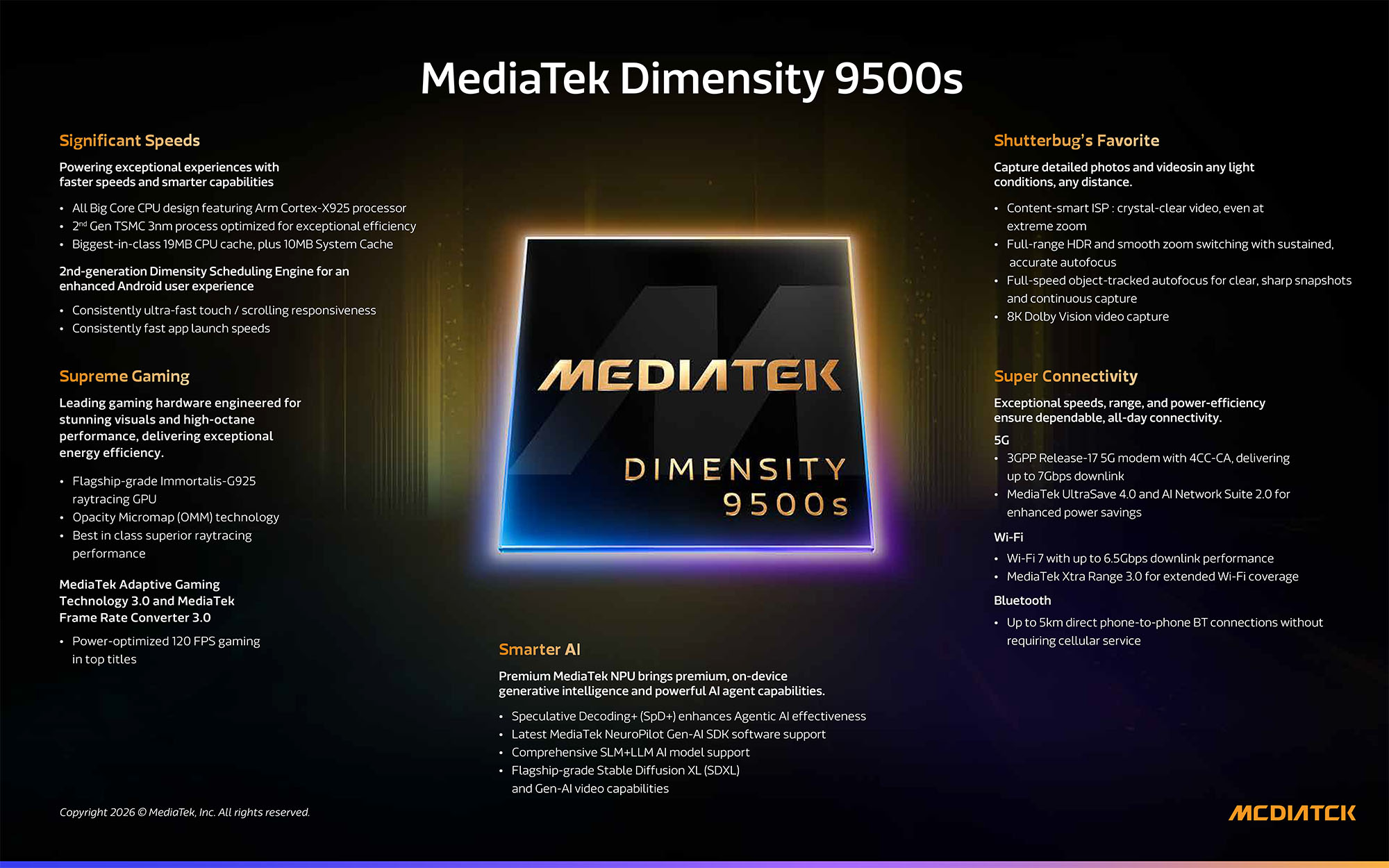
For graphics, the Dimensity 9500s sticks with ARM Immortalis G925, aiming for strong graphics fidelity with ray tracing support and Opacity Micromap technology. MediaTek is also bundling its gaming middleware stack, including MediaTek Adaptive Gaming Technology 3.0 and MediaTek Frame Rate Converter 3.0, to improve power efficiency while maintaining high frame rates.
In supported games, MediaTek claims the platform can reach up to 165FPS, with a power optimized option targeting 120FPS. This positions the 9500s as a practical choice for high refresh devices that want to advertise console like smoothness without overexposing thermals and battery life.
On the AI side, the Dimensity 9500s includes a MediaTek NPU focused on local features such as AI live photo, AI photo editing, AI document summarization, Stable Diffusion workflows, and generative AI video capabilities. This aligns with the broader market pivot toward on device creation features that can run without cloud round trips.
For imaging, MediaTek lists support for a single 320MP sensor, 18 bit RAW capture, 8K Dolby Vision capture, and 4K portrait bokeh video. The maximum capture spec is 8K at 60FPS, which is now a key spec line for premium tier marketing even when many users default to 4K day to day.
Connectivity is led by an integrated 5G modem described as Release 17 with up to 7Gbps downlink, plus WiFi 7 with up to 6.5Gbps downlink. Bluetooth range is listed as up to 5KM phone to phone, which is a headline grabbing number that will likely depend heavily on regional rules, antenna design, and real world radio conditions.
Overall, the Dimensity 9500s reads like a performance first refinement pass that keeps the Dimensity 9500 style CPU structure, adds an aggressive cache and memory story, and leans on scheduling plus gaming middleware to deliver the efficiency narrative without dedicated efficiency cores. The real verdict will come when shipping devices reveal sustained performance behavior and thermal curves under extended gaming and AI creation loads.
What matters more to you in a next gen mobile chip, peak gaming FPS, sustained performance over time, or practical AI features you will actually use daily?
