
LPDDR6 Targets 512GB Modules As AI Datacenters Chase More Efficient Memory
LPDDR6 is moving beyond mobile devices, with JEDEC preparing the standard for AI datacenters that need more memory capacity, stronger efficiency, and modular SOCAMM2 designs.
LPDDR memory has traditionally been associated with smartphones, laptops, and compact devices, but AI infrastructure is changing that role quickly. As agentic AI workloads become more demanding, datacenters need memory that can deliver higher capacity without pushing power and thermal limits too far. According to EETimes, JEDEC is expanding the LPDDR6 roadmap with features aimed directly at datacenter customers. That includes higher density targets, flexible metadata support, LPDDR6 SOCAMM2 modules, and LPDDR6 Processing in Memory.
The headline number is 512GB. JEDEC’s roadmap points to LPDDR6 densities beyond today’s LPDDR5 and LPDDR5X limits, with the goal of reaching 512GB capacity for AI training and inference systems.
"The goal is to reach 512GB density, which is beyond the current LPDDR5 and LPDDR5X maximum."
— Nagashima via EETimes
LPDDR6 is not only about raw bandwidth. EETimes reports that bandwidth may improve by around 10% to 20% over current generation LPDDR, but the bigger change is density.
JEDEC is moving toward narrower x6 per die interface options and additional sub channel modes, which would allow memory makers to fit more DRAM capacity per component and per channel. For AI servers, that can be more valuable than chasing bandwidth alone. That is especially important for agentic AI. Long running agents can hold more context, execute multiple tool calls, run coding tasks, and maintain longer working memory across sessions. The more agents a system supports, the more memory pressure rises.
This is why LPDDR6 is being positioned as part of the AI infrastructure roadmap, not just the next mobile memory standard.
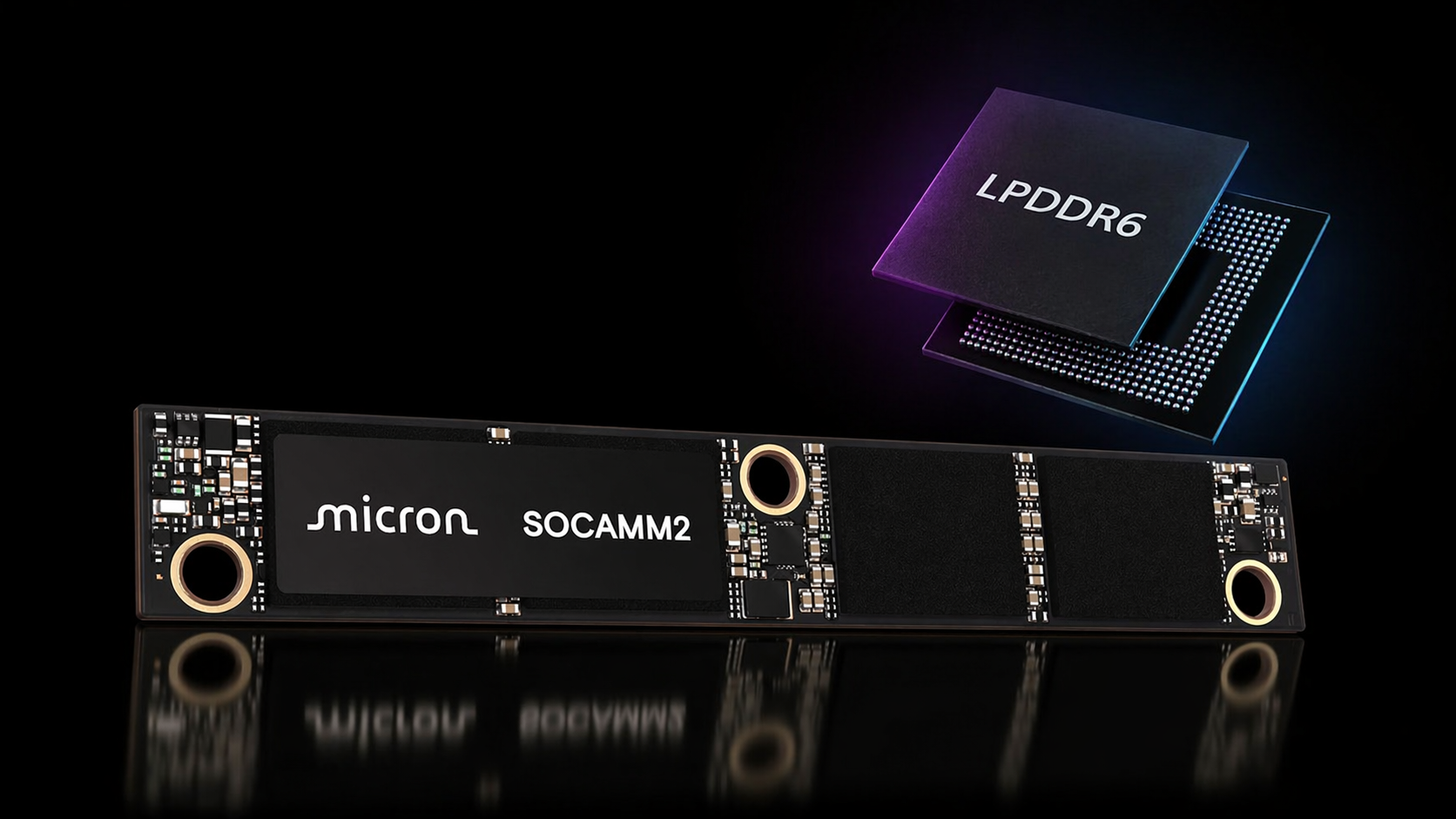
The SOCAMM2 module format is another key part of the story. Micron describes SOCAMM2 as a datacenter class modular LPDDR5X form factor built for AI systems, offering power efficiency and space savings compared with traditional DDR5 RDIMM configurations. JEDEC is now working on an LPDDR6 based SOCAMM2 standard, which would carry that compact and serviceable module format into the next generation. Current SOCAMM2 LPDDR5X modules can reach 256GB, while LPDDR6 is being aimed at 512GB.
NVIDIA has already adopted LPDDR memory around its Vera CPU roadmap, while AMD has also confirmed LPDDR5X SOCAMM2 support for future EPYC Verano systems. That gives LPDDR a much stronger path into mainstream AI infrastructure than it had only a few years ago. JEDEC is also nearing work on LPDDR6 Processing in Memory, or PIM. The idea is to let memory handle certain calculations closer to where data is stored instead of constantly moving data back to the CPU or accelerator.
That matters because memory movement is one of the biggest efficiency challenges in AI workloads. Even if GPUs and CPUs become faster, datacenters still lose power and performance when data has to move too often across the system.
"AI and data centers are really driving, or straining, the ecosystem right now."
— JEDEC via EETimes
PIM will not replace GPUs or CPUs, but it could help reduce bottlenecks in specific memory bound tasks, especially as inference systems become more complex and agentic workloads grow.
LPDDR6 shows how much AI is reshaping the memory industry.
A few years ago, LPDDR was mainly seen as mobile memory. Now it is becoming a serious datacenter option because power efficiency, module density, and space savings are becoming just as important as peak performance. That does not mean DDR5 RDIMM, MRDIMM, or HBM disappear. Each memory technology still has a different role. HBM will remain critical for GPU attached high bandwidth workloads, while DDR and MRDIMM will continue serving broad server platforms.
But LPDDR6 and SOCAMM2 are aiming at a very specific problem. AI systems need more memory per node, lower power consumption, and serviceable modules that fit dense server designs. If JEDEC, Micron, Samsung, SK hynix, NVIDIA, and AMD can align around the standard, LPDDR6 could become one of the most important memory shifts for AI infrastructure by 2028 and beyond.
The key point is simple. Agentic AI is not only creating demand for faster GPUs. It is creating demand for smarter memory systems.
Do you think LPDDR6 SOCAMM2 will become a major AI datacenter standard, or will HBM and DDR based server memory continue to dominate?
