
Lekuo Turns One PCIe Slot Into 12 Ports With AMD B650 Card
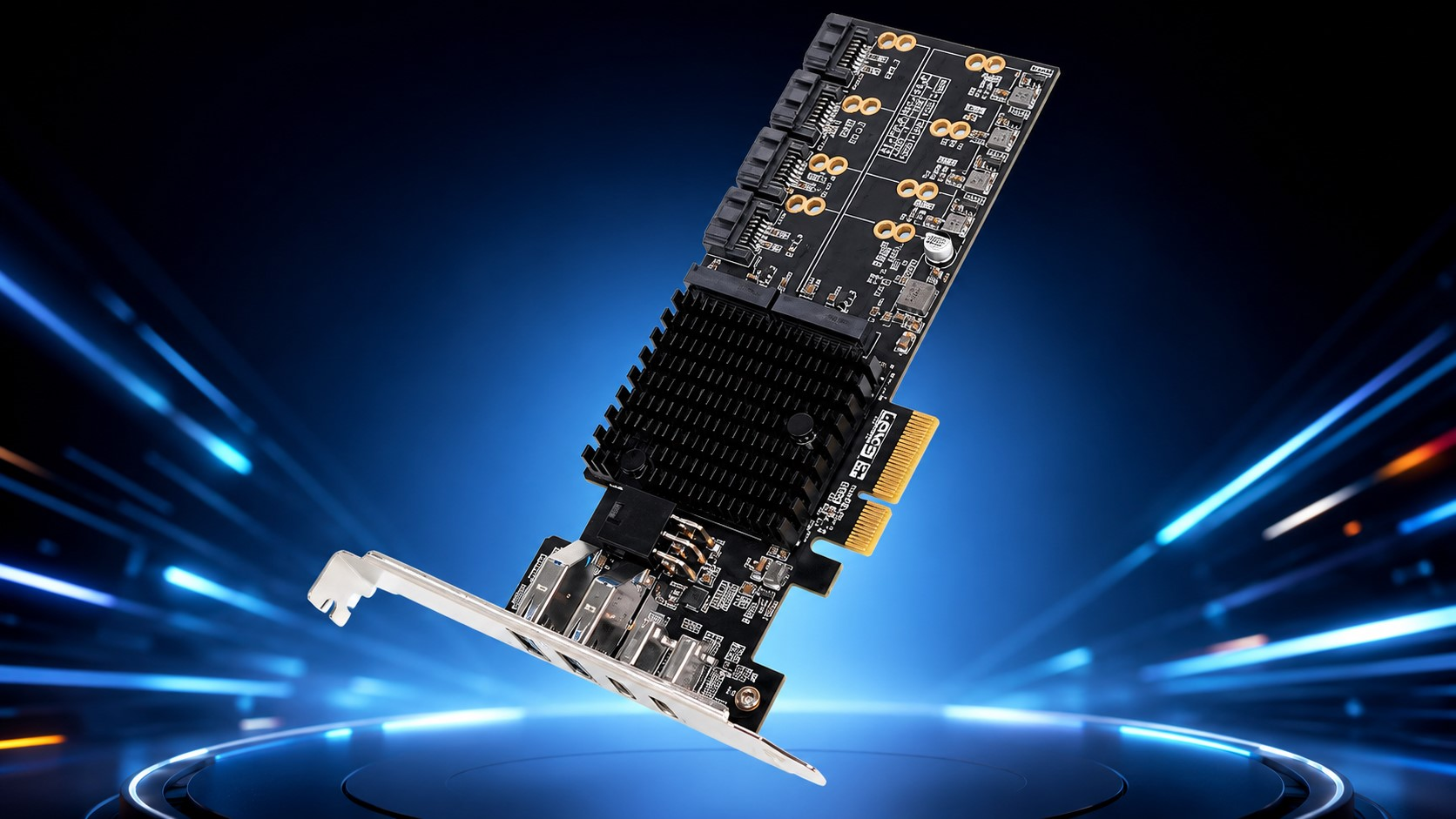
Lekuo has launched the SouthBridge Max PB65MX3, an unusual PCIe expansion card that places an AMD B650 chipset onto a compact circuit board to add 4 M.2 slots, 4 SATA connections, and 4 USB ports through a single PCIe 4.0 x4 slot.
The design effectively repurposes the motherboard chipset as an independent storage and connectivity controller. Unlike passive M.2 adapter cards, the Lekuo PB65MX3 does not require the host motherboard to support PCIe lane bifurcation because the onboard B650 chipset manages communication between the connected devices and the main system. This allows the card to work with motherboards that cannot divide a PCIe slot into several smaller links.
| Lekuo PB65MX3 Specification | Details |
|---|---|
| Onboard Controller | AMD B650 chipset |
| Host Interface | PCIe 4.0 x4 |
| Compatible Physical Slots | PCIe x4, x8, and x16 |
| M.2 Storage | 4 M.2 NVMe slots |
| SATA Storage | 4 SATA 6 Gbps ports |
| USB C | 1 x 20 Gbps, 1 x 10 Gbps |
| USB A | 2 x 10 Gbps |
| Total Downstream Connections | 12 |
| Additional Power | Optional 6 pin connector |
| Dimensions | 174 x 69 mm |
| Operating Systems | Windows 10, Windows 11, macOS, and Linux |
| China Launch Price | ¥599, approximately $89 |
The B650 chipset receives its connection through the card’s PCIe 4.0 x4 interface and distributes the available bandwidth dynamically across every attached device. This approach allows users to install as many as 8 storage drives through 4 NVMe sockets and 4 SATA ports while also gaining several fast external USB connections.
The 2 M.2 sockets positioned on the front of the card can each operate through PCIe 4.0 x4 when the rear sockets are empty. Installing SSDs in all 4 positions reduces every M.2 connection to PCIe x2. The complete card still communicates with the host through a single PCIe 4.0 x4 link, creating an approximate theoretical ceiling of 7.9 GB/s in each direction for all storage and USB devices combined.
| Installed M.2 Configuration | Available Connection Per Drive |
|---|---|
| 2 Front SSDs Only | Up to PCIe 4.0 x4 each |
| 2 Rear SSDs Only | PCIe 4.0 x2 each |
| All 4 SSDs Installed | PCIe 4.0 x2 each |
| Total Host Connection | Shared PCIe 4.0 x4 |
This shared connection means the PB65MX3 is primarily designed to increase storage capacity and connectivity rather than allow every attached SSD to reach maximum speed simultaneously. A single fast PCIe 4.0 NVMe drive can approach the card’s total host bandwidth by itself, leaving less capacity for the remaining storage devices and USB ports during concurrent transfers.
The bandwidth limitation should be less important for home servers, backup systems, media libraries, and network attached storage configurations where every drive rarely operates at maximum speed at the same moment. It may be more noticeable in professional workflows involving several NVMe drives transferring large video files or operating as a heavily loaded RAID array.
The card measures 174 x 69 mm and uses a half height design. Standard operation does not require external power, although Lekuo includes a 6 pin connector for configurations using USB devices with higher power requirements. The M.2 sockets are divided between the front and rear surfaces, which saves board space but could make cooling the rear SSDs more difficult during sustained workloads.
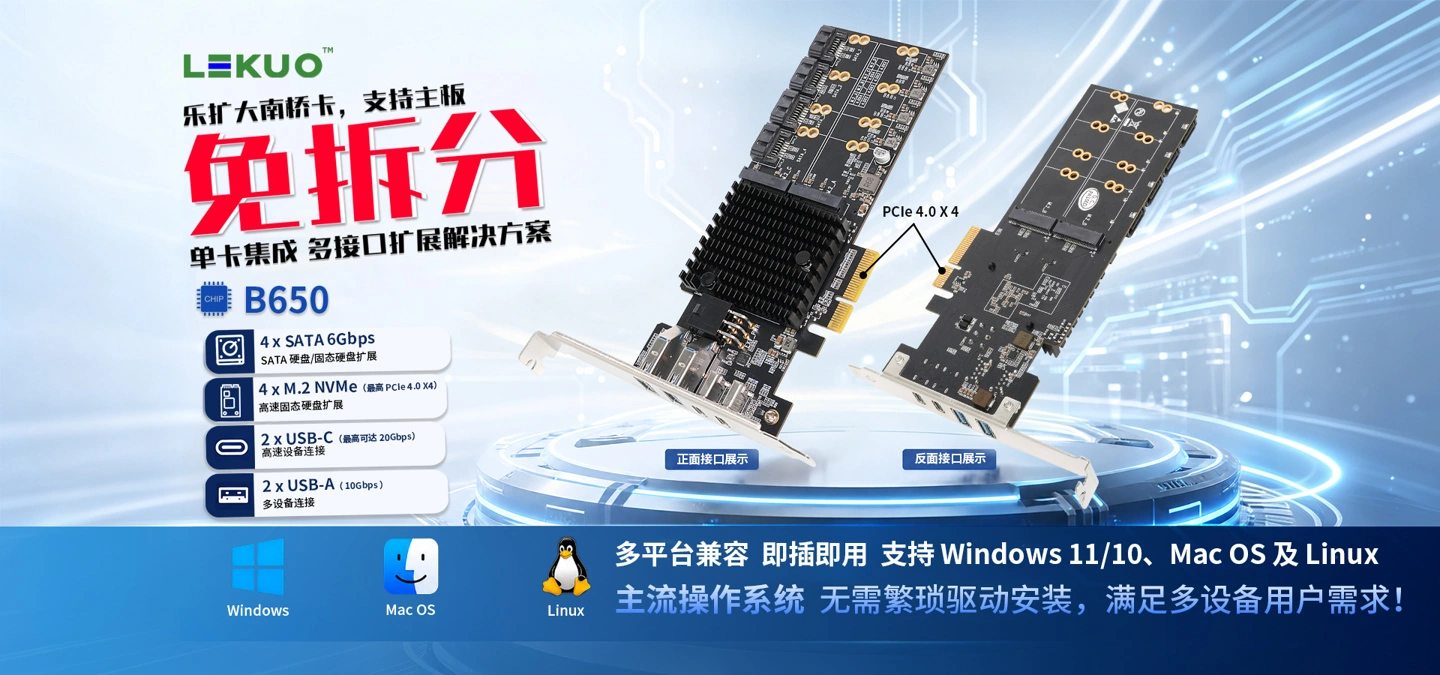
Lekuo lists plug and play support across Windows 10, Windows 11, macOS, and Linux. The chipset architecture is also not limited to AMD processors, meaning the PB65MX3 should operate on compatible Intel and AMD systems when an appropriate PCIe slot is available. Similar expansion cards have even been demonstrated on Arm based devices because the controller communicates through standard PCIe rather than requiring an AM5 processor.
The 599 yuan launch price makes the card particularly notable. Other commercial expansion cards using AMD’s Promontory 21 chipset have entered the market around 199$, while Lekuo is offering its model for approximately 89$ in China. Wider international availability and regional pricing have not been confirmed, although the manufacturer lists several international sales channels on its product page.
The design also demonstrates the growing importance of system connectivity. Modern processors already integrate the essential functions required to operate a computer, allowing motherboard chipsets to function mainly as PCIe connected input and output hubs. Lekuo has taken that architecture and moved it onto a removable expansion card. Longer term developments such as PCIe 8.0 targeting up to 1 TB/s of bidirectional bandwidth show how rapidly interconnect capacity is becoming central to storage, networking, and accelerator expansion.
Using an AMD B650 chipset as a standalone expansion controller is an inventive way to avoid motherboard bifurcation requirements. The PB65MX3 could be especially useful for home lab, server, and compact workstation users who have a spare PCIe x4 slot but lack enough M.2, SATA, or USB connectivity.
The card’s greatest strength is flexibility rather than maximum performance. Installing 4 NVMe drives does not create 4 independent PCIe 4.0 x4 connections to the processor because every device must share the same upstream link. It is therefore better suited to high capacity storage pools, backups, archives, and mixed drive configurations than workloads that continuously push several premium SSDs at full speed.
At approximately 89$, the PB65MX3 also makes this chipset based approach considerably more accessible than earlier products. International pricing, software reliability, chipset cooling, and long term driver support will determine whether it becomes a practical upgrade or remains a specialized product for hardware enthusiasts.
Would you use the Lekuo PB65MX3 to add more storage to an existing system, or would the shared PCIe 4.0 x4 bandwidth be too restrictive?
