
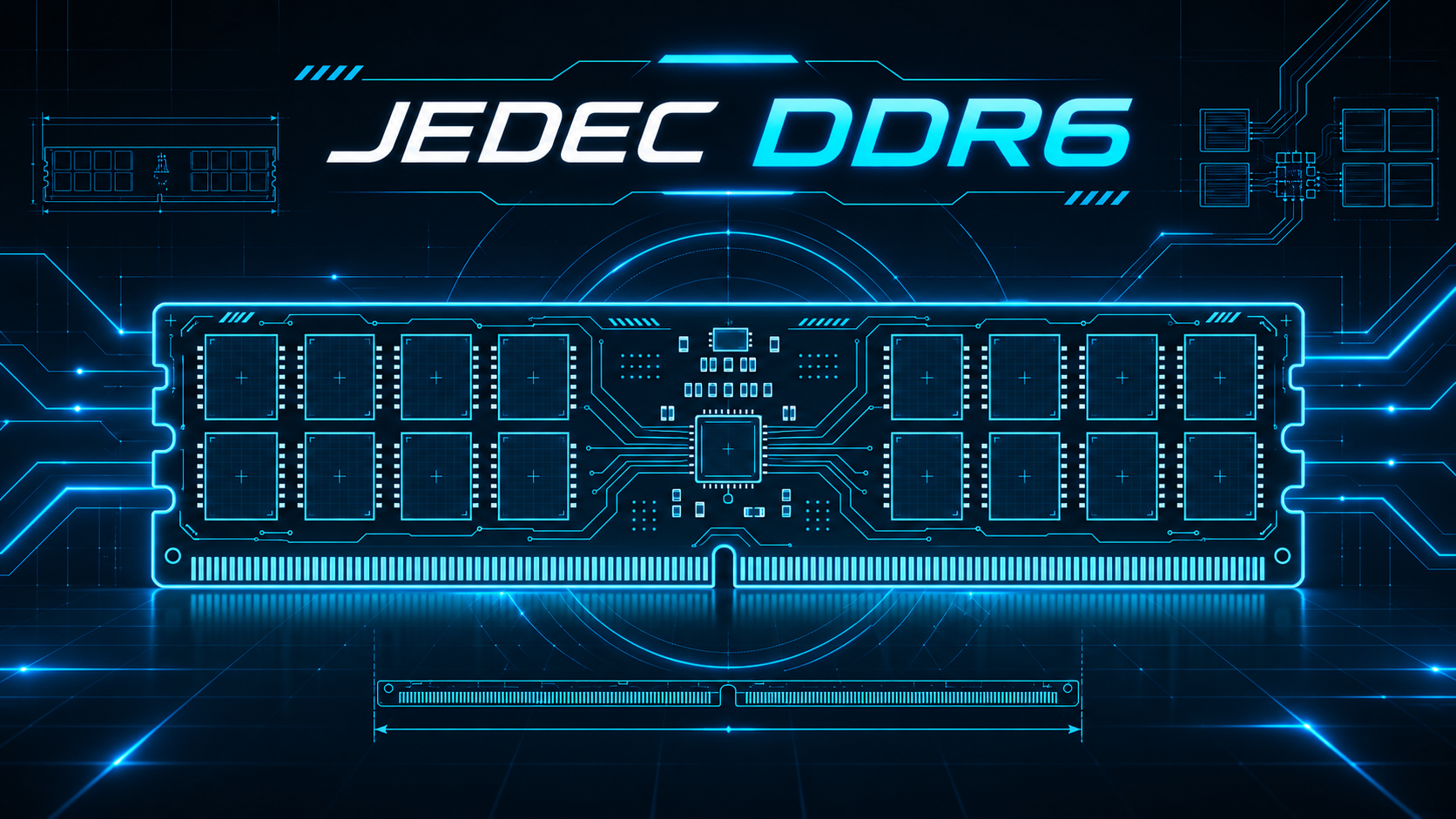
JEDEC has officially previewed its next generation DDR6 memory standard, introducing major improvements in bandwidth, capacity, power efficiency, and reliability for future desktop PCs, workstations, and servers. According to the official JEDEC announcement, published on November 18, 2026, DDR6 will introduce a wider 96 bit data bus, starting transfer rates of 12.8 GT/s, and a roadmap extending to 14.4 GT/s and beyond. The organization expects the new architecture to deliver over 50% greater memory bandwidth at introduction, although the specifications remain under development and could change before final approval.
DDR6 represents a substantial architectural evolution over DDR5, moving beyond improvements in memory frequency alone. The new standard increases the data bus width from 64 to 96 bits, introduces a pseudo channel architecture to improve memory access efficiency, and doubles the number of available memory banks. These changes are designed to increase throughput while improving refresh operations and reducing bottlenecks when handling demanding workloads, particularly AI inference, cloud computing, and high performance server applications.
JEDEC is also targeting significantly higher memory densities, supporting individual DRAM dies of up to 128 Gb, equivalent to 16 GB per die. Improved stacking capabilities could allow manufacturers to develop substantially larger memory modules without significantly increasing their physical footprint. Another notable change is the proposed compact module design, measuring just 74 mm in length compared with the 133 mm DDR5 reference, a reduction of approximately 44%. This smaller format is intended to increase memory density in servers and specialized computing systems rather than replace conventional desktop DIMM dimensions universally.
| Specification | DDR5 | DDR6 Planned |
|---|---|---|
| Reference Transfer Rate | 9.2 GT/s | Starting at 12.8 GT/s |
| Future Transfer Rate | Varies by implementation | 14.4 GT/s and beyond |
| Data Bus Width | 64 bits | 96 bits |
| Bus Width Increase | Baseline | 50% |
| Memory Bank Count | Baseline | 2x |
| Maximum Die Density | 64Gb | Up to 128 Gb |
| Referenced Module Length | 133 mm | 74 mm |
| Module Formats | RDIMM, UDIMM, CAMM variants | RDIMM, UDIMM, CAMM under consideration |
Power efficiency is another important design objective. DDR6 is expected to incorporate VSS terminated input and output signaling alongside specialized low power operating modes, improving performance per watt compared with DDR5. JEDEC is also developing flexible error correction support, allowing manufacturers to implement different system level ECC configurations depending on reliability, power consumption, and cost requirements.
While DDR6 and the previously introduced LPDDR6 memory standard share similar objectives, they target different computing environments. DDR6 focuses on conventional system memory for desktops, workstations, and servers, while LPDDR6 prioritizes energy efficient platforms such as mobile devices and compact computing systems. JEDEC is also advancing DDR5 MRDIMM technology, which targets 12,800 MT/s for next generation servers, demonstrating that DDR5 development will continue alongside the transition to newer memory architectures.
JEDEC has not confirmed a final release date, commercial availability, or pricing for DDR6 memory. Adoption will also require compatible processors and memory controllers, meaning current DDR5 systems cannot simply upgrade to DDR6 modules.
DDR6 represents an important advancement in system memory technology, particularly through its wider bus architecture and higher memory densities. However, the growing focus on AI infrastructure and data center computing raises concerns about how quickly these improvements will become accessible to regular PC users.
Higher bandwidth and capacity could benefit future gaming systems, content creation, integrated graphics, and local AI workloads, especially as applications become increasingly memory intensive. Nevertheless, manufacturers must ensure that consumer hardware remains a priority rather than concentrating production capacity exclusively on enterprise customers.
DDR6 should deliver meaningful improvements in performance, affordability, and accessibility. A faster memory standard has limited value to PC enthusiasts if supply constraints and premium pricing prevent widespread adoption.
Are you more interested in DDR6's higher memory speeds and bandwidth, or would you prefer manufacturers to prioritize affordable, high capacity DDR5 memory before moving to another generation?
