
Intel Unified Core Strategy Gains Fresh Signal as New Hiring Push Points to Early Pre Silicon Work

Intel’s long discussed unified core vision just received a tangible new data point, with a recent hiring post showing the company is actively staffing a dedicated Unified Core team. In an era where hybrid desktop and mobile CPUs have leaned heavily on a split between performance cores and efficiency cores, the idea of consolidating future products around a single core microarchitecture is becoming one of the most watched strategic pivots in the entire x86 roadmap.
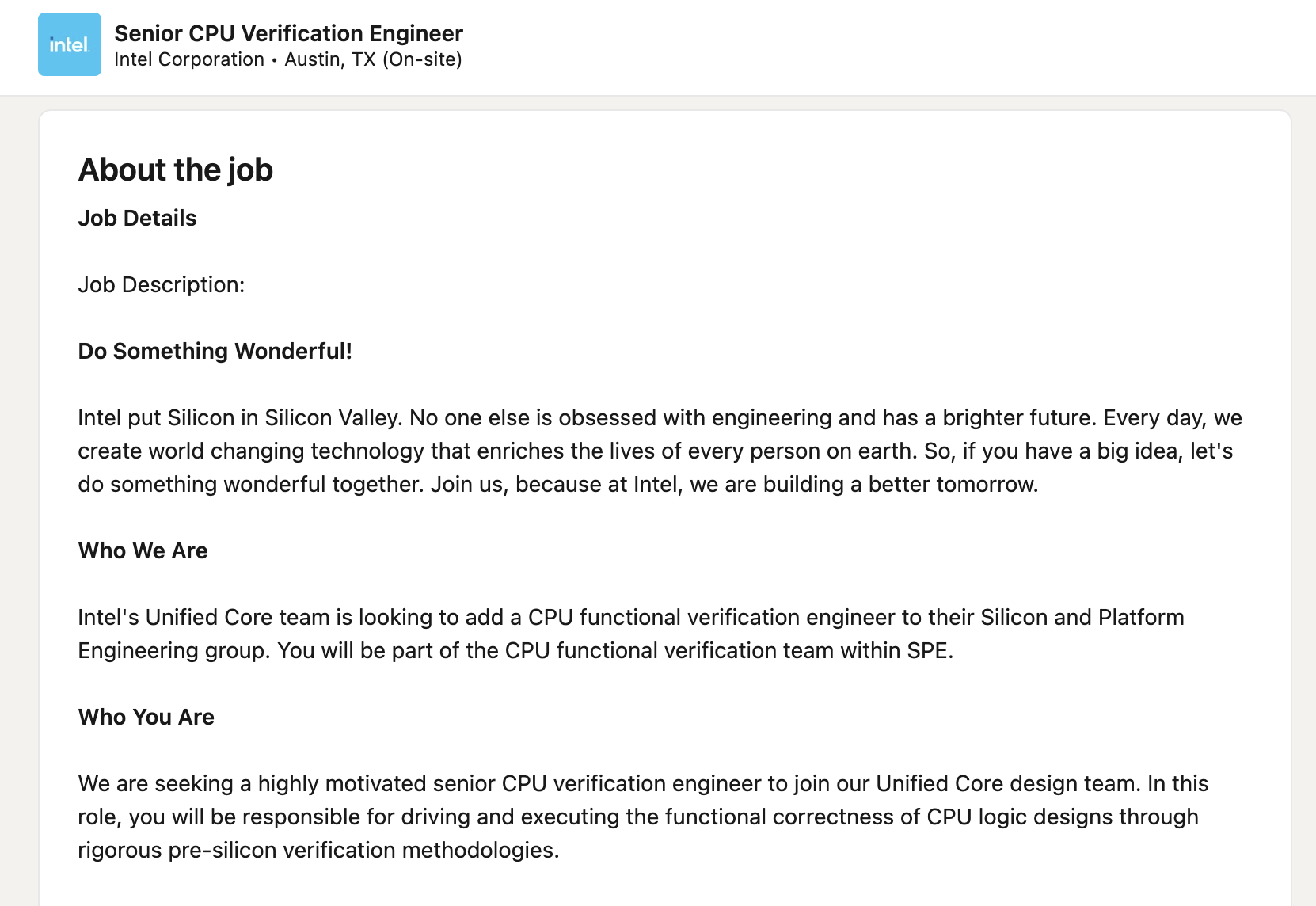
A newly Intel job posting surfaced listing for a Senior CPU Verification Engineer at Intel explicitly references the Unified Core team and positions the role inside Intel’s Silicon and Platform Engineering group. The focus is CPU functional verification and pre silicon validation, which matters because it signals this work is still upstream in the development pipeline. That is the stage where architectural assumptions are stress tested, verification infrastructure is built, and early models are validated long before final silicon arrives. In other words, this is not a product launch teaser, but it is a credible indicator that the concept is real internally and receiving resources.
So what does unified core mean in practical terms. The simplified thesis is that instead of juggling multiple core types with different microarchitectures, Intel could aim for one big core design, then scale it across the product stack using frequency, cache, power budgets, and core counts rather than mixing fundamentally different cores. The primary upside discussed by advocates is better performance per area and cleaner scaling behavior, since multi architecture layouts add complexity in scheduling, validation, and silicon allocation. There is also a platform level efficiency argument: fewer architectural variants can reduce engineering overhead and validation matrices over multiple product cycles.
This does not mean hybrid was a mistake. Hybrid has delivered real wins in parallel throughput and power management, especially when operating systems cooperate with scheduling hints. But the industry has also learned that hybrid introduces tradeoffs that are not always gamer friendly. Games and anti cheat stacks can be sensitive to thread scheduling behavior, latency variance, and core affinity. A unified core approach, if executed well, could simplify performance tuning, improve consistency in frame time delivery, and reduce edge case behavior that shows up in real world gaming rigs where background tasks, overlays, capture tools, and voice apps run nonstop.
The job posting also adds weight to the idea that this shift is still early. Verification roles tied to pre silicon efforts usually appear well before a consumer can buy anything related. That aligns with current speculation that Intel would not pivot away from hybrid immediately. Instead, the unified core approach is more likely to appear after at least one more generation or two of conventional hybrid evolution, with early external estimates commonly placing any meaningful transition somewhere around 2028 to 2030.
From a market strategy standpoint, this is a smart optionality play. Intel can continue to iterate on hybrid designs while simultaneously incubating a unified design path that could pay off if scaling limits, scheduling complexity, or product segmentation pressure becomes a bigger constraint than the hybrid benefits. For gamers and creators, the headline is not a guaranteed performance leap tomorrow, but a roadmap signal that Intel is exploring a future where CPU behavior may become simpler, more predictable, and potentially more consistent for latency sensitive workloads.
Engagement question
If Intel eventually ships a unified core desktop CPU, would you want maximum peak FPS, or would you prioritize smoother frame times and fewer scheduling quirks across real world multitasking?
