
Intel Handheld Focused Panther Lake Chips Rumored to Slip Into Q2 2026, Delaying Next Wave of Xe3 Powered Gaming Handhelds
Intel’s next step in the PC gaming handheld race may be arriving a little later than expected, based on fresh leak driven chatter pointing to a Q2 2026 window for handheld specific Panther Lake parts. The rumor suggests that instead of landing around the end of Q1 2026, Intel’s dedicated gaming handheld SoCs could shift a few weeks or months to the right, putting the first devices on a more realistic track for late spring through early summer, depending on partner adoption and product launch execution.
The discussion ties back to prior public messaging from Intel leadership that handheld oriented Panther Lake products were targeted for 2026, but the latest rumor cycle claims the timetable is tightening into Q2. The leaker referenced in the rumor, Golden Pig Upgrade, had previously suggested an end of Q1 or start of Q2 arrival if everything moved smoothly, and now indicates it may not be as smooth as originally expected.
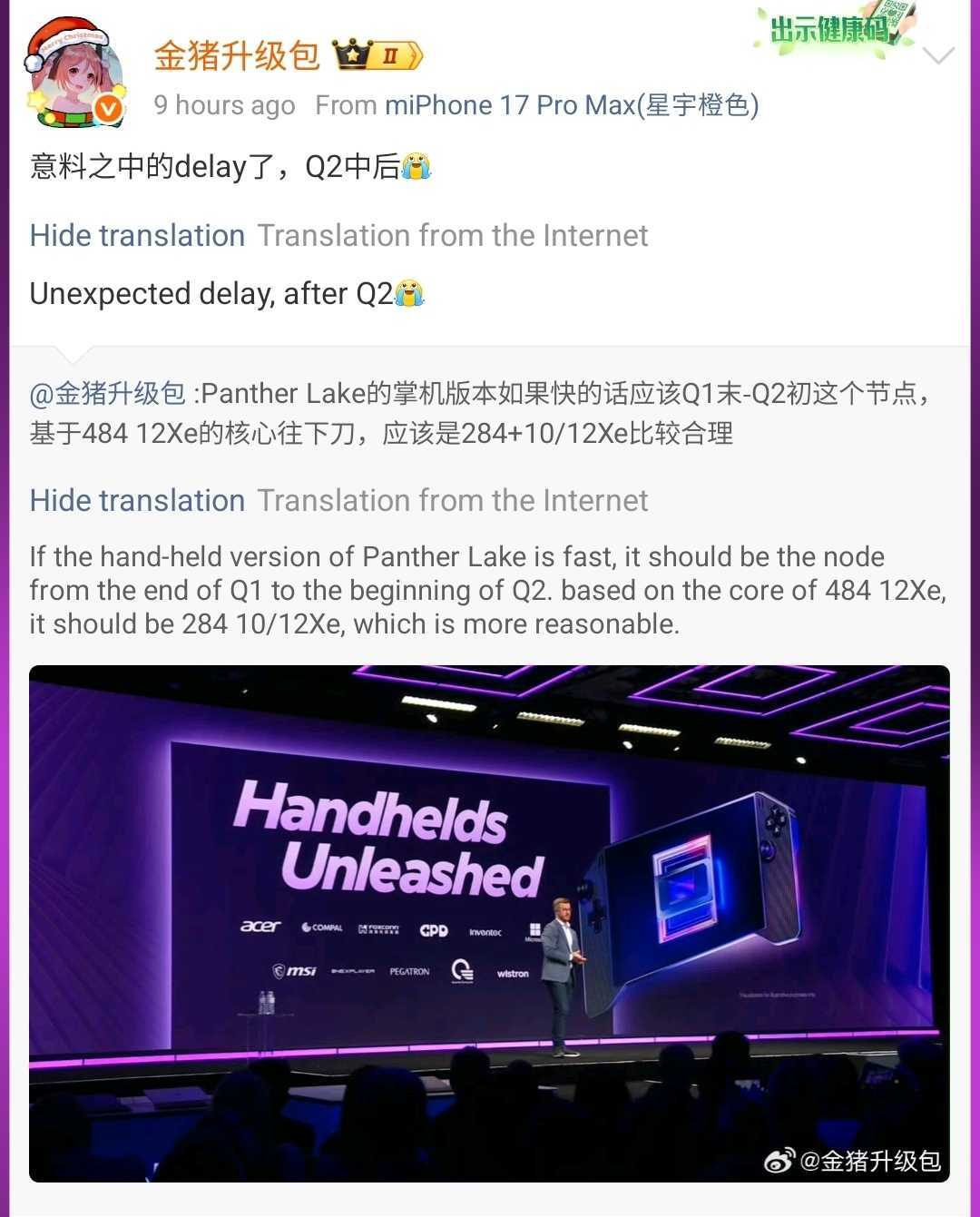
On the silicon side, the rumor points to 2 primary handheld SKUs, one featuring an integrated graphics configuration with 12 Xe3 cores and another with 10 Xe3 cores. The speculation is that these handheld parts may be derived from existing Panther Lake class configurations already associated with Intel’s Arc B300 series integrated graphics positioning, where 12 Xe core class graphics appears as the upper tier option. The leak narrative also attempts to map the rumored handheld designs to familiar lineup patterns, implying Intel is optimizing known building blocks into a power and thermal envelope that handheld makers can actually ship at scale.
From an industry perspective, a Q2 shift is not just a calendar footnote. Handheld launches are tightly coupled to platform readiness, firmware maturity, driver stability, and OEM validation. If Intel is still tuning the power profile, memory requirements, and graphics driver behavior for consistent frame pacing, a Q2 window can be the difference between a noisy launch and a clean one. That matters even more because AMD’s latest handheld class Zen 5 options have already built strong mindshare, and Intel’s value proposition has to be more than raw performance. It needs better efficiency, better driver cadence, and clear feature leadership such as upscaling, frame generation, and strong low watt gaming behavior.
For gamers, the practical takeaway is simple. If you are waiting specifically for Panther Lake based handhelds, the rumor suggests you may be shopping closer to 2026 04 through 2026 06 rather than the earliest part of the year, assuming partners align their product cycles quickly. The upside is that extra time can translate into better tuning, stronger BIOS and driver maturity, and fewer early adopter headaches, especially for a category where thermals and power limits can make or break a device’s real world experience.
Are you holding out for Panther Lake handhelds, or would you rather buy what is available now and count on software updates to close the gap over time?
