
Intel Arc Pro B70 Beats RTX 5090D in DeepSeek R1 Test as AI Value Race Heats Up
Intel’s Arc Pro B70 is starting to look like one of the most interesting budget focused AI workstation GPUs on the market, especially for users who care more about local inference throughput and memory capacity than gaming performance. According to benchmark results shared by Gunnir, 4 Intel Arc Pro B70 32 GB cards were tested against 4 NVIDIA GeForce RTX 5090D 32 GB cards and 4 NVIDIA GeForce RTX 4090D 24 GB cards in DeepSeek R1 Distill Qwen 32B FP16, with Intel’s workstation card pulling ahead at higher concurrency levels.
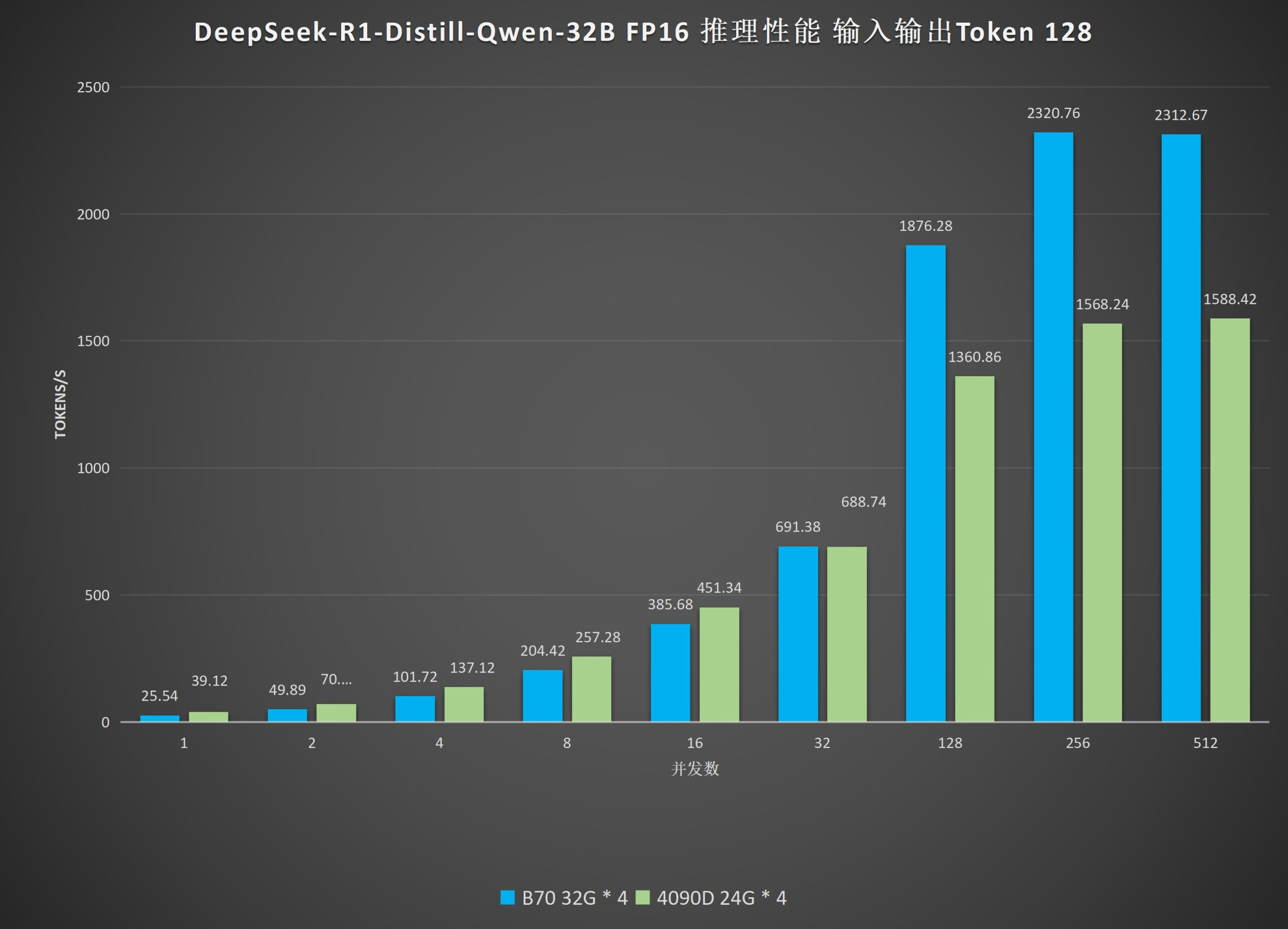
The test used a fixed input and output length of 128 tokens, measuring token throughput across concurrency levels from 1 to 512. At lower concurrency, the RTX 5090D remained ahead, with the RTX 4090D also showing strong early results. However, once the workload moved beyond lighter request levels, the Arc Pro B70 began closing the gap. At 32 and 64 concurrency, it matched or exceeded the RTX 4090D, and once the test reached 128 concurrency and above, Intel’s card reportedly started outperforming even the RTX 5090D.
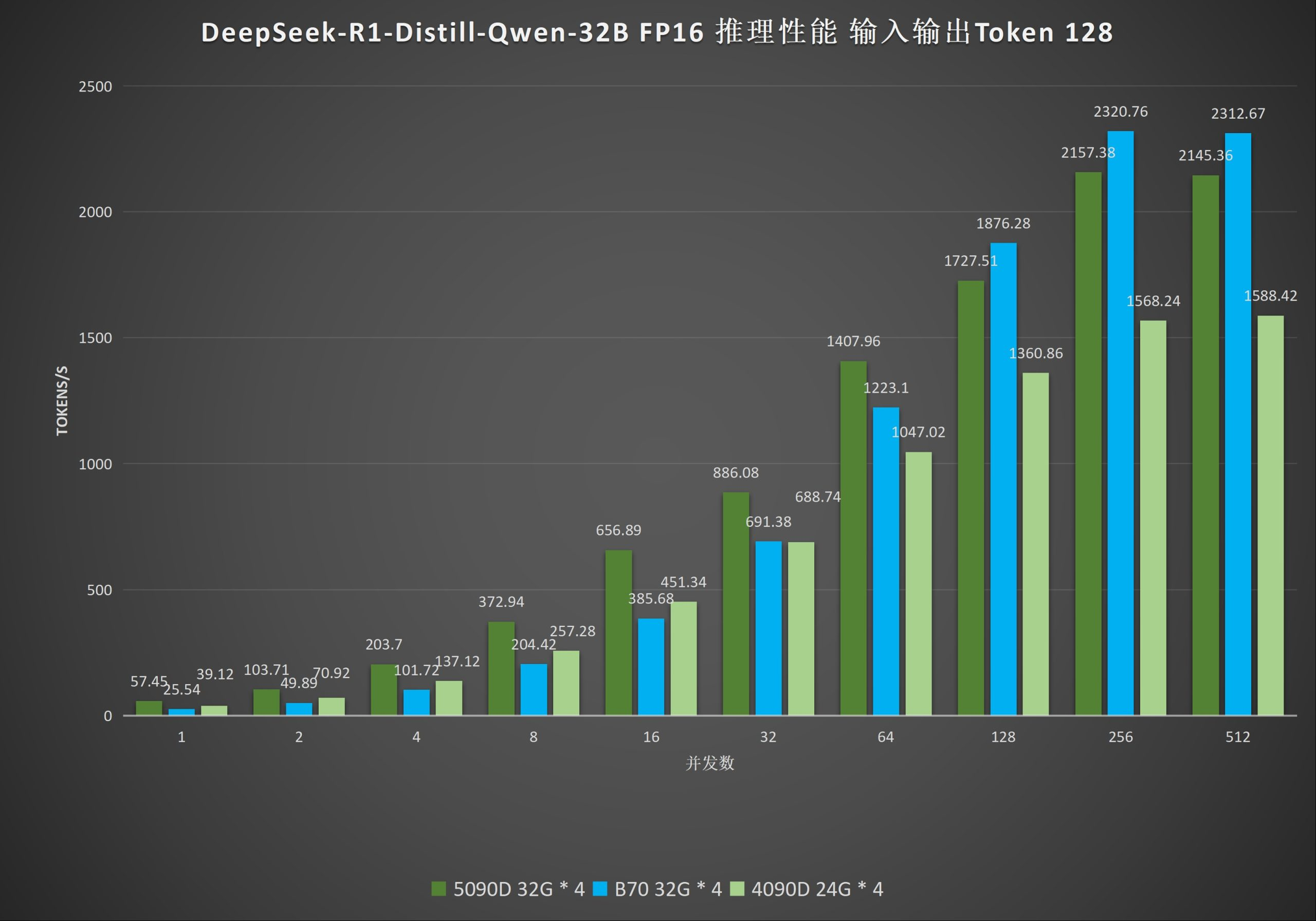
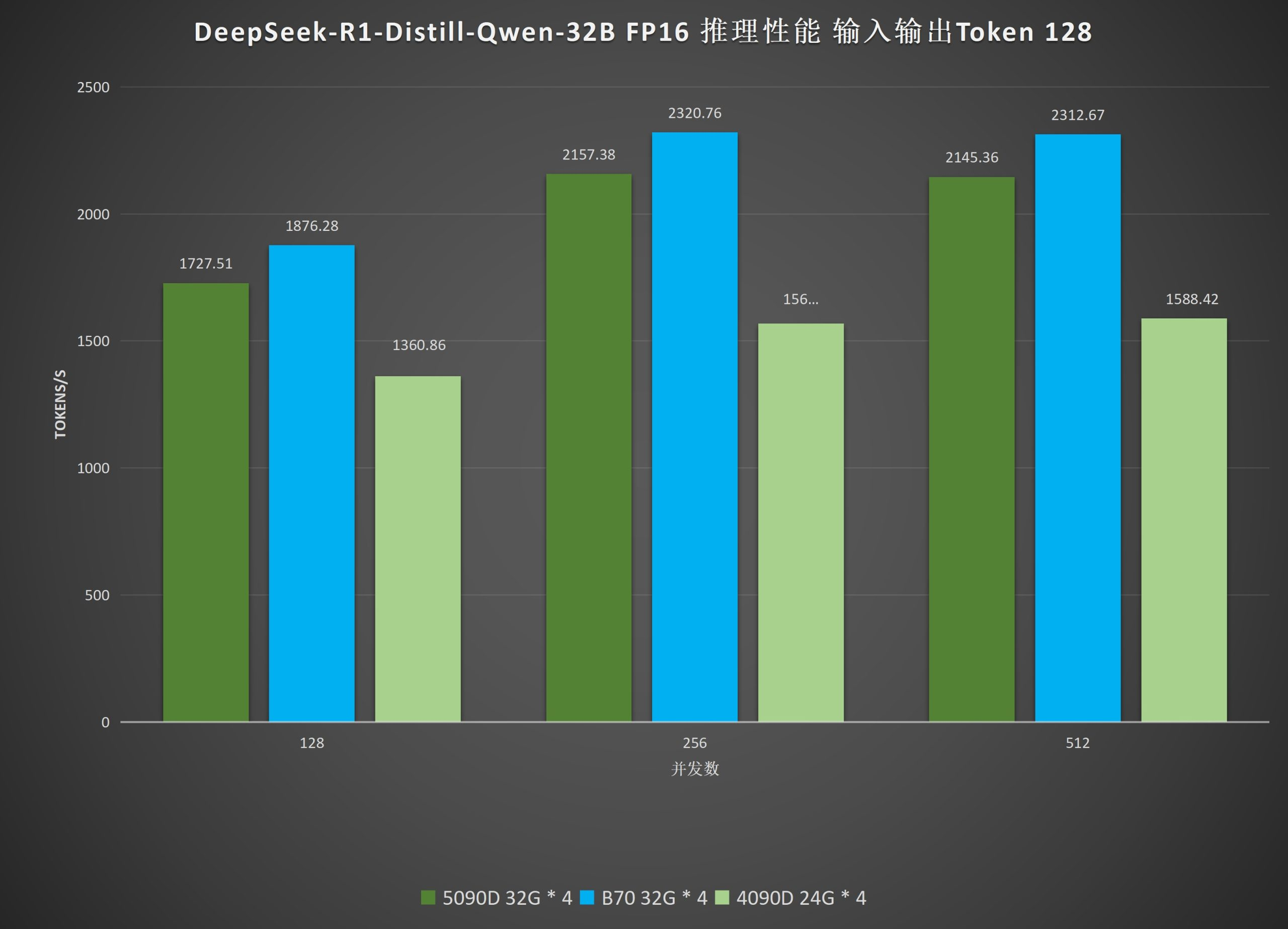
At 128 concurrency, the 4 card Arc Pro B70 setup reportedly delivered 8.6% higher throughput than the RTX 5090D setup and 34.2% higher throughput than the RTX 4090D setup. At 256 concurrency, the Arc Pro B70 was said to be 7.5% faster than the RTX 5090D and 48.7% faster than the RTX 4090D, with similar behavior continuing at 512 concurrency. Peak throughput reached 2320.76 tokens per second, putting Intel’s 32 GB workstation GPU in a surprisingly strong position for this specific FP16 inference workload.
The memory configuration is the biggest reason this result matters. Intel’s official Arc Pro B70 product specifications list 32 GB of GDDR6 memory, a 256 bit memory interface, 608 GB/s of bandwidth, 32 Xe cores, 256 XMX engines, 22.94 FP32 TFLOPS, 367 INT8 TOPS, PCIe 5.0 x16 support, and ECC memory support. Those specifications make it a very different product from mainstream gaming GPUs, because the B70 is clearly aimed at professional visualization, local AI inference, and creator workloads where memory capacity can matter more than gaming frame rates.
That also explains why the RTX 4090D falls behind more clearly at high concurrency. It has 24 GB of memory, while both the Arc Pro B70 and RTX 5090D configurations in this comparison have 32 GB. With larger models, more concurrent sessions, and higher context pressure, available VRAM becomes a limiting factor. Once a card cannot keep enough data resident in GPU memory, throughput can drop because the system has to manage memory pressure instead of simply serving tokens.
The comparison against RTX 5090D is more complicated. NVIDIA’s Blackwell architecture has major advantages in lower precision formats such as NVFP4, and NVIDIA’s software stack remains far more mature through CUDA, TensorRT LLM, vLLM support, SGLang, and broader production deployment experience. However, the Gunnir test is focused on FP16, and in that specific scenario, Intel’s XMX engines and 32 GB memory pool appear to give the Arc Pro B70 enough strength to compete at high parallelism.
Independent testing also supports the idea that the Arc Pro B70’s value is tied to concurrency and memory pressure. Puget Systems found that DeepSeek R1 Distill Llama 8B reached 66.9 tokens per second on 1 B70 and scaled to 905 tokens per second across 4 B70 cards at 8 users. Backend.AI also reported that the B70 can keep scaling under heavier agentic AI style loads, particularly when competing cards run into memory limits during longer context or higher concurrency scenarios.
Cost is where Intel gains its strongest headline advantage. Wccftech notes that the Arc Pro B70 32 GB has been listed at around 999.99 USD at Newegg, while RTX 5090D and RTX 4090D cards can sell for far higher prices in China due to supply restrictions, export limitations, and GPU shortages. Tom’s Hardware previously reported that Intel positioned the Arc Pro B70 around a 949 USD starting price, placing it far below many high end NVIDIA options for users who mainly need VRAM dense local AI capability rather than the full NVIDIA ecosystem.
Intel’s latest Arc Pro driver lets users allocate up to 93% of system memory to built in Arc Pro GPUs for wider AI LLM support. That driver update focused on integrated Arc Pro graphics, but the strategy is similar. Intel wants Arc Pro to become more relevant for AI developers, local model testing, small workstation deployments, and memory heavy inference workflows.
That is why the Arc Pro B70 result should be read carefully. It does not mean Intel has broadly beaten NVIDIA in AI. It means Intel has found a very compelling pocket of the market where 32 GB of VRAM, FP16 acceleration, multi GPU scaling, and lower card cost can deliver strong practical results. For local inference labs, developers, smaller AI startups, and workstation users experimenting with LLMs, that is still meaningful.
Intel Arc Pro B70 is not trying to beat RTX 5090D as a gaming flagship, and that is exactly why this result is interesting. Intel is attacking a more practical AI gap. Many users do not need the absolute fastest GPU in every benchmark. They need enough memory, enough throughput, stable software, and a price that does not destroy the entire workstation budget.
The B70’s 32 GB memory pool gives it a real advantage in local AI workloads where model size, context length, and concurrency are the bottlenecks. Once multiple users or agents are running at the same time, memory capacity becomes more than a spec sheet number. It becomes the difference between smooth scaling and performance collapse.
The caution is software maturity. NVIDIA still has the better ecosystem for production AI, and that matters for teams deploying real services rather than running controlled benchmarks. Intel needs oneAPI, OpenVINO, PyTorch support, driver stability, and framework compatibility to keep improving if it wants Arc Pro to become a serious AI workstation alternative.
Still, this is a strong signal. The AI hardware market is no longer only about the most expensive accelerator. Tokens per dollar, VRAM per dollar, and local deployment flexibility are becoming major buying criteria. In that specific lane, Intel’s Arc Pro B70 may be one of the most disruptive cards available right now.
Would you choose 4 Intel Arc Pro B70 GPUs for a local AI workstation, or would you still pay more for NVIDIA because of CUDA and its software ecosystem?
