
CXMT and YMTC Reportedly Removed From Pentagon Section 1260H List
A potential inflection point for Chinese memory adoption in global consumer hardware just surfaced, then immediately got complicated.
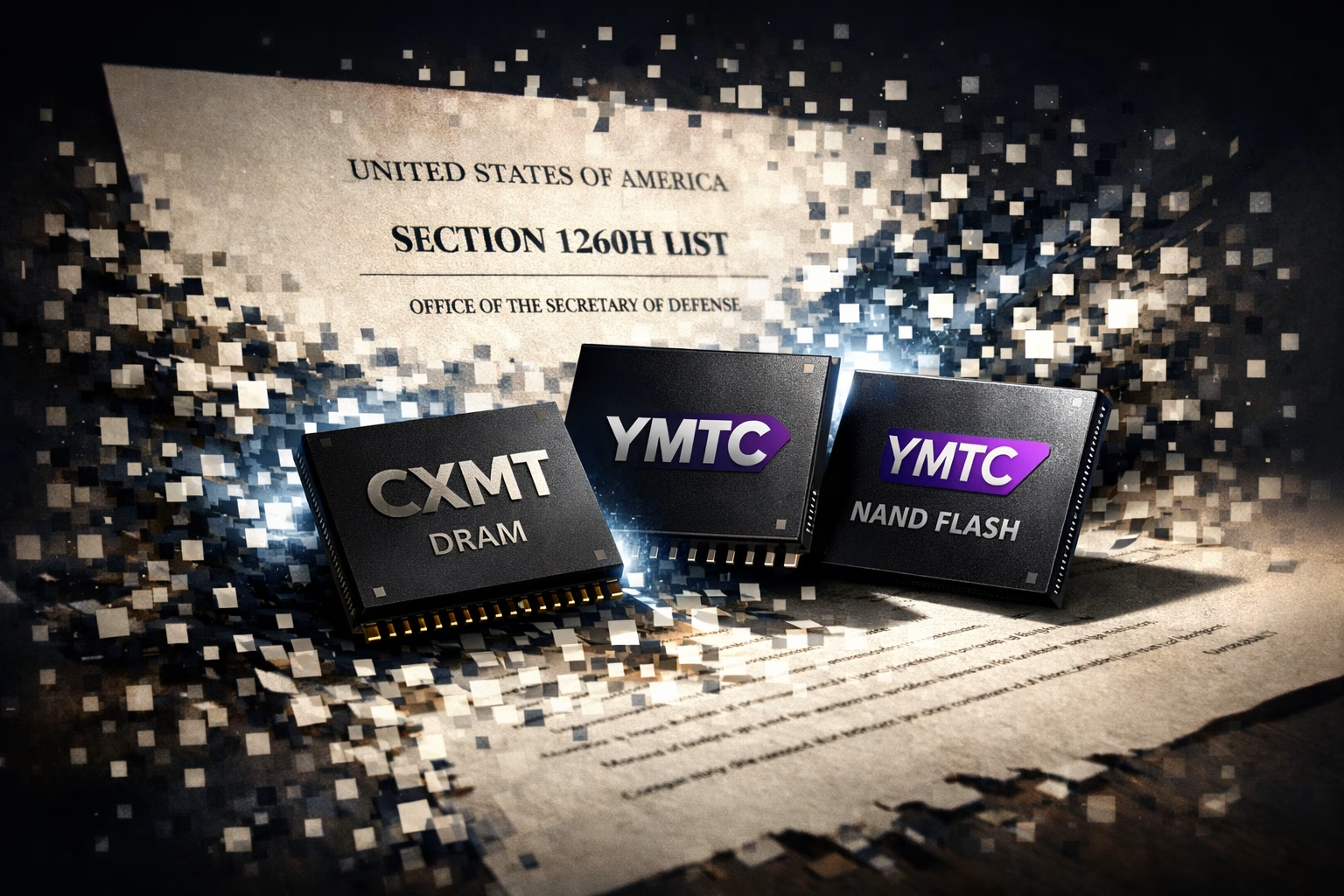
A newly circulated update tied to the Pentagon’s Section 1260H list indicated that ChangXin Memory Technologies, Inc. and Yangtze Memory Technologies Co., Ltd. would be removed from the list of entities categorized as Communist Chinese Military Companies. On paper, that kind of change would be a meaningful de risk lever for original equipment manufacturers evaluating Chinese DRAM and NAND as an alternative supply channel, especially during a memory constrained cycle where buyers are aggressively diversifying sourcing and negotiating leverage.
However, the same update now carries a critical caveat: the Pentagon withdrew the document that suggested the Section 1260H changes, and there has not yet been a confirmed follow up publication from the Department of War. In other words, the market signal exists, but the operational reality is not locked in.
Section 1260H status has functioned as a reputational and compliance gravity well. Even when a listing does not automatically ban every transaction, it materially increases risk perception across the supply chain. Legal teams, procurement, and large channel partners tend to treat these lists as red flags because they can trigger downstream exposure across government linked contracts, financing, insurance, and enterprise procurement policies.
If CXMT and YMTC were truly removed and that removal were formally confirmed and stable, it would reduce one of the headline political blockers that has kept many consumer facing manufacturers cautious. It would also support a narrative shift where Chinese DRAM and NAND can be evaluated more like commercial commodities, rather than permanently politicized components.
Even under the most optimistic interpretation, removal from Section 1260H would not automatically make business with either company risk free.
First, US Commerce Department restrictions remain a separate and often more impactful constraint. YMTC in particular has faced Commerce related restrictions that can complicate partnerships, tooling, technology transfer, and even the optics of integration into products sold into US aligned markets. For OEMs, that means you could theoretically see an opening on one list while still facing significant friction from other regulatory frameworks.
Second, there is the practical reality that large tier one brands will not replatform memory qualification overnight. DRAM and NAND adoption is gated by validation, firmware and controller tuning, long term supply assurances, RMA liability, and channel confidence. Even if interest is real and active, it would likely start with contained programs, regional skus, and lower exposure segments before scaling.
Third, the withdrawn update creates a decision paralysis moment. For procurement and strategy teams, an unconfirmed regulatory shift is not a green light. It is a scenario planning input. Until there is a durable, formally published change, the cleanest play for most OEMs is still caution, optionality, and limited engagement.
The next actionable signal is simple: whether a formally confirmed and persistent Section 1260H update reappears in an official capacity, and whether any adjacent US restrictions change in parallel or tighten in response. If the update comes back, expect manufacturers already in exploratory discussions to accelerate qualification work. If it does not, this episode will still matter because it indicates the topic is active inside policy channels, which can shape long term sourcing strategies even without immediate adoption.
Are you seeing Chinese DRAM and NAND as a realistic near term alternative for mainstream gaming laptops and consumer SSDs, or do you think regulatory and reputational risk will keep adoption limited to niche or regional products?
