
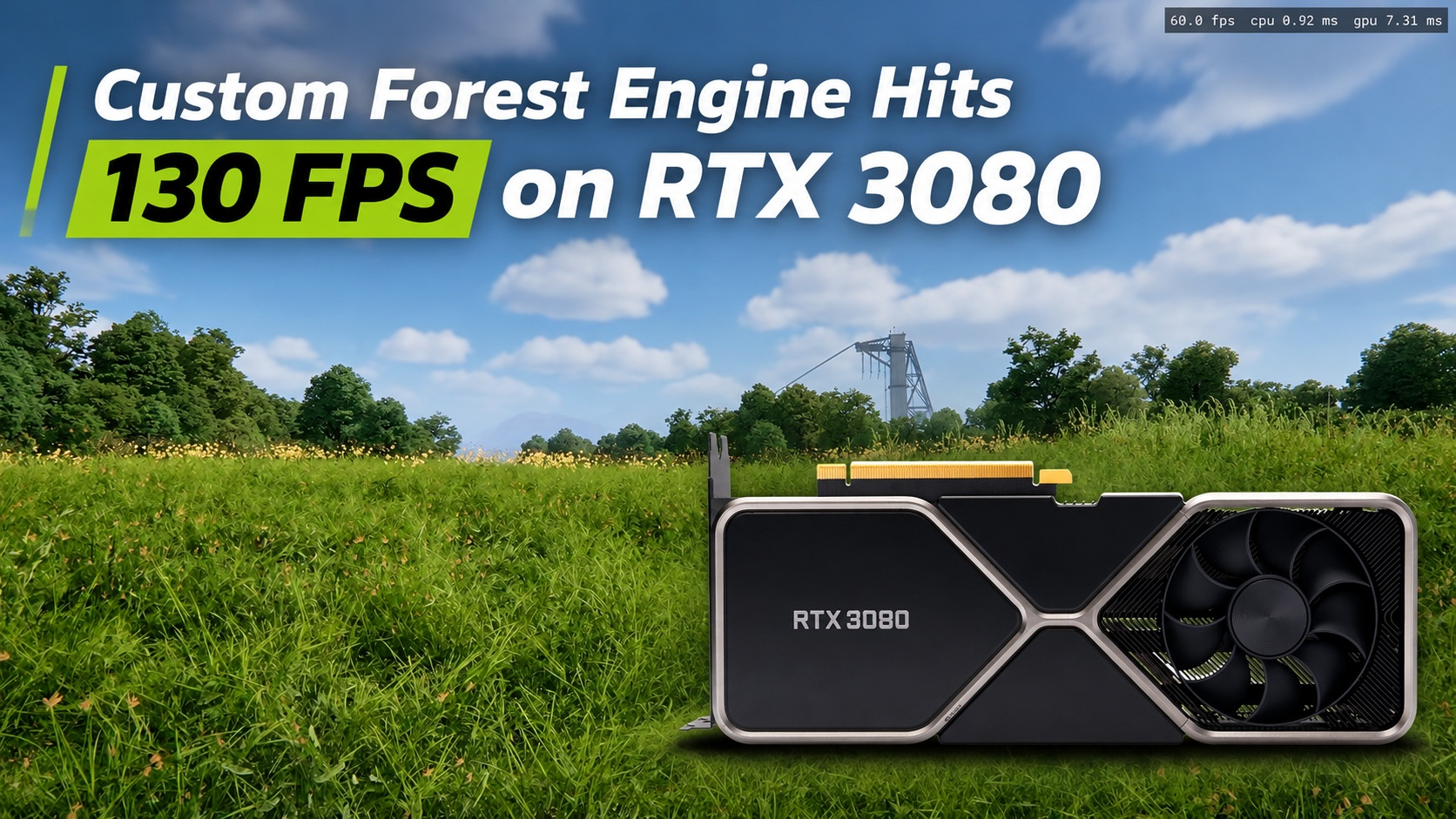
Modern game engines continue pushing graphical fidelity at the expense of performance, but independent developer and modder Toni Macaroni has demonstrated how optimized rendering techniques can deliver impressive visuals without demanding the latest GPU hardware. His custom forest engine reportedly achieves an average of 130 FPS at 1440p on an NVIDIA GeForce RTX 3080, without relying on hardware accelerated ray tracing. The YouTube demonstration showcases dense vegetation, expansive forests, detailed terrain, and realistic indirect lighting. According to performance figures, the engine reaches approximately 200 FPS in aerial views, averages 130 FPS, and drops to around 80 FPS in particularly dense environments.
The engine achieves these results through a specialized rendering architecture designed to minimize unnecessary geometry processing. It combines clustered levels of detail (CLODs) with virtualized geometry similar to Unreal Engine 5's Nanite. Distant vegetation uses voxel representations instead of relying exclusively on traditional impostors, while extremely distant objects transition into simplified proxies that reduce the amount of geometry and instance information the GPU must process. These techniques allow the engine to maintain large vegetation counts without rendering every object at its maximum complexity.
Lighting represents another important optimization. Instead of hardware ray tracing, the engine combines screen space rendering techniques with voxel based global illumination to simulate indirect lighting. The approach shares conceptual similarities with Sparse Voxel Octree Global Illumination (SVOGI), a technique associated with the modified CryEngine technology used by Warhorse Studios in Kingdom Come: Deliverance II. Macaroni reportedly spent approximately 7 months developing the custom engine, with an earlier example containing around 1 million instances and 4 million triangles.

This is not Macaroni's first experiment with optimized forest environments. In August 2025, 80 Level highlighted a separate demonstration built using Godot and Houdini, achieving approximately 170 FPS uncapped on the same RTX 3080. However, the latest demonstration remains a specialized rendering showcase rather than a complete game. Character animation, physics, artificial intelligence, and gameplay systems would introduce additional processing requirements. The reported performance figures have not been independently verified, and the exact rendering settings and upscaling configuration remain unclear.
This demonstration reinforces an important point for PC gaming: graphical innovation should not depend exclusively on increasingly expensive hardware. While modern technologies such as ray tracing, path tracing, and neural rendering continue advancing visual quality, optimization remains equally important. The substantial hardware demands seen in Unreal Engine 5's Zorah technical demonstration illustrate a different rendering philosophy, although the 2 demonstrations cannot be directly benchmarked against each other. Macaroni's work shows the potential of specialized rendering pipelines to extend the useful lifespan of existing GPUs, giving developers more opportunities to deliver visually ambitious experiences without forcing players into expensive upgrades.
Would you prefer developers to prioritize optimized game engines that maintain high visual quality on older GPUs, or continue pushing advanced ray tracing technologies that require increasingly powerful hardware?
