
CPUID Adds AMD Gorgon Halo Support to CPU Z as Intel Wildcat Lake and Bartlett Lake Join the Latest Update
CPUID has released CPU Z 2.20 for Windows, and the newest version expands support across a wide range of current and upcoming AMD and Intel hardware. The update is especially notable for adding support for AMD Gorgon Halo, while also bringing in Intel Wildcat Lake, Intel Bartlett Lake, and new Arc Pro graphics entries that broaden the utility’s hardware reporting coverage.
On the AMD side, CPUID now lists support for Ryzen AI Max Plus 495, 492, and 488, along with Ryzen AI Max 490 and 485, and several Ryzen AI Max PRO variants under the Gorgon Halo codename. The same update also adds Ryzen 9 PRO 9965X3D, Ryzen 9 PRO 9945, Ryzen 7 PRO 9755, Ryzen 7 PRO 9745, and Ryzen 5 PRO 9645, while also extending coverage to Gorgon Point 2 and Gorgon Point 3 parts. CPUID additionally lists Ryzen AI Max Plus 392 under Strix Halo, showing that version 2.20 is a broad AMD support pass rather than a narrow one.
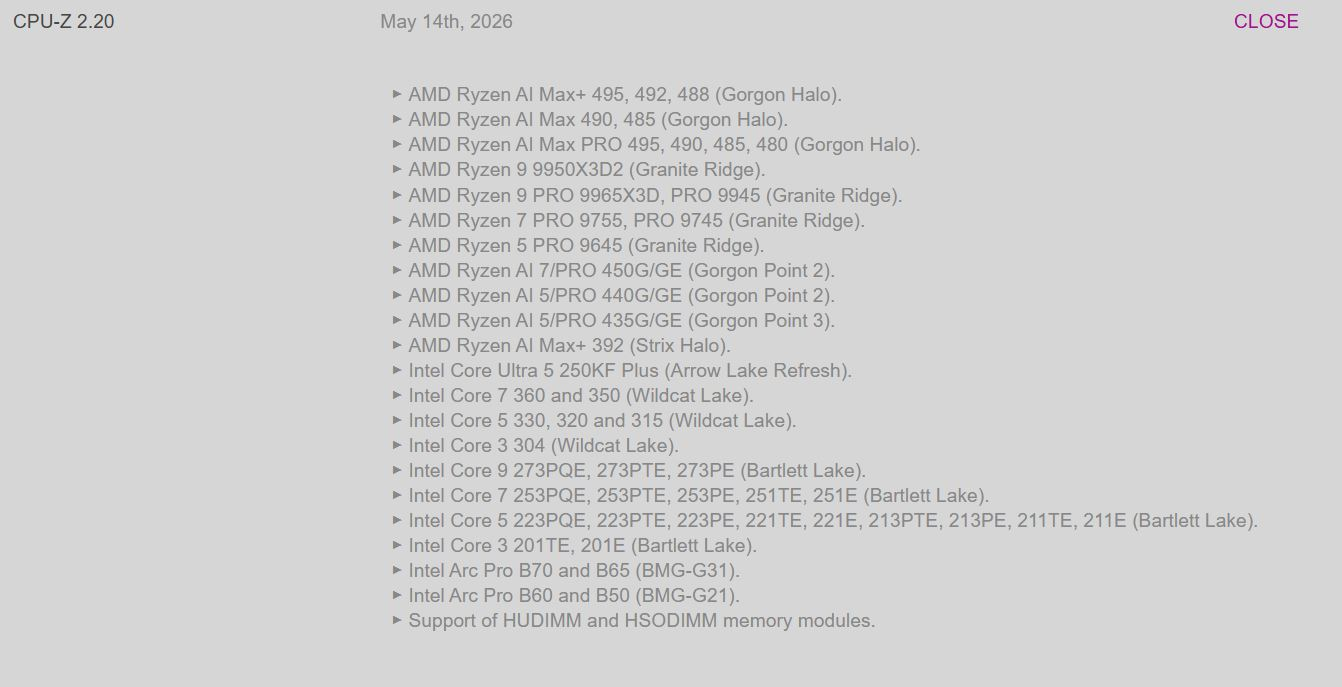
Intel’s additions are just as important for forward looking desktop and mobile watchers. CPU Z 2.20 now includes Core Ultra 5 250KF Plus under Arrow Lake Refresh, plus multiple Wildcat Lake chips including Core 7 360, Core 7 350, Core 5 330, 320, 315, and Core 3 304. CPUID also adds a full wave of Bartlett Lake models, headed by Core 9 273PQE, 273PTE, and 273PE, alongside several Core 7, Core 5, and Core 3 entries in the same family.
The update also reaches beyond processors. CPUID has added support for Intel Arc Pro B70 and B65 based on BMG G31, as well as Arc Pro B60 and B50 based on BMG G21. On the memory side, CPU Z 2.20 now adds support for HUDIMM and HSODIMM memory modules, making this a meaningful update for users tracking next generation client and workstation hardware platforms.
For enthusiasts, reviewers, and system integrators, this is the kind of update that matters quietly but significantly. CPU Z remains one of the most widely used tools for fast hardware identification and validation, so when CPUID begins adding future facing code names like Gorgon Halo, Wildcat Lake, and Bartlett Lake, it usually reflects a growing readiness for those platforms to appear more visibly across the market. Even if this does not reveal performance details on its own, it does give a clearer signal about what hardware families are moving closer to broader public visibility.
Which addition stands out most to you in CPU Z 2.20: AMD Gorgon Halo, Intel Wildcat Lake, or the growing Bartlett Lake lineup?
