
ASUS RTX 4090 Reportedly Scrapped During Warranty Claim Despite Customer Choosing Repair
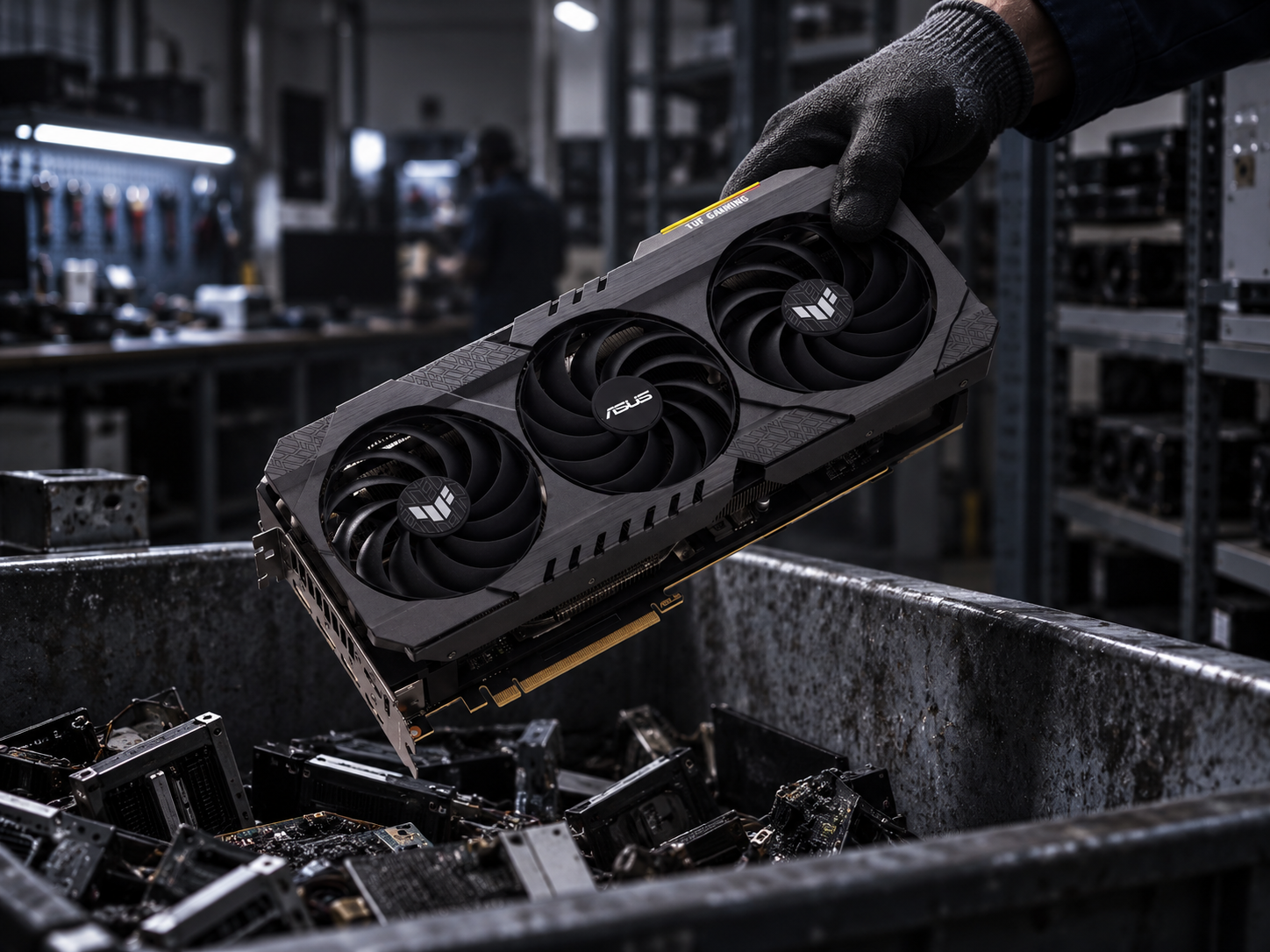
An ASUS GeForce RTX 4090 owner says his graphics card was disposed of during a warranty claim despite explicitly choosing repair or replacement rather than reimbursement, leaving him with a refund that can no longer purchase an equivalent high end graphics card. The incident involves an ASUS TUF Gaming RTX 4090 OG OC Edition 24 GB purchased from Swiss retailer Galaxus for 1,569 CHF in September 2023, with its 3 year warranty scheduled to expire on September 5, 2026.
According to the original Reddit report, the RTX 4090 had begun experiencing black screens during particularly demanding workloads involving ray tracing. Audio would continue for approximately 10 seconds before the system restarted, while Windows recorded LiveKernelEvent 141. Troubleshooting revealed a GPU hotspot temperature of approximately 112°C despite the GPU core sitting around 68°C, producing an unusually large 44°C temperature difference. The owner suspected degradation of the cooling system or thermal contact rather than a completely failed graphics processor.
With the warranty approaching its expiration date, the customer registered the claim on August 27 and Galaxus confirmed receiving the card on August 31. During the warranty process, the customer says he was specifically given a choice between repair or replacement and reimbursement, selecting repair or replacement because he wanted to continue using the RTX 4090. On September 8, however, Galaxus issued a credit note for the original 1,569 CHF purchase price and closed the case without first obtaining approval to change the requested resolution.
The customer then asked for the unrepaired RTX 4090 to be returned, only to learn that the graphics card had reportedly already been disposed of by the service center.
"The defect was so severe that the product could no longer be repaired."
— Quote by: Galaxus
According to the response shared by the customer, the service center considered the graphics card irreparable and processed it as electronic waste before the owner requested its return. The customer later clarified that he does not believe Galaxus itself made the disposal decision and that his primary frustration is with the service center responsible for handling the hardware. Galaxus nevertheless remains the retailer managing the warranty case and issued the refund.
The financial impact is what makes the situation particularly controversial. Receiving the complete original purchase price would normally represent a substantial warranty resolution, but RTX 4090 availability and premium GPU pricing have changed dramatically since 2023. The customer argues that 1,569 CHF is no longer enough to purchase an equivalent replacement, while the original graphics card can no longer be taken to an independent repair specialist because it has already been scrapped.
Galaxus' published warranty provisions state that defective products are generally repaired through certified service centers, while its terms and conditions provide several possible warranty remedies including repair, equivalent replacement, refund, or a price reduction. The terms therefore give the retailer considerable flexibility in determining the final warranty resolution. However, the unusual part of this case is not simply that a refund was provided. It is that the hardware was reportedly destroyed before the customer was informed that his selected repair or replacement option would not be fulfilled.
The case comes during a period when graphics card replacement costs have become particularly sensitive. GPU availability is expected to tighten further during 2H 2026, with PC Partner warning that graphics card supply could decline while average selling prices continue increasing. NVIDIA graphics card pricing has also faced repeated upward pressure during 2026 as memory and component costs rise.
It also adds another example to growing scrutiny around enthusiast hardware warranty procedures. Earlier this year, ASUS faced criticism after another customer claimed a motherboard was returned without the requested functional repair. That case is unrelated to the current RTX 4090 incident, and the service center responsible for disposing of this graphics card has not been independently identified. However, both cases highlight why customers are increasingly paying close attention to what happens to expensive hardware once it enters an RMA process.
A full refund would normally sound like a satisfactory warranty outcome, but high end graphics hardware creates an unusual problem when replacement prices have increased dramatically. Returning the original purchase price does not necessarily restore the customer to the hardware position they occupied before the failure.
The bigger issue is control of the hardware. If a product cannot be repaired or replaced, informing the owner before permanently disposing of it should be a fundamental part of a transparent service process, particularly when the customer explicitly requested repair or replacement. An RTX 4090 with a suspected thermal problem could also carry substantial residual value even when official service channels consider it uneconomical to repair.
This case remains based on the customer's account, so the exact reasoning used by the service center cannot be independently established. But for owners sending valuable graphics cards for warranty service, it provides a useful reminder to clarify in writing whether unrepaired hardware must be returned before submitting an RMA.
If your RTX 4090 could not be repaired, would you accept a refund of the original purchase price, or would you expect the service center to return the card or provide an equivalent replacement?
