
ASUS Preps For Intel Granite Rapids WS With A Flagship Pro WS W890 Workstation Motherboard
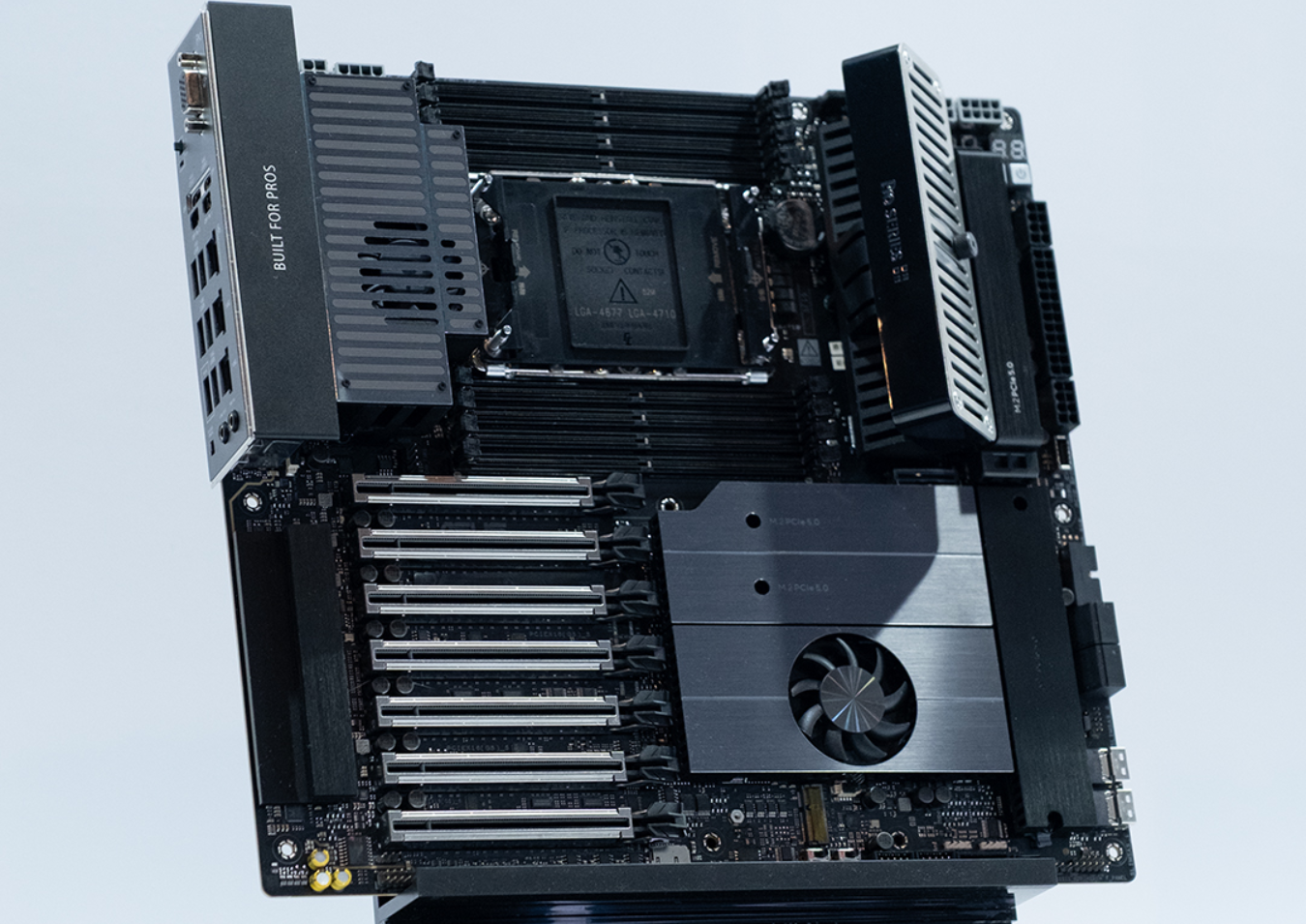
ASUS is signaling that its workstation roadmap is already aligned with Intel’s next wave of Xeon workstation silicon, showing off a new Pro WS class motherboard built on the Intel W890 chipset and designed around the LGA 4710 socket for the upcoming Granite Rapids WS CPU family. Positioned as the successor direction to the Pro WS W790 SAGE SE era, this platform jump is clearly aimed at creators, engineers, and AI workstation builders who want maximum PCIe bandwidth, dense memory capacity, and enterprise grade stability without leaving the desk side form factor.
At the core of the reveal is a board that looks purpose built for heavy GPU compute and multi accelerator workflows. ASUS equips it with 8 DDR5 DIMM slots and outlines 2 platform configurations tied to the Granite Rapids WS ecosystem: a Mainstream option with 4 channel memory support and up to 80 PCIe Gen5 lanes, plus an Expert option with 8 channel memory support and up to 96 PCIe Gen5 lanes. ASUS appears to be pushing the Expert class positioning for this flagship, pairing the 8 slot memory layout with a total claimed memory ceiling of up to 2TB, and a physical layout that can accommodate up to 7 reinforced PCIe x16 slots. In practical workstation terms, that is the kind of expandability that targets multi GPU render boxes, simulation rigs, and AI inference development nodes where you scale performance by adding more accelerators rather than swapping the entire system.
Storage on the board is framed as modern and bandwidth first. ASUS includes 4 dedicated M.2 Gen5 x4 slots with heatsinks, alongside 4 SATA III ports and 2 SlimSAS ports for additional drive and backplane flexibility. Cooling also reads like a no compromise workstation design, with active chipset cooling on the W890 PCH, additional active airflow over the VRM area, and a heatsink layout intended to sustain long duration workloads without throttling.
🤩Unveiled at #CES2026.
— ASUS (@ASUS) January 14, 2026
Meet the next-gen #ASUS Pro WS #Intel motherboard — built for pros who demand serious performance and rock-solid stability.
Stay tuned, the future of workstations is almost here. 👀https://t.co/ZuC0eQDnAG
#ASUSProWS #Workstation #BuiltForPros pic.twitter.com/RDWfUjf32z
Power delivery and serviceability are also clearly part of the workstation story. ASUS reportedly uses a heavy connector layout including 4 8 pin connectors, 2 4 pin connectors, plus a 24 pin ATX connector, and integrates practical bring up tools such as an onboard power button, reset button, and a debug LED. On the connectivity side, the board is described with strong rear IO including at least 6 USB Type A ports, 2 USB Type C ports, and 3 LAN ports, a configuration that aligns with content creation studios and lab environments where you need high speed peripherals, multi network segmentation, or dedicated management networks.
One of the more interesting strategic signals is that ASUS is already tying this board to its broader AI workstation narrative. ASUS lists the board in connection with the ExpertCenter Pro ET900N G3 platform, which ASUS positions around the NVIDIA Blackwell Ultra GB300 Superchip, reinforcing that the Pro WS W890 is being treated as part of a larger workstation and AI system portfolio rather than a niche enthusiast release.
Validation remains the critical checkpoint before any workstation platform earns trust at scale, especially one targeting dense memory and high lane count GPU builds. For buyers planning deployment, the smart play is to focus validation on memory training stability across full population configurations, PCIe Gen5 signal integrity under sustained multi device load, VRM thermals during continuous rendering or AI workloads, plus BIOS maturity around lane bifurcation, storage mapping, and device enumeration. In short, this is the kind of platform where the headline specs matter, but the win is proven stability over days of uptime, not just a successful boot.
Pricing will likely be the make or break lever for broader adoption. Early expectations put this class of flagship workstation board in the 1500$ to 2000$ range or higher, which makes sense for the hardware density, but it also positions the platform squarely for professionals and serious builders rather than casual upgraders. If ASUS can land the total platform cost at a level that feels competitive against high end DIY builds and boutique workstation towers, Pro WS W890 could become the new default foundation for GPU heavy creator and AI desktop rigs in 2026.
If you were building a Granite Rapids WS workstation, would you prioritize 2TB memory scaling, maximum GPU count, or storage bandwidth as the number 1 reason to choose this platform?
