
ASRock Recommends Intel Arc A380 for DeskMeet Series Budget Gaming Builds, but the Value Pitch Comes With Limits
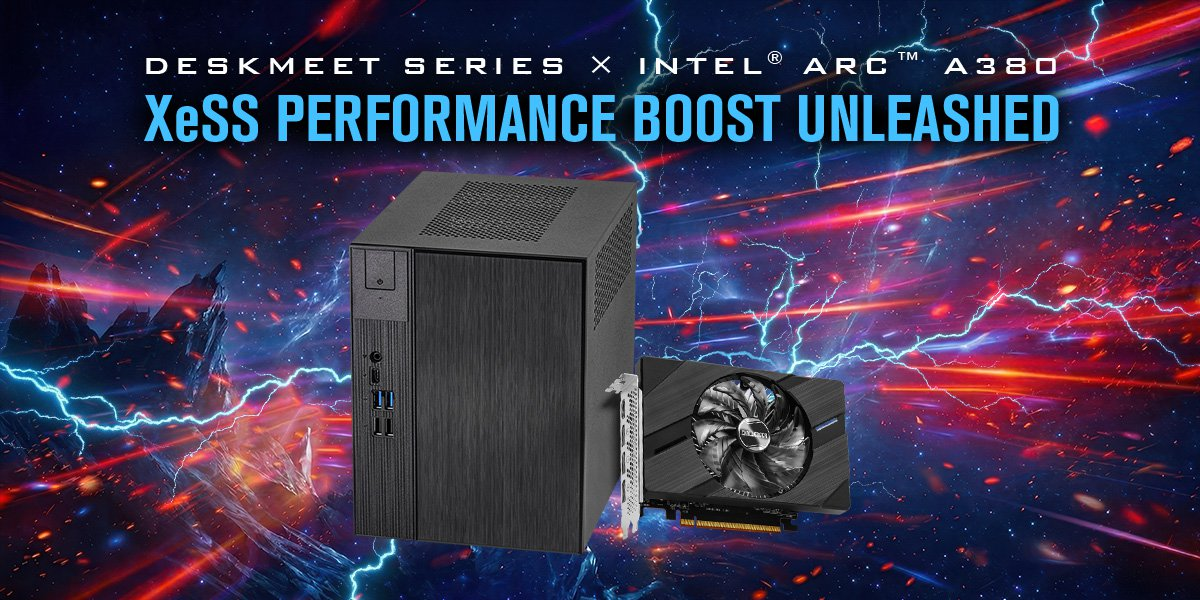
It is not every day that a hardware company openly recommends an older and slower graphics card for gamers, but that is exactly what ASRock is doing with its latest push for the DeskMeet series. In its new announcement, the company is positioning the Intel Arc A380 Challenger ITX 6GB OC as a smart match for compact DeskMeet systems, arguing that newer driver support and XeSS 3 can now give the card a much stronger value proposition for budget focused players. ASRock specifically says the pairing can deliver “strong performance” and “outstanding value” for mainstream gaming, which is a bold claim considering where the Arc A380 sits in the current GPU market.
The timing of the recommendation is not hard to understand. Budget gaming builds have become far more difficult to put together as pricing pressure continues across several key components. When memory and SSD prices climb, even lower cost systems quickly start to lose flexibility, especially for buyers trying to stay in the 500 dollars to 600 dollars range. That makes compact desktop platforms like the DeskMeet X300, DeskMeet B760, and DeskMeet X600 more appealing, because they offer a smaller integrated build path while still supporting a discrete GPU and multiple memory slots. ASRock’s official product pages confirm that the current DeskMeet family spans AM4, AM5, and Intel LGA1700 platforms, giving buyers a broad range of CPU options depending on budget and upgrade plans.

The graphics card at the center of this recommendation is still the Intel Arc A380, a card based on Intel’s Alchemist architecture with 6 GB of GDDR6 memory. By raw hardware standards, it is not a modern performance leader, and it does not compete natively with today’s stronger budget cards. However, ASRock’s argument is built around software support rather than pure raster power. The company says that with Intel’s latest graphics driver and XeSS 3 enabled, the Arc A380 can provide a 1080p gaming experience comparable to the Radeon RX 6600, while also improving image quality and frame rate through AI assisted upscaling and frame generation.
That is the part of the pitch that deserves the most scrutiny. Intel’s official driver release notes do confirm that XeSS 3 Multi Frame Generation support has been extended to Arc A Series discrete GPUs, which includes the Alchemist family and therefore the Arc A380. Intel also positions XeSS 3 as a stack that combines Super Resolution, Frame Generation, and Low Latency technologies to improve performance while trying to maintain responsiveness. On paper, that gives older Arc hardware a much more relevant feature set than it had before.
Still, there is an important difference between feature support and actual gameplay reality. A card like the Arc A380 can certainly benefit from modern reconstruction and frame generation tools, but that does not automatically mean it becomes a true RX 6600 class competitor in a broad, native sense. Technologies like Multi Frame Generation are most effective when the base frame rate is already at a reasonably healthy level. On a lower end GPU, especially in newer and heavier titles, the starting point may still be too low for the final experience to feel consistently responsive. In other words, smoother animation and higher reported frame rates do not always translate into the kind of low latency gameplay players expect from a genuinely stronger graphics card. That caution is an inference based on how frame generation works and on the Arc A380’s class of hardware rather than a direct contradiction of ASRock’s announcement.
There is also the software ecosystem question. XeSS 3 support is meaningful, but it only matters in games that actually implement or properly support the feature path. For lighter titles, esports games, or older releases, the Arc A380 may indeed become a more attractive option if expectations are realistic. In that role, it makes more sense as a card for compact, affordable, casual gaming machines rather than as a true solution for demanding modern AAA workloads at uncompromised settings.
That is where ASRock’s DeskMeet strategy does make practical sense. The DeskMeet series is designed around compact desktop use, and the Arc A380’s smaller footprint matches that positioning well. The company is not trying to sell this as a premium enthusiast machine. Instead, it is framing the combination as a balanced entry path for buyers who want a small desktop with some gaming capability, some content creation flexibility, and a lower initial spend. In that context, features like AV1 encode and decode, along with improved upscaling support, do give the Arc A380 a clearer identity than older entry level cards that lack those media and AI focused advantages. ASRock’s own release also highlights the media processing angle as part of the value case.
The strongest part of ASRock’s message is not that the Arc A380 has suddenly become a hidden performance monster. It is that for the right kind of buyer, especially someone building a compact system around a strict budget, this older Intel card may now be more relevant than expected thanks to newer software support. The weakest part of the message is the “strong performance” framing, because that sets expectations higher than the hardware class probably deserves in demanding modern games.
Ultimately, ASRock’s DeskMeet plus Arc A380 pitch is more about survival in the budget segment than about breakthrough performance. For casual players, compact PC enthusiasts, or buyers trying to avoid today’s more painful GPU pricing, it is a creative and practical positioning move. But gamers should still approach it with the right expectations. The Arc A380 may be more useful in 2026 than it was before, especially with XeSS 3 now officially available on Alchemist, yet it remains an entry level GPU whose biggest strengths come from smart software assistance rather than raw rendering power.
Do you think the Arc A380 deserves a second look for compact budget builds, or is ASRock pushing the value argument a bit too far here?
