
AMD’s New CPPC HighestFreq Could Sharpen CPU Scheduling on Future Ryzen Platforms and Improve System Responsiveness
AMD appears to be preparing an important low level scheduling improvement for future Ryzen platforms through a new CPPC feature called HighestFreq, a change that could help operating systems make better decisions about which cores should handle demanding work. According to reporting from Gazlog, AMD is proposing support for a new HighestFreq register that would allow the CPU, through firmware, to report its actual highest frequency directly to the operating system instead of forcing the scheduler to estimate it indirectly. Independent reporting from Phoronix says the Linux AMD P State driver is already being prepared for this support and that the register is currently trending toward inclusion in the upcoming ACPI 6.7 specification.
That may sound like a niche firmware detail, but it could have a real impact on everyday performance behavior. Right now, operating systems typically rely on CPPC performance values and interpolation to estimate boost capability, rather than reading a direct maximum boost frequency value from firmware. Phoronix quoted AMD engineer Mario Limonciello as saying this becomes a problem on systems where performance to frequency mapping is not linear across all cores, making boost ratio calculations less accurate. The new HighestFreq register is meant to solve exactly that limitation by providing the actual highest frequency when available, which can then be used for more accurate CPU capacity calculations and boost ratio determination.
For Ryzen, that matters because modern AMD processors already lean heavily on preferred core behavior and asymmetric boosting. Not every core boosts in exactly the same way, and schedulers that treat all cores too similarly can end up placing sensitive work on a core that is not actually the best performer in that moment. With HighestFreq, the operating system would have a cleaner firmware level signal for identifying the strongest cores, which should improve scheduling precision for bursty and latency sensitive tasks such as game threads, foreground apps, and interactive desktop workloads. This is an inference from the reported purpose of the feature rather than a published benchmark claim from AMD.
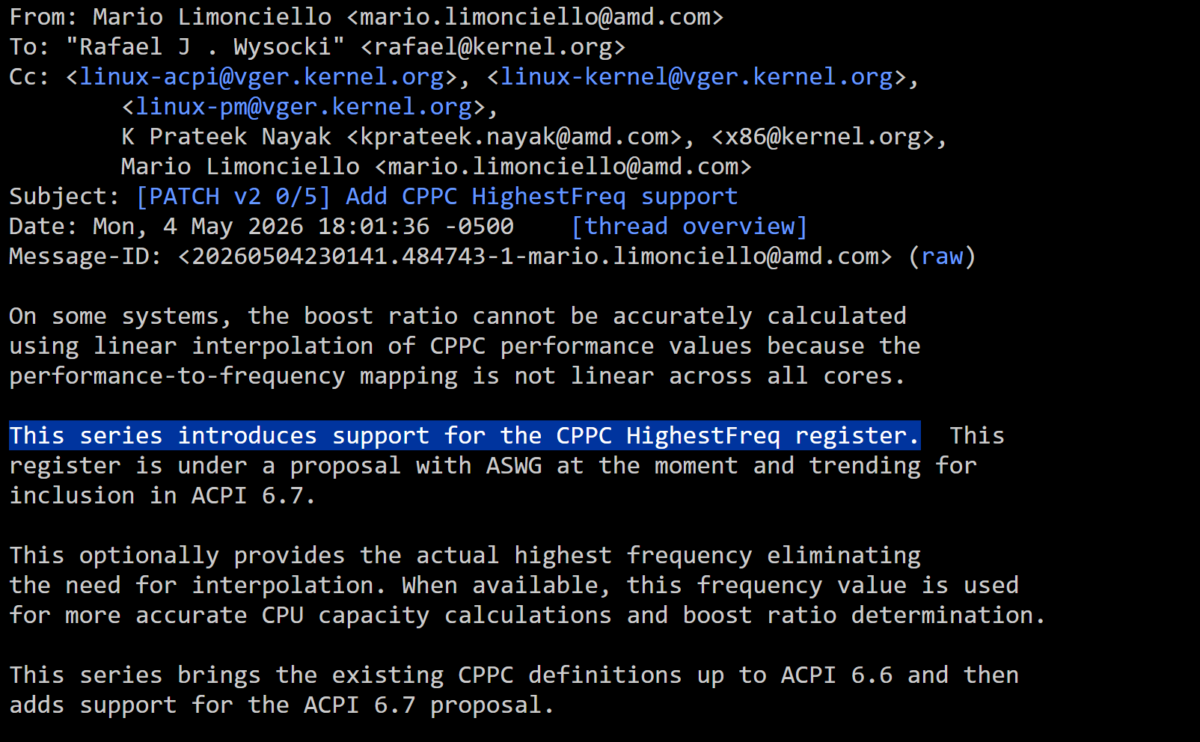
The Linux side is the clearest near term proof that this is real work in progress rather than rumor alone. Phoronix reports that AMD has submitted a patch series to bring existing CPPC definitions up to ACPI 6.6 and then add support for the ACPI 6.7 HighestFreq proposal. That means the plumbing is already being lined up at the kernel level in advance of the specification update, which is usually a strong signal that AMD expects this capability to matter for upcoming processor designs.
What is less certain right now is exactly when consumers will feel the benefit and on which chips first. Some reporting has linked the feature to future Zen 6 products, but the available primary details only show that AMD is preparing software and standards support ahead of a future ACPI revision. So it is safer to say this looks like an enabling technology for future Ryzen platforms rather than a confirmed shipping feature for any specific retail CPU at this stage.
Even without hard performance numbers yet, the direction is easy to understand. CPU scheduling has become more dependent on fine grained topology and boost awareness as processors grow more dynamic, and any improvement that helps Windows or Linux better identify the fastest core for a given workload can translate into smoother responsiveness. This will not magically transform overall CPU performance on its own, but it could help future Ryzen systems behave more intelligently under real world mixed workloads, especially in situations where milliseconds and thread placement matter most. That last point is a reasoned conclusion based on the feature’s stated purpose, not a vendor published result.
Do you think smarter firmware level scheduling data could become one of the most underrated CPU improvements for gaming and desktop responsiveness over the next generation?
