
AMD Details Dense Geometry Format Push for Future RDNA GPUs as DGF SuperCompression Cuts Storage by Up to 30% on Current Radeon Hardware
AMD has shared a much deeper look at its Dense Geometry Format strategy, outlining how DGF is designed to help the industry handle the growing wave of extremely dense 3D assets in ray traced games and other real time rendering workloads. Through its latest DGF SuperCompression overview, AMD explains that DGF is meant to serve as a hardware friendly geometry compression format for future rendering pipelines, while also offering a practical fallback path for non DGF devices. The broader goal is clear. As engines move toward smaller triangle clusters and increasingly detailed models, AMD wants DGF to become a more efficient way to package, stream, and decode geometry for both rasterization and ray tracing workflows.

At the technical level, AMD describes DGF as a block based geometry compression format where a mesh is broken into compact meshlets. In its current design, a DGF meshlet can contain up to 64 positions and 64 triangles, all packed into a 128 byte DGF block with metadata. AMD argues that this format helps move beyond the limitations of today’s black box ray tracing acceleration structure pipeline, where memory allocation, triangle order reproduction, and runtime hardware transcoding all add overhead. In AMD’s framing, DGF is intended to do for geometry what established formats like DXT, ETC, and ASTC did for textures, giving developers a standard and much denser way to represent highly complex scene data.
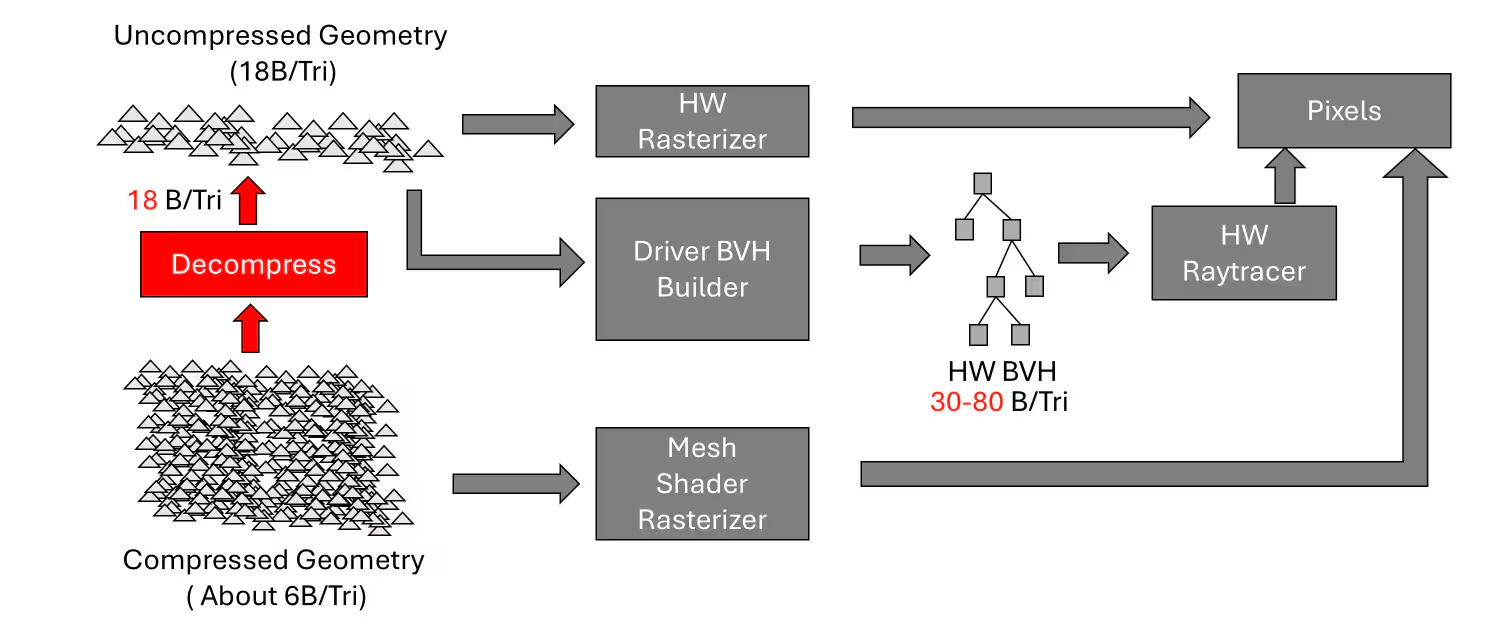
The new piece of the story is DGF SuperCompression, or DGFS. AMD says DGFS is a software system that further compresses DGF data so it takes less storage space while still being able to exactly reconstruct the original DGF blocks when needed. Importantly, AMD says DGFS can also decode efficiently into conventional vertex and index buffers, which means the same content can still run on non DGF hardware. That makes the technology relevant not only for future native implementations, but also for current generation GPUs that do not have full DGF specific hardware support. AMD says this gives developers a common asset format that can target both DGF and non DGF devices more cleanly.
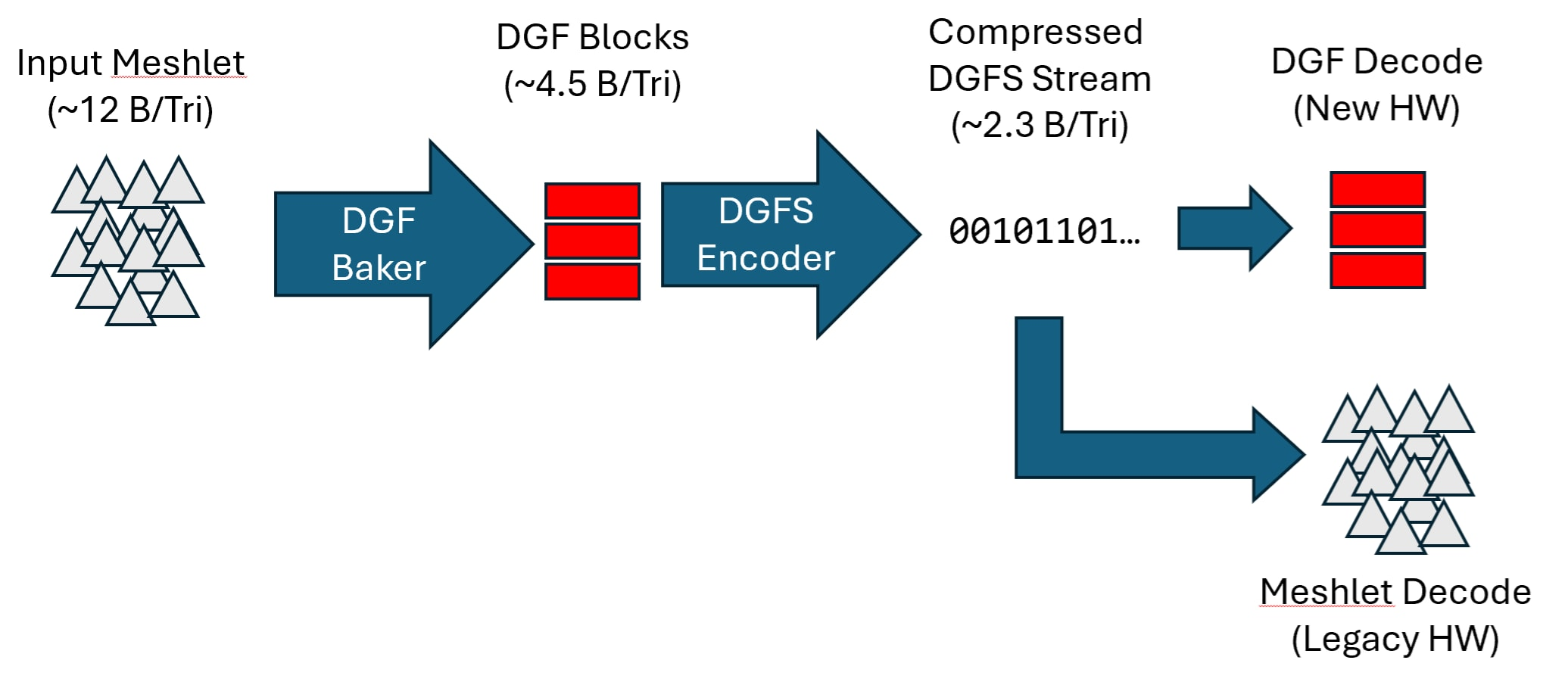
In raw asset storage terms, AMD’s published figures show DGFS delivering substantial gains. In one test set, AMD says DGFS is roughly 30% smaller than standard DGF in raw form, with the Dragon sample showing a reduction from 29.25 MB to 20.15 MB, or 31.09%. Other samples such as Statuette and Crab also posted meaningful savings. When both formats are compressed further with GDeflate, AMD says DGFS remains roughly 20% smaller than DGF, which is why the company separately highlights up to 22% lower compressed file size in actual asset package scenarios. Those results were generated on a system using a Ryzen 9 7950X, 64 GB of DDR5 6000 memory, and a Radeon RX 9070 XT, giving a current generation proof point even before future DGF focused hardware arrives.
| Model | Triangles in Millions | DGF Size MB | DGFS Size MB | Savings |
|---|---|---|---|---|
| Crab | 2.14 | 10.22 | 8.48 | 17.06% |
| Dragon | 7.22 | 29.25 | 20.15 | 31.09% |
| Statuette | 10.00 | 40.99 | 29.31 | 28.48% |
| Buddha | 1.09 | 4.94 | 3.95 | 20.03% |
| Bike | 1.68 | 6.96 | 5.54 | 20.47% |
AMD also published compressed size figures with GDeflate applied, plus CPU based decode timings that suggest the format can be streamed and unpacked quickly enough for real world use. On those tests, meshlet decode times ranged from 0.02 seconds to 0.15 seconds, while DGF decode ranged from 0.03 seconds to 0.22 seconds across the sample assets. AMD says these results indicate that CPU based decoding during streaming should already be practical, while leaving open the possibility of future GPU based decoders as well. That matters because the real value of a compressed geometry format is not only how small it gets on disk, but how smoothly it can move through the content pipeline without introducing new bottlenecks.
| Model | Meshlet Decode Time sec | DGF Decode Time sec |
|---|---|---|
| Crab | 0.03 | 0.05 |
| Dragon | 0.09 | 0.15 |
| Statuette | 0.15 | 0.22 |
| Buddha | 0.02 | 0.03 |
| Bike | 0.02 | 0.04 |
The bigger strategic angle is that AMD is not presenting DGF as a one off experiment. In its companion post on the open geometry compression standard, the company says DGF has the potential to deliver transformative increases in geometric complexity for ray traced rendering, content creation, virtual production, and other real time 3D applications. AMD also says it has already released an open source toolchain, a provisional Vulkan extension, and an updated DGF SDK, while announcing a multivendor Vulkan extension effort with Samsung that both companies intend to implement. That signals a long term platform play rather than a narrow vendor locked feature.
This is where the future RDNA angle becomes especially important. AMD is clearly positioning DGF as infrastructure for more geometry heavy workloads that current APIs and hardware structures are not well suited to handle at scale. On current Radeon hardware, DGFS already delivers useful storage and asset pipeline benefits. On future architectures with fuller native support, the upside would likely shift from just smaller assets and faster fallback decoding to much more direct geometry handling in hardware. AMD has not attached a consumer product timeline in these DGF posts, but the company’s language makes it clear that this is aimed at future generation rendering pipelines rather than only today’s GPUs.
For game development, the timing makes sense. Modern engines are pushing aggressively toward richer scenes, more detailed models, and more ambitious ray traced content, which increases pressure on geometry representation just as much as on shading and lighting. AMD’s DGF strategy is an attempt to solve that problem at the asset format level. It is not just about higher polygon counts for screenshots. It is about reducing memory pressure, improving storage efficiency, and making very dense content more practical to ship and render across multiple classes of hardware. If AMD can turn DGF into a meaningful multivendor standard, it could become one of the more consequential building blocks for the next wave of PC and console graphics.
What do you think, will geometry compression formats like AMD’s DGF become as important to future games as texture compression standards once were?
