
AMD Zen 6 APU With 24GB LPDDR5 at 9600 MT/s Appears in Benchmarks, Possibly Targeting Steam Deck 2
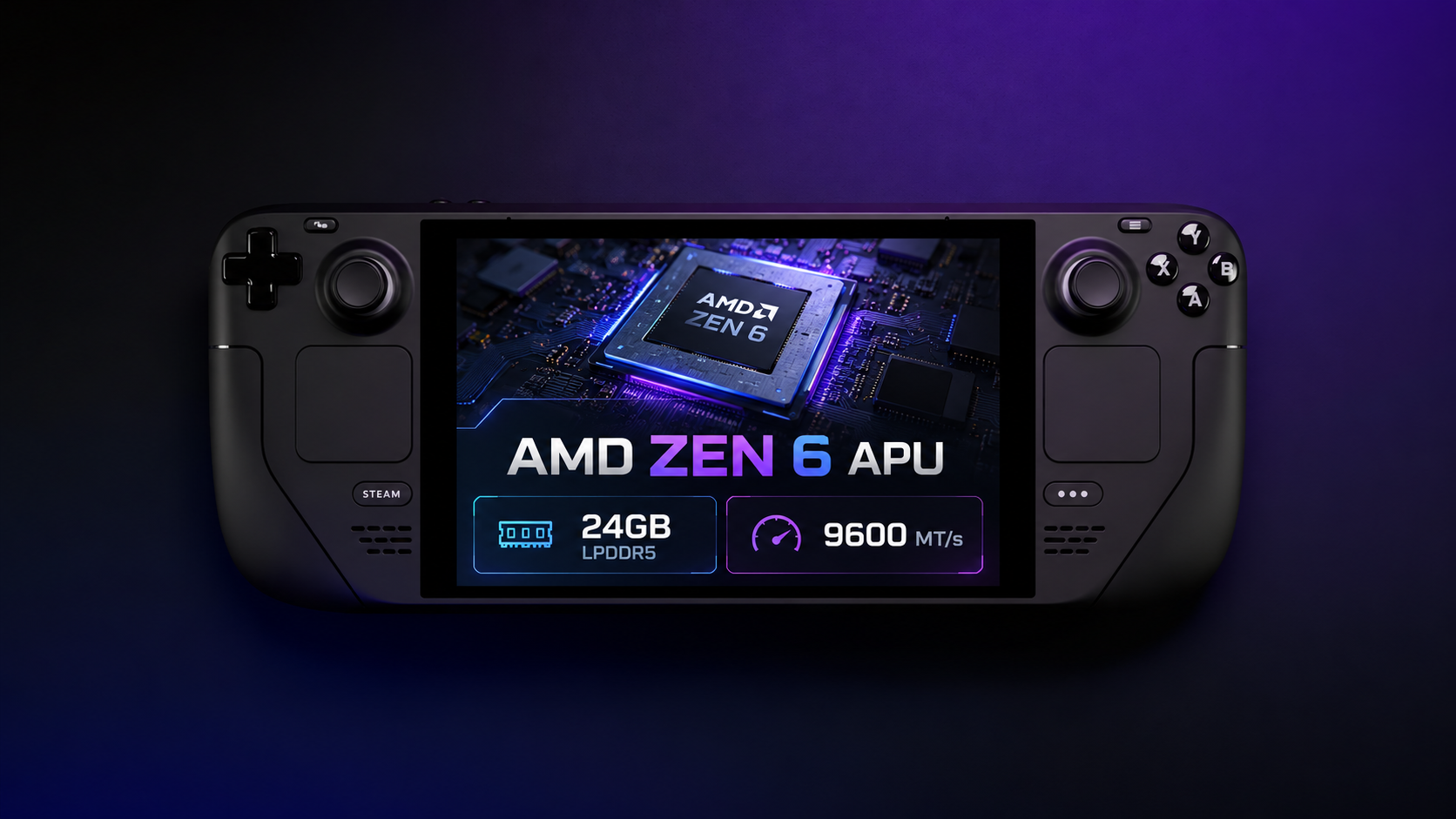
AMD's upcoming Zen 6 architecture has surfaced in an early benchmark listing, revealing a mysterious 6 core, 12 thread APU equipped with 24GB of LPDDR5 memory operating at 9600 MT/s. The engineering sample, potentially belonging to AMD's rumored Gainsborough family, could provide an early glimpse into the hardware powering future gaming handhelds, including a possible successor to Valve's Steam Deck.
The processor appeared in an OpenBenchmarking submission dated August 7, 2026, carrying the engineering sample identifier 100-000001930-12_Y. Testing was conducted on an AMD GBR-FF6-SKT validation platform with the CPU operating at 2.4 GHz. The memory configuration consists of 4 SK Hynix packages with 6GB each, while the integrated GPU reportedly operates at 2400 MHz. Its architecture and Compute Unit count remain unknown.
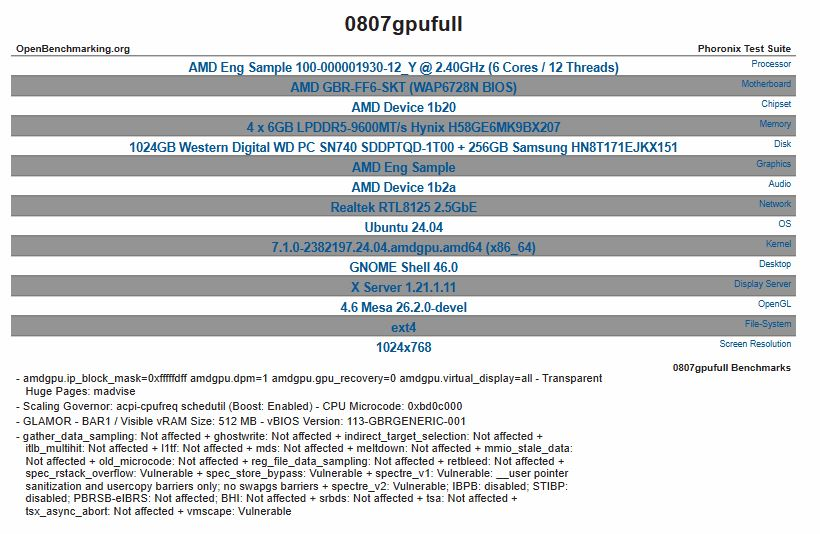
Analysis of the processor's microcode identifies AMD Family 1Ah, Model DCh, placing it within a range associated with Zen 6 designs in recent Linux kernel developments. However, it remains unclear whether AMD is using standard Zen 6 cores, the more compact Zen 6c architecture or another power optimized configuration.
AMD Gainsborough vs Steam Deck OLED
| Specification | Steam Deck OLED | AMD Gainsborough Sample |
|---|---|---|
| CPU Architecture | Zen 2 | Zen 6 expected |
| CPU Cores / Threads | 4 / 8 | 6 / 12 |
| CPU Frequency | 2.4 to 3.5 GHz | 2.4 GHz recorded |
| Memory Capacity | 16 GB LPDDR5 | 24 GB LPDDR5 |
| Memory Speed | 6400 MT/s | 9600 MT/s |
| GPU Architecture | RDNA 2 | Unknown |
| GPU Frequency | Up to 1600 MHz | 2400 MHz reported |
| Status | Available | Engineering sample |
Steam Deck OLED specifications are based on Valve's official documentation. The Gainsborough configuration is unconfirmed and does not establish a connection to a future Steam Deck.
Compared with Steam Deck OLED, the engineering sample offers 50% more CPU cores, 50% greater memory capacity and a 50% higher memory transfer rate. These improvements could benefit gaming handhelds where the CPU and integrated GPU share system memory, particularly in demanding games requiring additional memory for textures and graphics processing.
The early GpuTest results recorded on Ubuntu 24.04 at 1024 × 768 include 3,871 points in GiMark, 3,508 in FurMark and 9,319 in TessMark. However, these synthetic workloads cannot establish real gaming performance without knowing the GPU architecture, power limits and thermal configuration.
Speculation surrounding Steam Deck 2 comes partly from the Gainsborough codename, which references Aerith Gainsborough from Final Fantasy VII. Valve previously used Aerith and Sephiroth as codenames for its Steam Deck processors. Nevertheless, the sample could also be intended for other handheld devices, including AMD's rumored Ryzen Z3 family.
The discovery arrives as AMD continues expanding its Zen 6 processor roadmap across desktop and mobile platforms. While AMD has not confirmed Gainsborough's specifications or commercial destination, the benchmark provides an early indication of the company's ongoing development of more powerful and memory capable APUs.
The most promising aspect of this engineering sample is its combination of 24GB LPDDR5 memory and a potentially more efficient Zen 6 architecture. Handheld gaming performance increasingly depends on balancing CPU resources, integrated graphics bandwidth and power consumption rather than simply increasing processing frequencies.
A 50% increase in memory capacity could give developers greater flexibility when allocating resources between system memory and graphics workloads. However, a 2400 MHz GPU clock alone does not guarantee better frame rates. If AMD can translate these specifications into improved performance per watt, Gainsborough could become an important foundation for the next generation of portable gaming PCs.
Would a Steam Deck 2 with 6 Zen 6 cores and 24GB of RAM be enough to convince you to upgrade, or would you prioritize a more powerful GPU and longer battery life?
