
AMD Secures Anthropic for 2 GW MI450 Deployment and Plans US$5 Billion Investment
AMD and Anthropic have announced a major strategic partnership that will see the Claude developer deploy up to 2 GW of AMD Instinct MI450 Series accelerator capacity through AMD Helios rack scale infrastructure. The first 1 GW deployment is scheduled to begin during the first half of 2027, giving AMD another major frontier AI customer as it works to challenge NVIDIA across large scale training and inference infrastructure.
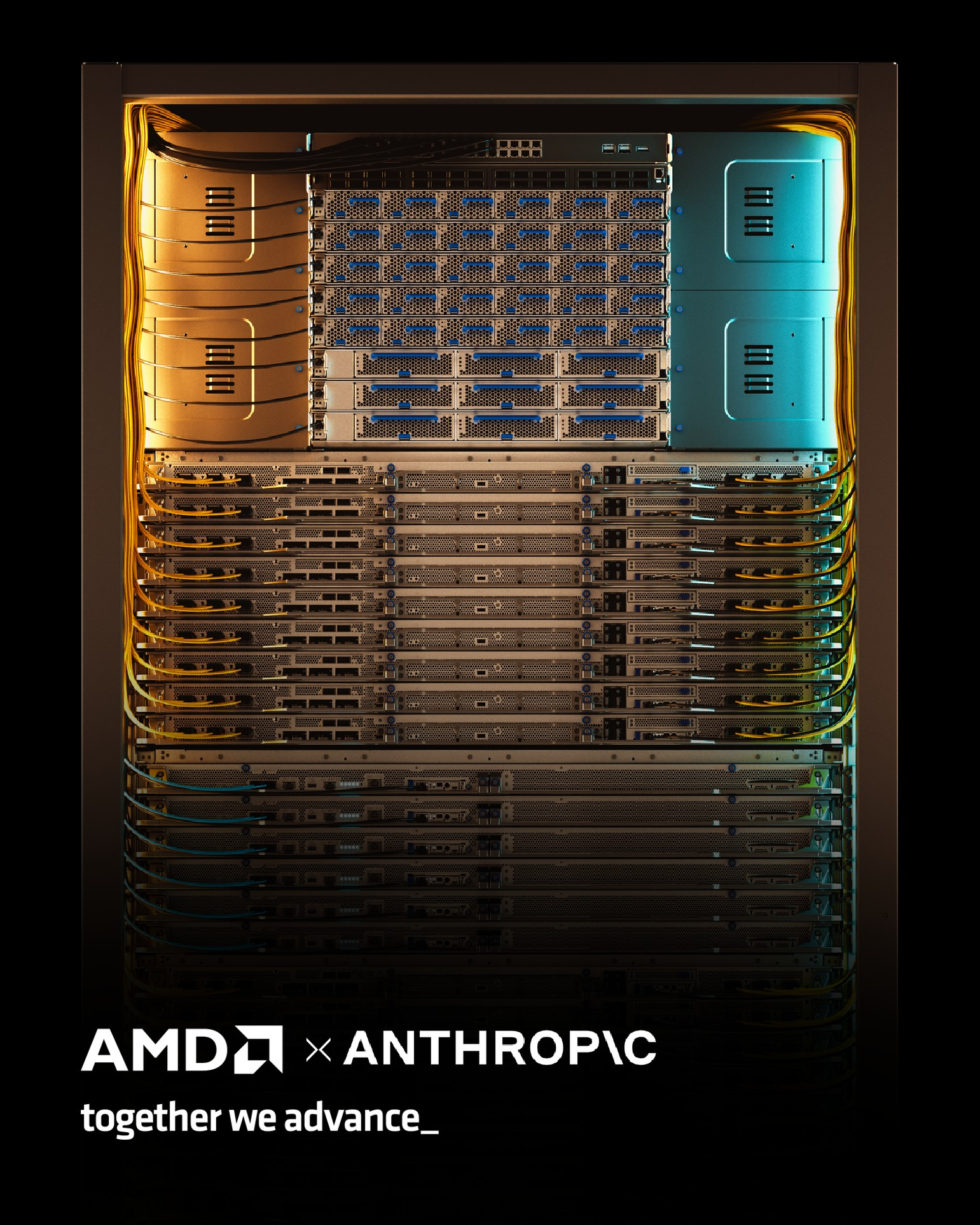
According to the official AMD announcement, Anthropic will deploy Helios systems equipped with Instinct MI455X GPUs, 6th Gen EPYC Venice processors, Pensando networking, and the ROCm software platform. The agreement builds on Anthropic’s existing use of Instinct MI355X accelerators and expands the relationship from individual GPU deployments into complete rack scale systems.
“We are thrilled to deepen our partnership with Anthropic and deploy AMD Helios at gigawatt scale. This collaboration brings together Anthropic’s leadership in frontier AI with the full strength of AMD high performance computing. Together, we will accelerate AI adoption at scale and establish Helios as a major platform for the next generation of AI infrastructure.”
— Quote by: Dr. Lisa Su
AMD has also committed to making a future strategic equity investment of up to US$5 billion in Anthropic. The company has not disclosed the timing, valuation, ownership percentage, or additional conditions attached to the investment, meaning the final amount could be lower than the maximum commitment.
“Access to compute is central to keeping Claude at the frontier and meeting demand from our customers. By partnering with AMD across the stack, we are securing the capacity we need and optimizing it for training and serving Claude. Running across a diversified range of hardware lets us map the right workloads to the right hardware.”
— Quote by: Tom Brown
We are excited to announce that AMD and @AnthropicAI are expanding our strategic partnership to accelerate the development and deployment of next-gen AI infrastructure. Tune in at 9:30am PT tomorrow to hear from Dr. @LisaSu from the #AdvancingAI keynote stage!
— AMD (@AMD) July 22, 2026
✅ Up to 2 GW of… pic.twitter.com/HW2E1mSecN
The AMD Helios platform integrates 72 Instinct MI455X GPUs in each rack, providing up to 31 TB of HBM4 memory, 2.9 exaFLOPS of FP4 compute performance, 1.4 exaFLOPS of FP8 performance, 260 TB/s of scale up bandwidth, and 43 TB/s of scale out bandwidth. Each MI455X provides 432 GB of HBM4 memory and up to 19.6 TB/s of memory bandwidth.
AMD has not disclosed how many accelerators Anthropic’s complete 2 GW deployment will require. Although each Helios rack contains 72 GPUs, converting the announced electrical capacity directly into a reliable GPU count would require details regarding rack power limits, cooling infrastructure, utilization targets, and supporting data center equipment.
AMD previously projected that its MI400 Series could provide up to 10 times higher inference performance than MI355X in selected Mixture of Experts workloads. However, this should not be interpreted as a universal 10 times improvement for MI455X across every model, precision format, or workload.
The partnership also extends beyond hardware. Anthropic and AMD will begin a multiyear engineering collaboration that uses Claude to optimize workloads for Instinct GPUs and accelerate ROCm software development. AMD also plans to adopt Claude across its engineering and product development teams, potentially applying the model to software creation, validation, research, and chip development workflows.
AMD had started sampling MI450 accelerators, with customer demand reportedly exceeding the company’s initial expectations. Anthropic now provides AMD with another confirmed gigawatt scale deployment alongside previously announced infrastructure agreements involving Meta, Microsoft, and other major customers.
The Anthropic agreement is one of AMD’s most important AI infrastructure wins because it combines hardware sales, software collaboration, and a substantial equity commitment. AMD is not simply supplying accelerators. It is using the partnership to strengthen ROCm, validate Helios at gigawatt scale, and position its complete CPU, GPU, networking, and software portfolio as a credible alternative to NVIDIA.
However, this is not an exclusive transition away from competing hardware. Anthropic continues to use AWS Trainium, Google TPUs, and NVIDIA GPUs, while Amazon remains its primary cloud and training partner. The AMD deployment therefore expands Anthropic’s diversified compute strategy rather than replacing its existing infrastructure relationships.
That diversity could ultimately benefit AMD. Frontier AI companies increasingly require more capacity than any single supplier can provide, creating an opportunity for Helios to secure meaningful deployments without requiring customers to abandon established NVIDIA, Google, or Amazon platforms. The larger challenge will be proving that ROCm can deliver competitive reliability, model support, developer tooling, and operational efficiency when Anthropic begins deploying the first 1 GW in 2027.
Can the Anthropic partnership establish AMD Helios as a true competitor to NVIDIA’s rack scale AI platforms, or will ROCm remain the deciding factor?
