
AMD Radeon RX 9050 Targets 1080p Gaming at a Reported $279
AMD has officially expanded its RDNA 4 graphics portfolio with the Radeon RX 9050, a new entry level GPU designed for 1080p gaming. The card arrives with 1024 Stream Processors and 8 GB of GDDR6 memory, while board partner listings have also revealed a significantly reduced 4 GB version with half the memory bus.
According to the official AMD Radeon RX 9050 product page, the GPU features 16 Compute Units, 16 Ray Accelerators, 32 AI Accelerators, 64 Texture Units, 64 ROPs, and 32 MB of Infinity Cache. It operates at a 1920 MHz game clock and can boost up to 2600 MHz, delivering a claimed 10.6 TFLOPS of FP32 performance.
The official configuration includes 8 GB of GDDR6 memory running at 18 Gbps across a 128 bit interface, providing up to 288 GB per second of memory bandwidth. AMD rates the card at only 92W of typical board power, although it still requires a single 8 pin power connector and carries a recommended power supply rating of 450W.
AMD positions the RX 9050 as a 1080p medium settings graphics card. Its internal performance claims include 60 FPS in 007 First Light, 96 FPS in Cyberpunk 2077, 131 FPS in Forza Horizon 6, and 85 FPS in PRAGMATA. Esports results reach 227 FPS in Counter Strike 2, 206 FPS in Rainbow Six Siege, and 593 FPS in Valorant using high settings. However, AMD does not clearly disclose the complete test platform or whether upscaling and frame generation were active, meaning independent testing will be essential.
ASRock has officially launched the Radeon RX 9050 Challenger 8 GB for retail and system integrated customers in Latin America and Asia Pacific. The dual fan card measures 249 mm, uses 2 DisplayPort 2.1a connections and 1 HDMI 2.1b output, and supports PCI Express 5.0, AMD FSR, HYPR RX, ray tracing, and current Radeon software features.
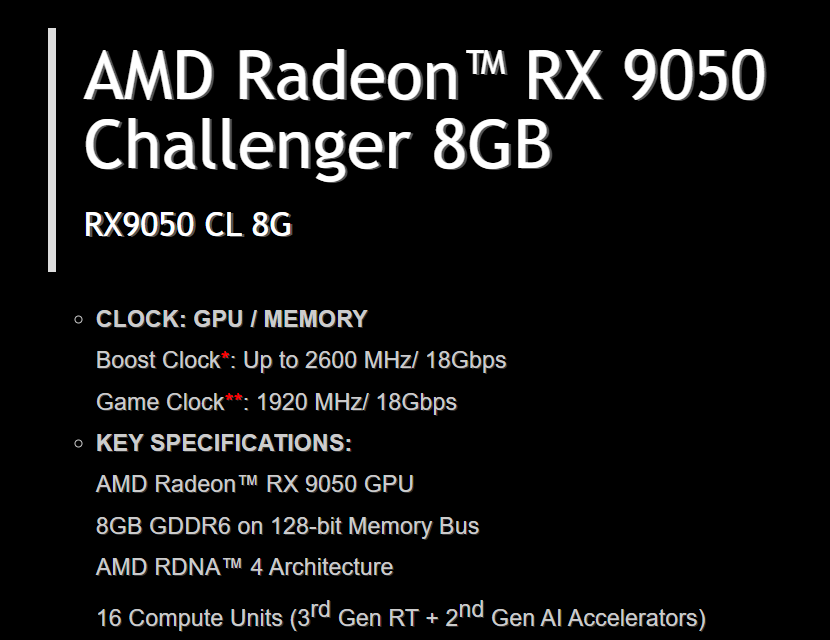
A second ASRock listing also revealed a Radeon RX 9050 Challenger with only 4 GB of GDDR6 memory. That version maintains the same 16 Compute Units and clock speeds but reduces the memory interface from 128 bit to 64 bit. With memory still operating at 18 Gbps, bandwidth falls from 288 GB per second to approximately 144 GB per second. The 4 GB product page was later removed, while ASRock’s formal launch announcement only mentioned the 8 GB card.
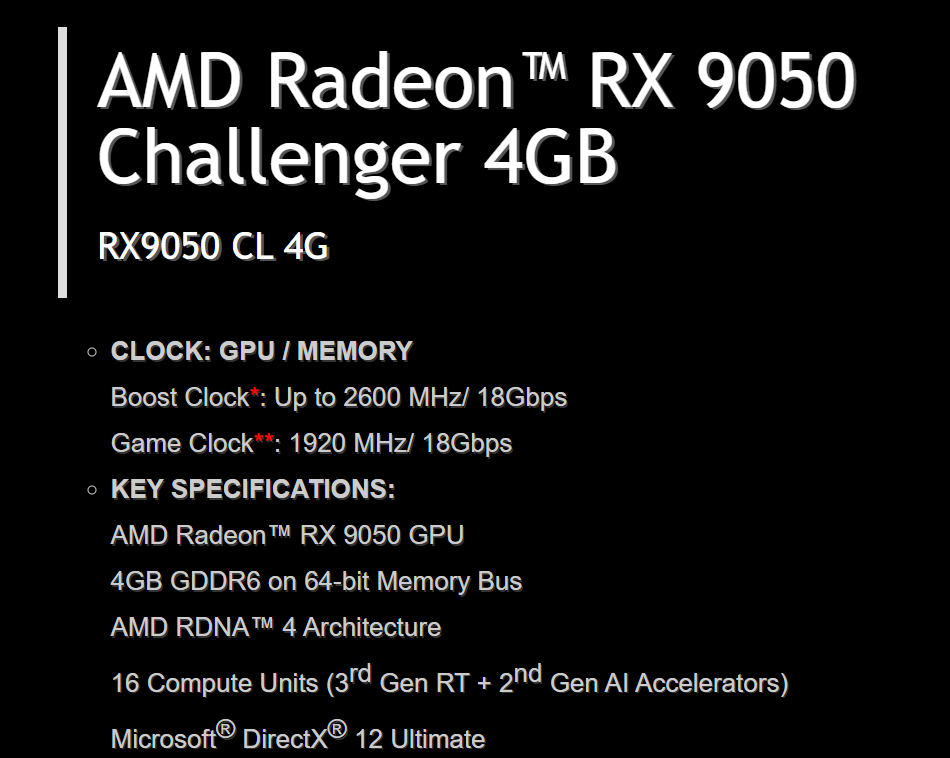
This creates a potentially major performance difference between cards carrying the same Radeon RX 9050 name. Modern games frequently exceed 4 GB of video memory at 1080p, particularly when using higher resolution textures, detailed environments, ray tracing, or advanced rendering features. The narrower interface could further restrict performance even before the card reaches its capacity limit.
AMD would have created a clearer product hierarchy by giving the 4 GB version a separate name, such as Radeon RX 9040. Selling both memory configurations as RX 9050 products risks confusing buyers, particularly within the prebuilt computer market where detailed GPU specifications are not always displayed prominently.
The 8 GB Radeon RX 9050 is reportedly expected to cost $279 in selected Asia Pacific, Japanese, and Latin American markets. However, AMD has not publicly confirmed an official suggested retail price, so the $279 figure should currently be treated as reported regional pricing rather than a formally announced global MSRP.
Pricing will be especially important because the RX 9050 sits in a segment traditionally expected to remain between approximately $100 and $200. At $279, it could face competition from discounted previous generation cards and faster products positioned only slightly above it.
The Radeon RX 9050 addresses a genuine gap below the RX 9060 family, but its value depends almost entirely on final retail pricing. The 8 GB model offers modern RDNA 4 features, low power consumption, AV1 support, and enough memory bandwidth for an entry level 1080p system.
The 4 GB version is considerably harder to justify as a gaming product in 2026. Reducing both memory capacity and interface width could produce major performance inconsistencies, particularly in demanding releases. It may still serve basic esports systems, media computers, and low cost prebuilts, but it should not be marketed as equivalent to the 8 GB card.
At a reported $279, the 8 GB model also appears expensive for its specifications. AMD may have created a technically efficient entry level GPU, but independent benchmarks and real retail prices will determine whether it delivers meaningful value or simply reflects how severely memory shortages have disrupted the affordable graphics market.
Would you consider the Radeon RX 9050 at $279, or should an entry level graphics card with these specifications cost below $200?
