
AMD's upcoming Fluid Motion Frames 3 (AFMF 3) technology has reportedly been unlocked ahead of its official release, thanks to a Radeon enthusiast who used DeepSeek AI to identify a hidden configuration within AMD's latest graphics drivers. The discovery potentially enables the next generation frame generation technology on RDNA 3 and RDNA 4 graphics cards, introducing new image quality options and compatibility improvements without modifying the original driver files.
The discovery was shared by Reddit user SixPie174632251, who claims to have used DeepSeek 4.1 Flash to investigate hidden functionality within AMD Software: Adrenalin Edition 26.10.2. The AI assisted investigation identified a Windows Registry setting named afmf3dev, which can reportedly expose AFMF 3 in the Radeon control panel after being enabled and restarting AMD Software.
Unlike traditional GPU modifications that require altering driver files or installing unofficial software, this method reportedly relies on changing a single registry value. However, enabling the setting remains an unsupported modification, and AMD has not confirmed whether the feature is complete, stable, or intended for public use.
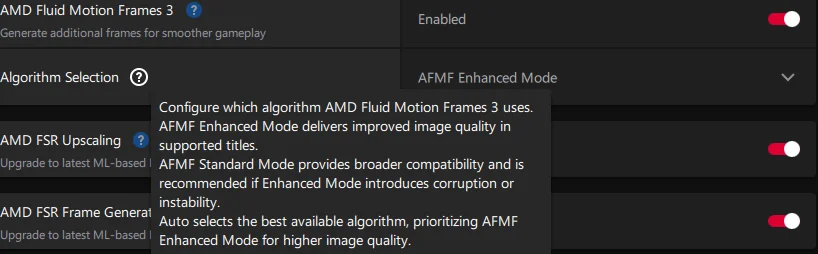
The experimental implementation introduces 2 operating modes, Standard and Enhanced. Standard appears to follow AMD's existing driver level frame generation approach, while Enhanced reportedly interacts with temporal reconstruction technologies such as AMD FidelityFX Super Resolution (FSR), Intel XeSS, Unreal Engine's Temporal Super Resolution (TSR), and temporal anti aliasing systems.
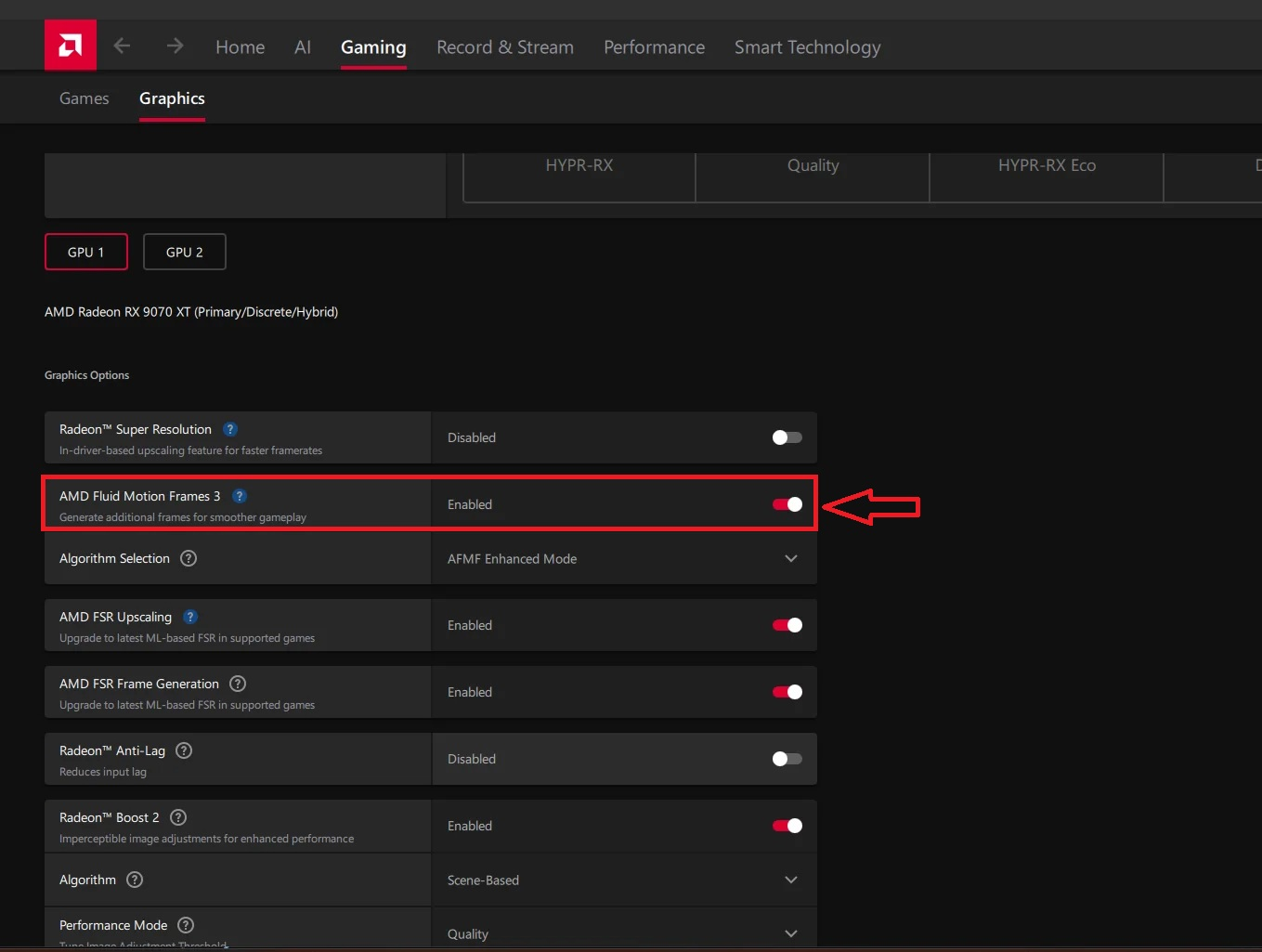
This could represent a significant improvement over AFMF 2.1, which generates additional frames through AMD's graphics driver without requiring direct integration into individual games. Access to additional reconstruction information could potentially improve motion handling and reduce visual artifacts, although the precise mechanism used by AFMF 3 remains unconfirmed.
According to the developer's preliminary testing, Enhanced mode delivers noticeably better image quality than Standard mode, particularly around user interface elements, but introduces slightly higher latency. The feature also reportedly supports games with motion blur enabled, while fullscreen compatibility varies depending on the title. Some games require exclusive fullscreen, whereas others operate in borderless mode.
AMD Fluid Motion Frames 2.1 vs Experimental AFMF 3
| Feature | AFMF 2.1 | AFMF 3 Experimental |
|---|---|---|
| Availability | Officially supported | Unannounced |
| Frame Generation | Driver level | Driver level with additional reported integration |
| Operating Modes | Existing AFMF controls | Standard and Enhanced |
| Image Quality | Established implementation | Enhanced mode reportedly improves quality |
| Temporal Reconstruction Integration | No equivalent confirmed feature | FSR, XeSS, TSR and TAA reportedly supported |
| RDNA 3 Support | Yes | Reportedly working |
| RDNA 4 Support | Yes | Reportedly working |
| RDNA 2 Support | Yes | Unconfirmed |
| Release Date | Available | Not announced |
AFMF 3 specifications are based on the original enthusiast demonstration and have not been independently validated.
The discovery is particularly interesting for Radeon RX 7000 owners, as it suggests AMD may continue introducing significant rendering improvements without requiring users to purchase newer graphics cards. This follows the company's recent expansion of FSR 4.1, which brought additional image reconstruction capabilities to older Radeon architectures. As previously covered in AMD's expansion of FSR 4.1 to Radeon RX 6000 graphics cards and additional gaming platforms, the company has increasingly emphasized extending the capabilities of existing hardware through software improvements.
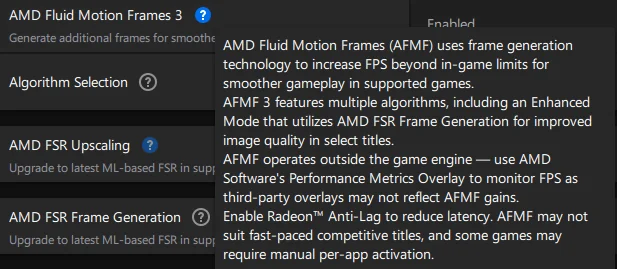
However, AFMF and FSR Frame Generation remain different technologies. FSR Frame Generation is integrated into supported game rendering pipelines, while AFMF operates through the graphics driver. Although the experimental Enhanced mode reportedly interacts with existing reconstruction technologies, this does not establish that AFMF 3 provides the same capabilities or image quality as native game engine frame generation.
AMD's official Adrenalin Edition 26.10.2 release notes, published October 30, make no mention of AFMF 3. The company has not announced a release date, confirmed supported graphics cards, or published performance benchmarks. There are also no independently verified measurements demonstrating frame rate improvements, latency differences, or stability across multiple games.
For now, the discovery should be considered an experimental preview of technology still under development. Users interested in testing unofficial functionality should understand the risks associated with modifying Windows Registry settings and enabling unsupported graphics driver features, particularly on their primary gaming systems.
This discovery highlights 2 important developments in modern PC gaming: the increasing role of AI assisted technical research and the potential for software improvements to extend the useful life of existing graphics cards.
DeepSeek did not create AMD Fluid Motion Frames 3. Instead, it reportedly helped an enthusiast identify a configuration setting associated with technology already present in AMD's driver. That distinction matters because the achievement demonstrates how AI tools can assist with software investigation and troubleshooting without replacing the engineering work behind the technology itself.
For Radeon owners, the more interesting possibility is improved frame generation on existing hardware. If AMD successfully delivers AFMF 3 to RDNA 3 and RDNA 4 GPUs, users could benefit from better visual quality and smoother gameplay without investing in another expensive graphics card.
However, frame generation must be evaluated beyond reported FPS increases. Image consistency, input latency, frame pacing, and compatibility are equally important, especially in competitive games where responsiveness matters more than artificially increasing displayed frame rates.
We believe meaningful software upgrades should extend hardware longevity rather than encourage unnecessary replacement. With graphics card prices continuing to rise, improvements that allow gamers to enjoy their existing GPUs for longer are particularly valuable.
Better graphics technology should improve the hardware we already own, not automatically require another expensive upgrade.
Would you experiment with an unofficial AFMF 3 unlock on your Radeon GPU, or would you rather wait for AMD to release a fully tested version with official driver support?
